
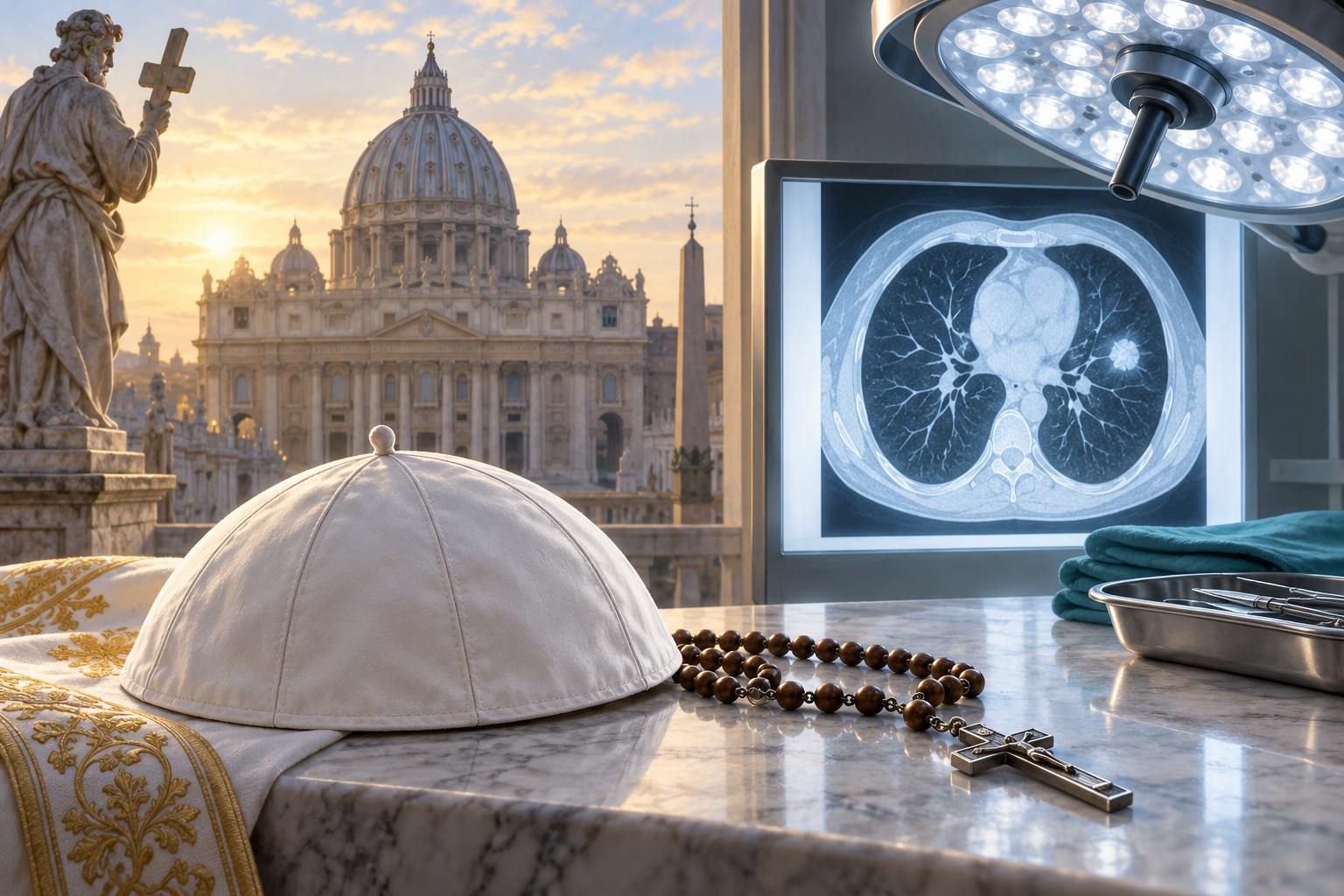
VATICAN CITY - Pope Leo XIV said Sunday that he will undergo surgery in the coming days to remove a small nodule from his lung, announcing the first major health event of his 17-month pontificate directly to worshippers in St. Peter's Square.
The 71-year-old pope said recent medical examinations found the nodule at a very early stage and that it was well localized. Doctors recommended removing it, he said after delivering his weekly Angelus prayer, and the operation has already been scheduled.
The Vatican said Leo's expected recovery would last about one week. It did not give an exact date for the procedure, though officials indicated it would take place early this week at Rome's Agostino Gemelli University Polyclinic, the hospital traditionally used by popes.
Leo thanked the faithful for their spiritual closeness and asked for their prayers. He showed no visible sign of illness during Sunday's appearance and has no previously disclosed major health condition. He is known to play tennis and swim regularly.
A lung nodule is a small abnormal area, generally less than 3 centimeters across, that can appear on a chest scan. Such nodules are common and often benign, but imaging alone may not determine whether one is cancerous. Medical specialists who have not treated the pope said surgical removal can provide a definitive diagnosis when the location and a patient's overall health make the procedure appropriate.
The Vatican has not said whether doctors suspect cancer. Experts interviewed by the Associated Press warned against assuming that a nodule is malignant. They said the early and localized finding described by Leo is encouraging, while emphasizing that laboratory analysis after removal will establish what it is.
The surgery may affect the pope's immediate schedule. Leo had been expected to celebrate the closing Mass of a family ministry conference on Wednesday, but Vatican officials suggested he could miss it. A November 6-17 trip to Uruguay, Argentina and Peru remains on his calendar, and Leo referred Sunday to his planned visit to Peru.
The announcement carries additional weight because Pope Francis died in April 2025 after a stroke following a lengthy hospitalization that began with a respiratory crisis and developed into double pneumonia. Francis had chronic lung problems and underwent several hospital stays during his papacy.
Vatican communication during Francis' illnesses was sometimes criticized as incomplete or confusing. In 2023, officials initially described one hospital visit as scheduled testing before Francis later said he had experienced chest pain and was treated for bronchitis.
Transparency is part of institutional stability
Leo's decision to disclose the finding himself was an unusual but responsible act. The health of any patient deserves privacy, including the pope. Yet the head of a global church is also a sovereign and an executive whose ability to work affects dioceses, diplomacy and more than a billion Catholics.
Secrecy creates a vacuum that is quickly filled by rumor. That was a recurring weakness during earlier papal illnesses, when guarded bulletins sometimes produced more anxiety than reassurance. Leo's concise disclosure established the known facts without pretending that doctors already have every answer.
The same standard should continue after surgery. The Vatican should report whether the operation was completed, whether recovery is proceeding as expected and when Leo resumes public duties. It does not need to release every clinical detail, but it should not use religious language or institutional tradition to avoid basic accountability.
The darker side of leadership in a highly centralized institution is that one person's illness can expose how much authority depends on a single office. The Catholic Church has procedures for a pope's death and for voluntary resignation, but prolonged incapacity can create uncertainty over who is empowered to make urgent decisions.
That concern is not a prediction about Leo, whose doctors expect a short recovery. It is a reason for the Vatican to maintain clear delegation, publish schedule changes promptly and avoid treating health information as palace property.
For now, the responsible conclusion is limited. Doctors found a small, localized nodule, surgery is planned and no diagnosis has been announced. The pope's openness deserves respect, while the coming medical update should be judged by evidence rather than fear or speculation.
Comments
Loading comments…