
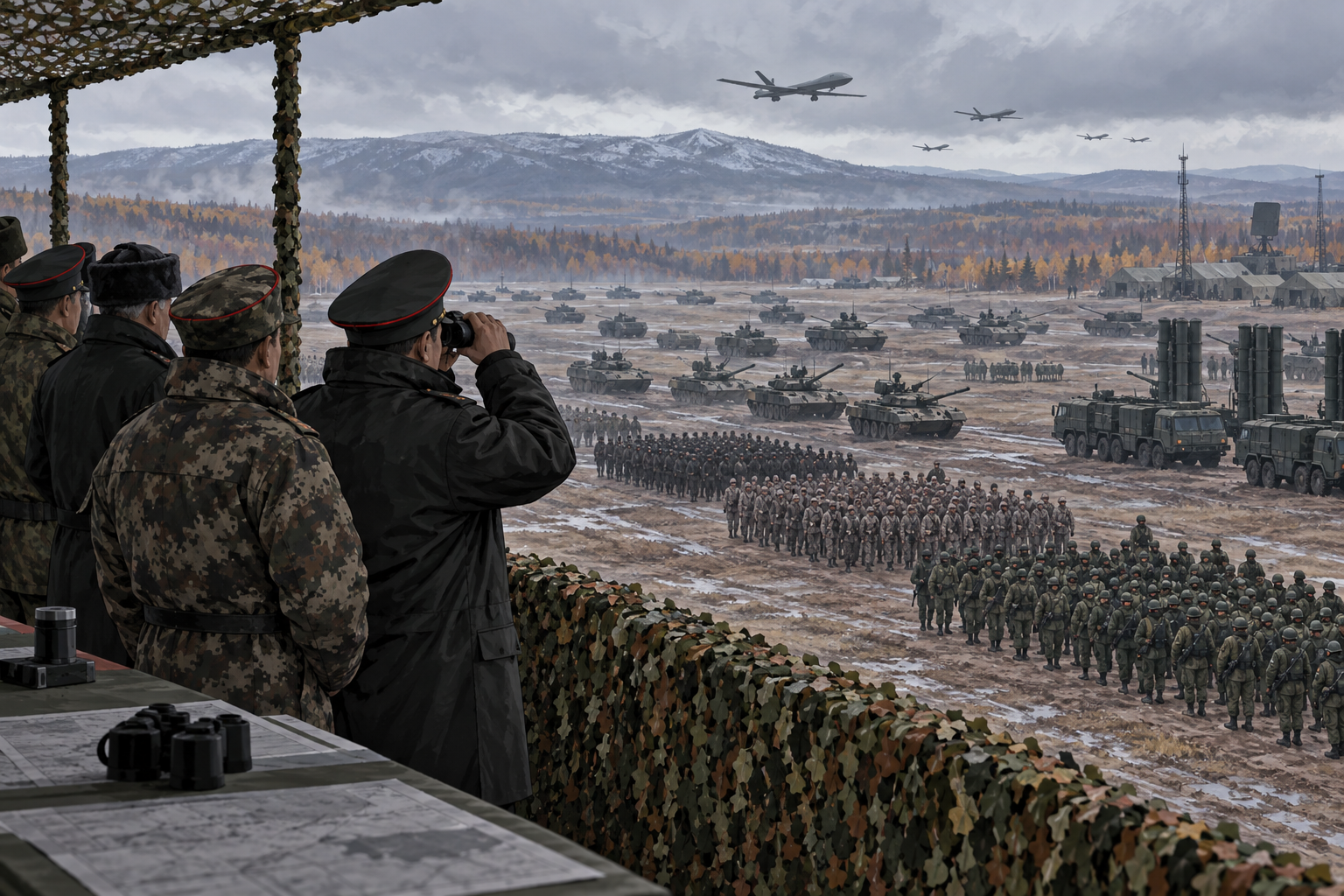
MOSCOW - Russian President Vladimir Putin observed large military exercises in the Ural Mountains on Friday that included troops from China and several other partner countries, as Moscow displayed both battlefield lessons from Ukraine and its ability to attract foreign military participation.
Putin visited the Chebarkulsky training ground in Russia's Chelyabinsk region for the final stage of the Center-2026 strategic command exercise. He said 47,000 troops were involved across 11 training grounds and the Caspian Sea, according to reporting by the Associated Press and footage distributed through Reuters Connect.
About 6,000 Russian and foreign personnel took part in the final phase at Chebarkulsky, Putin said. Military contingents came from China, Belarus, Kyrgyzstan, Mongolia, Pakistan and Tajikistan, while delegations from dozens of countries attended as observers, according to Russian accounts cited by the AP.
The Center-2026 maneuvers were combined with Interaction-2026 and related exercises involving the Collective Security Treaty Organization, the Moscow-dominated security bloc that includes Russia, Belarus, Kazakhstan, Kyrgyzstan and Tajikistan. Kazakhstan's Defense Ministry said the CSTO exercises in Russia were scheduled from September 24 through October 3.
Russian officials described the training as preparation to repel an external attack in the Central Asian direction, protect security in the Caspian region and improve commanders' ability to control combined forces. The scenario incorporated experience gained during Russia's war against Ukraine.
During the visit, Putin inspected military hardware that included new jet-powered Geran drones of a type Russia has used in attacks on Ukraine. Tanks, air-defense systems, aircraft and large troop formations were also shown at the training ground.
The display came one day after Russia warned NATO that it could use nuclear weapons if alliance members attempted to isolate Kaliningrad, the Russian territory between Poland and Lithuania, from the rest of the country. No such NATO operation has been announced, and the warning formed part of a broader pattern of Russian nuclear signaling.
The presence of Chinese personnel does not turn the exercise into a formal Russia-China alliance commitment. Beijing and Moscow have expanded defense contacts, however, and repeated training gives their forces opportunities to observe equipment, command practices and operational lessons while demonstrating political alignment.
A military exercise is also a political message
Center-2026 was designed to train forces, but its audience extended far beyond the soldiers on the field. Putin wants Russians to see military capacity despite the cost of the Ukraine war, wants NATO to calculate the risk of confrontation and wants countries outside the West to believe that Moscow is not isolated.
China gains something different. It can study lessons from a war involving mass drone use, electronic warfare, layered air defense and industrial-scale ammunition consumption without paying Russia's battlefield price. Participation also signals that Beijing is willing to sustain military ties with Moscow even while presenting itself internationally as a stabilizing power.
That does not mean every visiting country has chosen Russia's side on every dispute. Pakistan, Mongolia and Central Asian governments maintain other security and economic relationships and may view attendance as hedging rather than allegiance. Democracies should distinguish limited participation from treaty obligations instead of exaggerating a unified anti-Western bloc that does not yet exist.
Still, the trend cannot be dismissed. Authoritarian governments learn from one another, share methods and use multinational events to normalize aggressive power. Exercises create personal relationships among officers, expose participants to procedures and make future cooperation easier. Even symbolic attendance helps Moscow challenge the claim that its invasion of Ukraine has left it diplomatically alone.
The right democratic response is steady preparation, not panic. NATO and U.S. allies should continue realistic exercises, improve drone and air-defense capacity, protect logistics and explain their activities transparently. Strong deterrence is more credible when paired with clear defensive objectives and open communication that reduces the chance of miscalculation.
Washington should also compete for partnerships beyond its traditional alliances. Many countries represented at Russian events are not committed clients of Moscow or Beijing. Security assistance, professional military education, trade and reliable diplomacy can give them alternatives to dependence on authoritarian powers.
Putin's inspection of drones used against Ukraine exposed the central contradiction of the event. Russia presented the drills as defense against external aggression while displaying weapons refined through its own invasion of a neighbor. That gap between language and conduct is why democratic countries should judge the exercise by capabilities and behavior, not by Moscow's description.
Center-2026 does not prove that a new military alliance is ready for war with the West. It does show Russia converting combat experience into training, China maintaining access to that experience and Moscow assembling an international stage for its power. Those are facts worth watching with discipline, because military coordination usually becomes dangerous before it becomes formal.
Comments
Loading comments…