
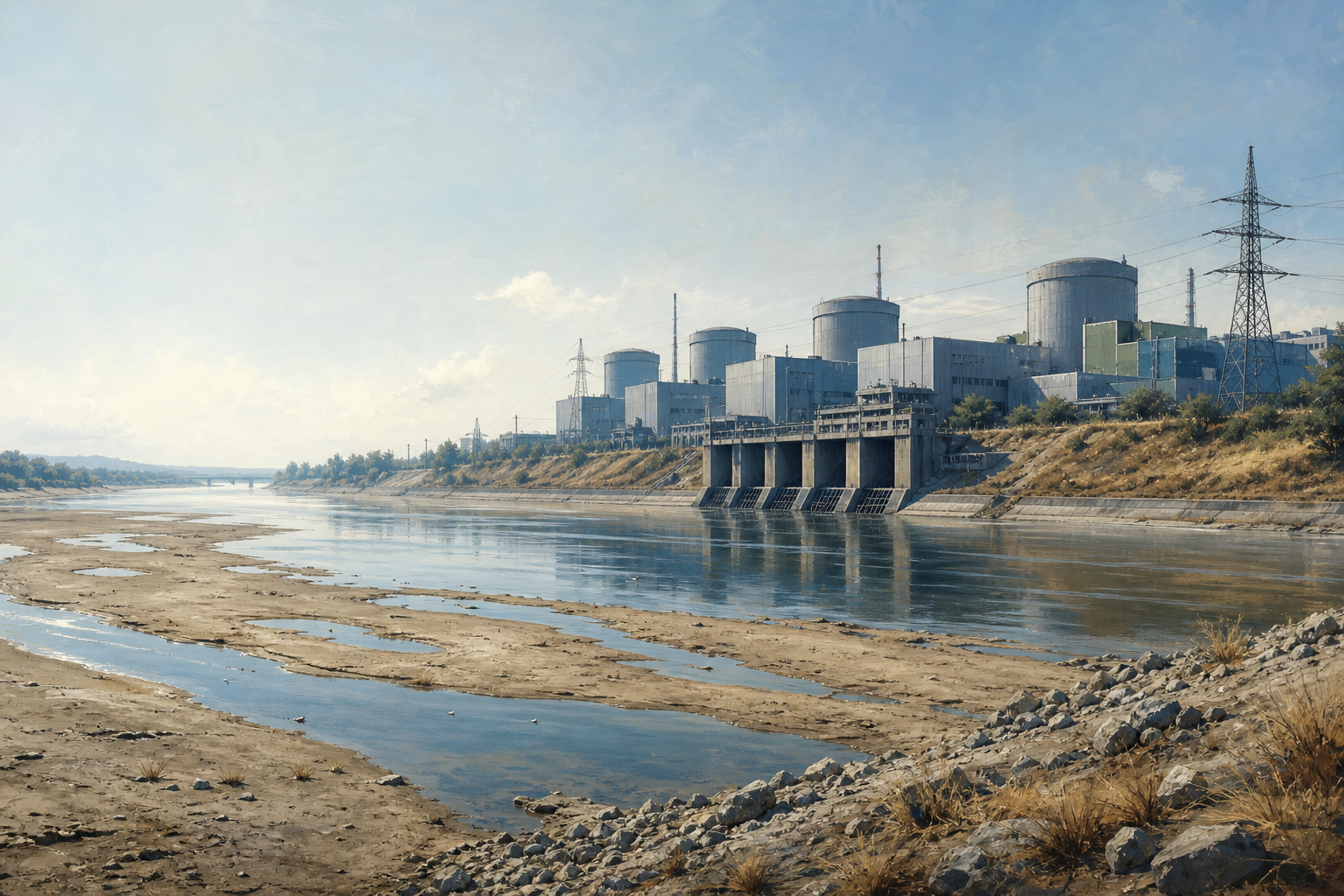
Record-low water on the Danube has sharply reduced output at Hungary's Paks nuclear power station and could force the first complete shutdown in the plant's roughly 44-year operating history, according to the government. As of Sunday, however, the operator had not confirmed that all four reactors were offline, making the threatened shutdown an urgent projection rather than a completed event.
Paks is Hungary's only nuclear plant. Its four Soviet-designed reactors have about 2,000 megawatts of nominal output and provide nearly half of the country's domestic electricity generation. The Associated Press reported that output had fallen to 965 megawatts by Friday as prolonged drought and heat lowered the river that supplies cooling water to the facility.
Operator MVM said the local Danube gauge reached minus 106 centimetres on July 27, an all-time low at Paks. The negative number is a reading relative to the gauge's reference point, not the depth of the river. MVM said the conditions prompted a 254-megawatt reduction at Unit 1 beginning that night. Earlier reductions during the summer also reflected environmental limits on the temperature of discharged cooling water.
Prime Minister Péter Magyar said a full power-down would be required if the gauge fell to minus 134 centimetres, and he cited forecasts that could take it to minus 144 centimetres. He warned that a complete outage could last for weeks. Those levels were a threshold and a forecast, not measured readings at the time, and the precise timing has shifted as water conditions have evolved.
The stress is regional as well as local. The Danube crosses or borders 10 countries, supporting power generation, industry, farming and transport along its route. The same exceptional conditions have disrupted other river-dependent activity, and Romania also reduced nuclear generation at Cernavoda. One shrinking waterway can therefore create simultaneous pressure across several national systems.
Officials have emphasized that an orderly shutdown would be a safety and supply measure, not evidence of a nuclear accident. Reactors can be reduced or stopped when cooling-water conditions move outside operating limits. The immediate danger is therefore to electricity reliability and industry, not a radiation emergency. That distinction matters because alarmist language can undermine public confidence just when accurate technical information is most valuable.
The crisis nevertheless exposes a structural vulnerability. Nuclear power is often valued because reactors can produce large amounts of low-carbon electricity regardless of sunlight or wind. But a river-cooled plant remains tied to water levels and temperatures. Successive heatwaves can squeeze both sides of that system: less water may reach the intake while warmer water leaves less room under environmental discharge limits.
Hungary now faces a difficult test of resilience. Losing even part of a plant that supplies nearly half of domestic generation raises pressure on imports, reserve capacity and large industrial users. Emergency conservation can bridge a short interruption, but a weeks-long outage would require clear coordination with neighboring grids and honest communication about costs. Energy security depends on redundancy, not confidence that one large asset will always be available.
The broader lesson reaches beyond Hungary. Governments across Europe have extended reactor lives and reconsidered nuclear power as they seek dependable electricity without fossil-fuel emissions. That strategy can still make sense, but it needs climate adaptation: redesigned intakes, alternative cooling options where feasible, stronger regional interconnections and planning that treats extreme river conditions as an operational scenario rather than a remote anomaly.
Democratic accountability is part of that infrastructure. The public should be able to see current output, river measurements, shutdown criteria and contingency plans in a form that can be independently checked. Officials should also separate immediate weather and drought facts from longer-term climate attribution unless the science supports a specific claim. Transparency reduces both complacency and panic.
Paks may yet avoid a full shutdown if the Danube stabilizes. That would be welcome, but it would not erase the warning. A record gauge, output below half of normal and an acknowledged shutdown threshold are already evidence that an essential power system is operating close to its environmental boundary. Hungary's next step should be to manage the present risk safely and then make that boundary less dangerous.
Comments
Loading comments…