
BUCHAREST, Romania — Romania shot down three drones that entered its airspace on three consecutive days beginning July 24, a sharp but limited defensive response to repeated spillover from Russia’s war against Ukraine. Romanian investigators say recovered wreckage establishes that the aircraft were of Russian origin. That finding identifies the drones; it does not, by itself, prove that Moscow deliberately aimed them at Romania. Russia denies directing combat drones toward Romanian territory.
Three interceptions in three days
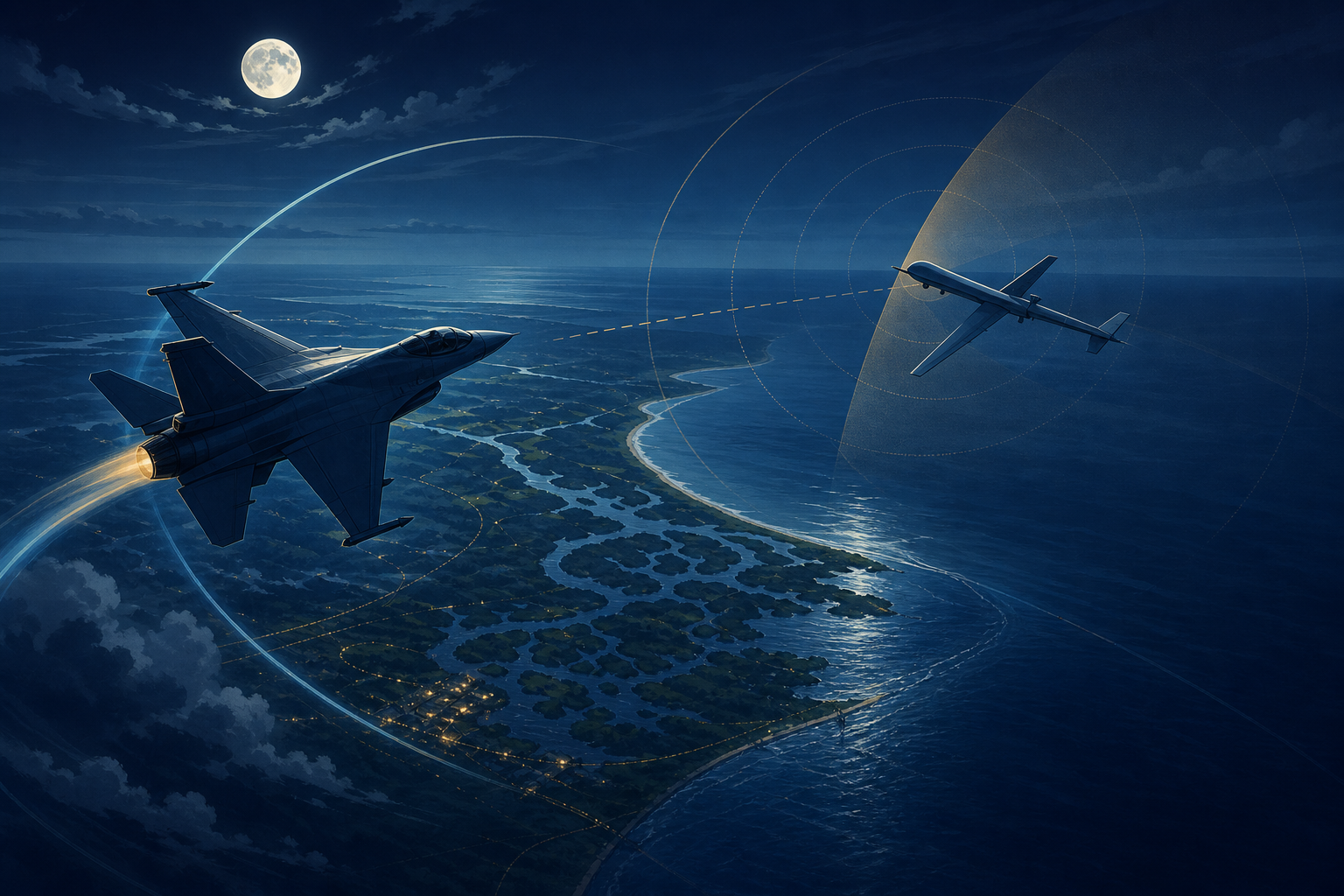
On July 24, Romania’s Defence Ministry said radar detected an aerial target about 20 kilometres east of Sulina before it crossed into national airspace on a route through Sulina, Brăila, Fetești and Buzău. Italian Eurofighter Typhoons serving NATO air policing and Romanian F-16s were scrambled. At 11:02 a Romanian F-16 fired an air-to-air missile and destroyed the drone over an unpopulated area near Padina in Buzău County. Authorities also sent public safety alerts in Tulcea and Brăila.
Romanian F-16s downed a second intruding drone on July 25 and a third on July 26. The Defence Ministry said Sunday’s interception occurred at 10:13, about 12 kilometres northeast of Sulina, within Romania’s territorial waters, and was conducted safely. Together, the operations gave the Romanian Air Force three successful interceptions in three days while attacks continued near Ukraine’s Danube border region.
The interceptions mark a change from Romania’s earlier practice of scrambling aircraft, tracking incursions and searching for wreckage without opening fire. The scale of the problem helps explain the shift. The ministry told The Associated Press that at least 19 drones have entered Romanian airspace in 2026, while drones or fragments have been identified on Romanian territory in 50 cases since Russia launched its full-scale invasion in February 2022.
Romania had passed legislation last year allowing drones in its airspace to be shot down, despite strong opposition from nationalist parties, but had not used that authority domestically before this sequence. Pressure increased after a drone crashed into an apartment building in Galați in May, injuring a mother and child. The new policy therefore reflects an accumulated public-safety risk, not a sudden decision to enter the Russia-Ukraine war.
Russian origin is not the same as proven intent
Romania’s evidence supports a firm conclusion about origin. Foreign Minister Oana Toiu said fragments recovered by the Defence Ministry and an ongoing prosecutor’s investigation confirmed beyond doubt that the downed drones were Russian. But no public finding cited by Romanian authorities or AP established that the drones were deliberately targeted at Romania rather than straying from attacks on Ukraine. Keeping that distinction clear is not weakness; it is how a democratic government preserves credibility while making serious security claims.
Russia’s embassy rejected Romania’s account, saying Russia had never directed combat drones at Romanian territory and calling the allegations unfounded. Bucharest nevertheless summoned the Russian ambassador, presented drone fragments and said Moscow bore responsibility for the incidents. Romania also expelled one member of the Russian diplomatic mission, giving the person five days to leave. Moscow said the expulsion would not go unanswered.
A proportional defence of NATO territory
Romania’s response was forceful without being reckless. The drones were engaged after radar tracking and fighter monitoring, and the available official accounts emphasized that the shoot-downs occurred over an unpopulated area or territorial waters. Civil alerts were issued where appropriate. This is territorial defence, not an attack across the border: a NATO member removing unauthorized military aircraft from its own airspace while taking measures to limit danger to civilians.
That proportionality matters. NATO’s credibility depends on defending every ally’s sovereignty, but also on avoiding unsupported claims or impulsive escalation. Romania demonstrated both principles: it acted against an immediate airborne threat, preserved wreckage for investigation, coordinated through allied air-policing structures and used diplomatic measures after gathering evidence. Such discipline strengthens deterrence because Moscow cannot plausibly mistake the defensive boundary, while Romanian citizens can see that their institutions are acting lawfully and transparently.
The next task is to sustain that balance. Romania and its allies should continue sharing radar data, publishing forensic findings where security permits and expanding layered, lower-cost counter-drone systems so fighter-launched missiles are not the only option. They should also keep military and diplomatic communication channels open. Clear evidence, predictable rules of engagement and practical civil protection offer the best route to defend democratic territory, reassure the public and deny Russia either an undefended opening or a pretext for widening the war.
Comments
Loading comments…