
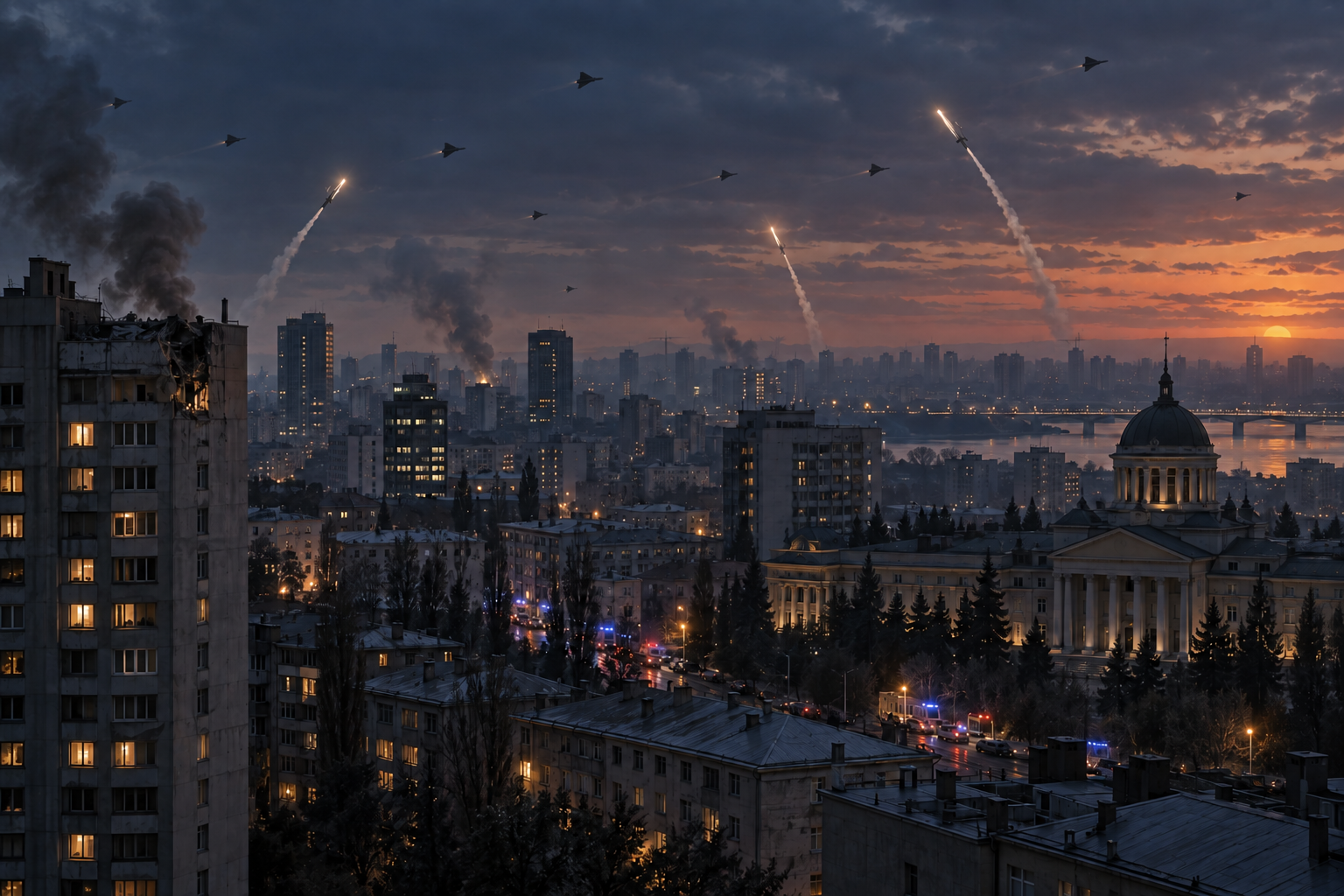
KYIV - Russia launched more than 120 attack drones across Ukraine on Monday, killing at least nine people and wounding more than 80 as strikes hit homes, offices, businesses and public institutions in several cities.
Ukrainian President Volodymyr Zelenskyy said 90 of the drones were faster jet-powered models. The casualty count rose through the day; the Associated Press reported at least seven deaths earlier Monday, while Zelenskyy's evening address placed the total at nine across the country.
In the Kyiv region, drone attacks killed four people and wounded eight, according to Ukrainian officials. A woman was killed when a drone struck the National Academy of Sciences building in central Kyiv, starting a fire and forcing some staff to escape through windows using firefighters' ladders.
Other strikes hit a pharmaceutical company, gas stations, data centers and a hospital building in the capital. Kyiv Mayor Vitali Klitschko said the continuing attacks were disrupting ordinary life and terrorizing civilians.
In Dnipro, a drone hit an office center during working hours, killing three people and wounding at least 18, local authorities told the AP. A strike on a nine-story apartment building in Kharkiv wounded 43 people, including 11 children. Officials reported 30 civilians wounded in Zaporizhzhia and three more injured when an apartment building was damaged in Odesa.
The attacks followed a week of diplomacy at the United Nations that failed to create visible progress toward ending Russia's invasion. Kremlin spokesman Dmitry Peskov said Ukraine would pay a price for its recent actions and suggested a quick peace settlement was unlikely. Russia did not provide evidence that the civilian buildings struck Monday were lawful military targets.
Ukraine has also continued long-range attacks inside Russia, including strikes on military and energy infrastructure. Those operations do not remove Russia's obligation under international law to distinguish military targets from civilians and civilian objects.
Zelenskyy used the barrage to renew requests for air-defense support and financing. Ukraine faces a growing challenge from jet-powered attack drones, which are faster and more difficult to intercept than earlier propeller-driven Shahed designs. Shooting them down can require scarce missiles or aircraft, creating a costly contest between inexpensive attack systems and limited defenses.
Russia is turning time and exhaustion into weapons
The scale and duration of Monday's campaign reveal a strategy broader than destroying one target. Repeated alerts force schools, businesses, hospitals and transport systems to stop. Even drones that are intercepted consume defenders, interrupt sleep and make normal economic life harder to sustain. The objective is pressure accumulated hour after hour.
That is the darker advantage available to an authoritarian state. The Kremlin can absorb casualties, suppress domestic criticism and direct industrial resources toward a long war with limited public accountability. Ukraine must fight while preserving an open society, holding elections when conditions allow and explaining every difficult demand to citizens and democratic partners.
The West should not mistake endurance for stalemate. When Russia can strike apartment buildings, offices and scientific institutions every day at manageable cost, delay favors the aggressor. Air-defense missiles, radar, electronic warfare and domestic interceptor production are not charitable gifts; they are the equipment required to keep a European democracy functioning under sustained attack.
America has a particular interest in helping Ukraine defeat this model of coercion. If mass drone attacks can exhaust a democratic country while allies debate each shipment, other authoritarian governments will study the lesson. Taiwan, NATO's eastern members and U.S. forces abroad all face versions of the same problem: cheap, numerous weapons designed to overwhelm expensive defenses.
Support should still be disciplined. Weapons need tracking, production contracts need oversight and Ukrainian battlefield claims require independent scrutiny. Democratic accountability is a strength, not an obstacle. But oversight should accelerate effective assistance rather than provide a reason for paralysis.
Monday's deaths were not an abstract change in front lines. People were killed at work, in residential areas and inside institutions meant for science and medicine. Russia may describe the barrage as retaliation, but retaliation does not make civilians expendable or erase the rules of war.
Ukraine's immediate need is enough layered defense to reduce the toll. The longer-term answer is to deny Moscow the belief that civilian pressure will break Western commitment. A peace built on exhaustion and fear would reward the method used to produce it. That would not end the danger; it would teach aggressors that the method works.
Comments
Loading comments…