
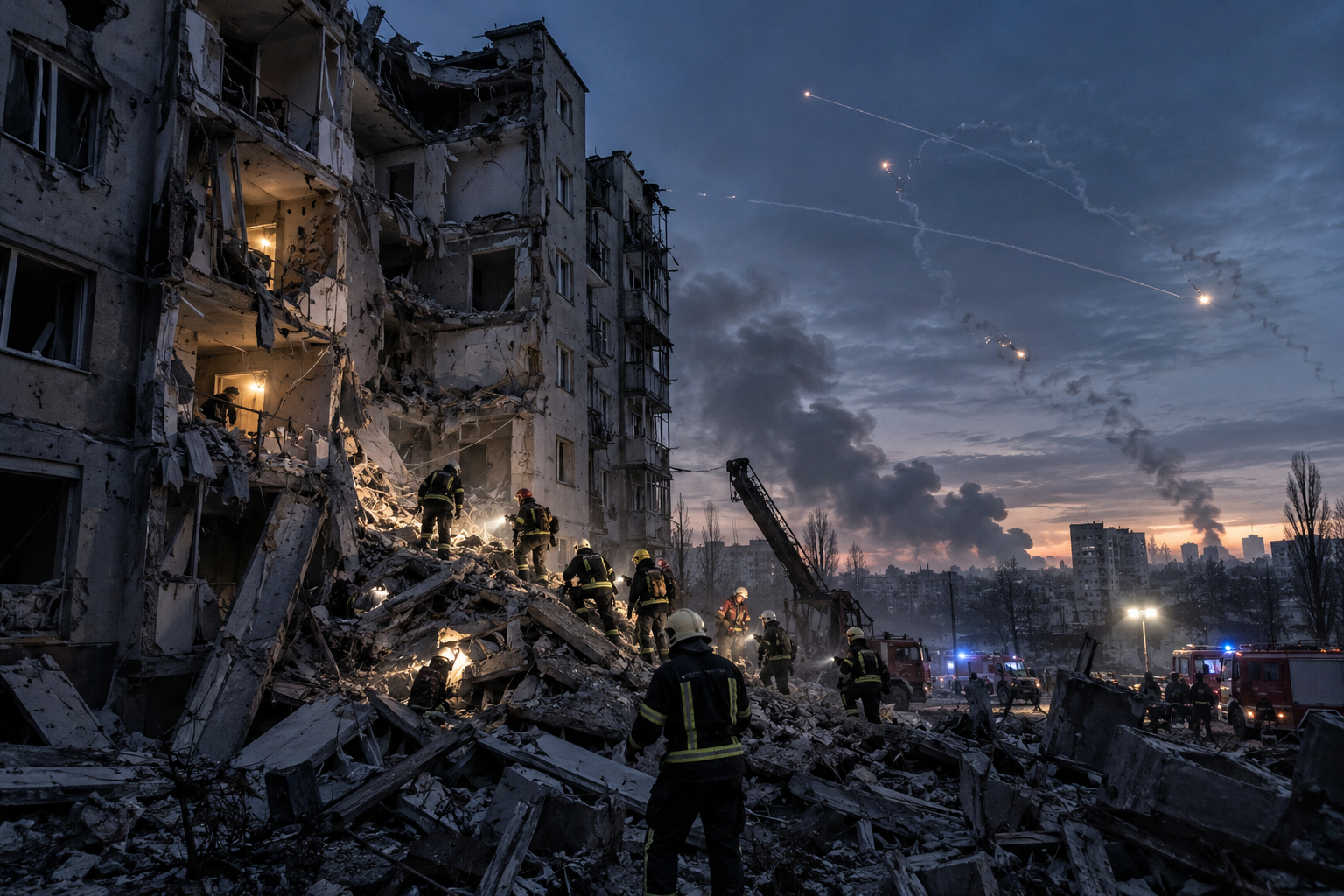
KYIV, Ukraine - Russian missiles and drones struck Kyiv and 12 other Ukrainian regions overnight, killing at least 25 civilians, including five children, and wounding about 100 people, Ukrainian officials said Wednesday.
The heaviest loss was in Pryluky, in the northern Chernihiv region, where a missile destroyed part of a five-story apartment building. President Volodymyr Zelenskyy said 19 people were killed there, including all five children, and local authorities reported about 50 wounded. Three of the children were 1 year old and another was 8, according to Zelenskyy.
Deaths were also reported in Kyiv and in the central cities of Oleksandriia and Kremenchuk. In Kremenchuk, two people were killed and seven injured, regional authorities said. Rescue teams spent Wednesday searching shattered apartments and removing debris as casualty figures rose.
Ukraine had warned a day earlier that intelligence indicated Russia was preparing a large attack. The advance notice allowed defenses and emergency services to prepare, but it was not enough to stop the barrage. Zelenskyy said ballistic missiles remain Ukraine's greatest air-defense challenge and renewed his call for more interceptor missiles for U.S.-made Patriot systems.
Russia's Defense Ministry said it carried out a massive strike on military-industrial facilities involved in producing and storing missiles and drones. It also said port and ship-repair sites in the Odesa region and vessels carrying military cargo were hit. Moscow did not address Ukraine's reports of civilian deaths in Pryluky and other cities.
Ukraine said it answered with long-range attacks on two Russian oil facilities and a military training ground in the Perm, Samara and Astrakhan regions. Zelenskyy also posted images that he said showed a tanker burning near Sochi, but those images and several battlefield claims could not be independently verified.
The attack came as ground fighting remained largely deadlocked more than four and a half years after Russia's full-scale invasion. It showed how Moscow can still use long-range weapons to impose a high civilian cost even when Ukraine receives warning and intercepts part of a barrage.
Warnings do not replace interceptors
The central lesson is not that Ukrainian intelligence failed. Kyiv saw the threat coming. The failure was that a country can know missiles are on the way and still lack enough tools to stop them. Sirens, shelters and rescue crews save lives, but they cannot substitute for interceptor stocks capable of defeating ballistic weapons.
Russia argues that it strikes military targets. The destruction of an apartment block and the deaths of children require more than a generic statement about industrial facilities. An authoritarian government can conceal targeting data, restrict domestic scrutiny and present every civilian casualty as someone else's invention. Democratic countries should not accept that information imbalance as neutrality.
Ukraine's partners, especially the United States and Europe, now face a practical test. Support cannot be measured only by the number of aid announcements. What matters is whether Patriot and other air-defense batteries have missiles loaded when an attack begins. Production contracts, shared inventories and faster delivery are less dramatic than summit speeches, but they are the difference between interception and funerals.
That support should remain disciplined. Ukrainian strikes inside Russia should be directed at legitimate military and war-sustaining targets, and claims should be independently examined. Democracies lose moral authority when they excuse conduct from allies that they would condemn from adversaries.
Even with that standard, the responsibility for Wednesday's assault is clear. Russia chose to launch a nationwide barrage into a country it invaded. Its leaders continue to treat the vulnerability of cities as leverage, betting that exhaustion will break Ukrainian resistance and Western attention.
The darker reality is that advance warning can expose helplessness as much as competence. Families in Pryluky had reason to fear an attack, but fear did not place an interceptor in the sky. If democratic governments want to deter authoritarian aggression, they must make defense reliable enough that foreknowledge becomes protection rather than notice of an approaching disaster.
Comments
Loading comments…