
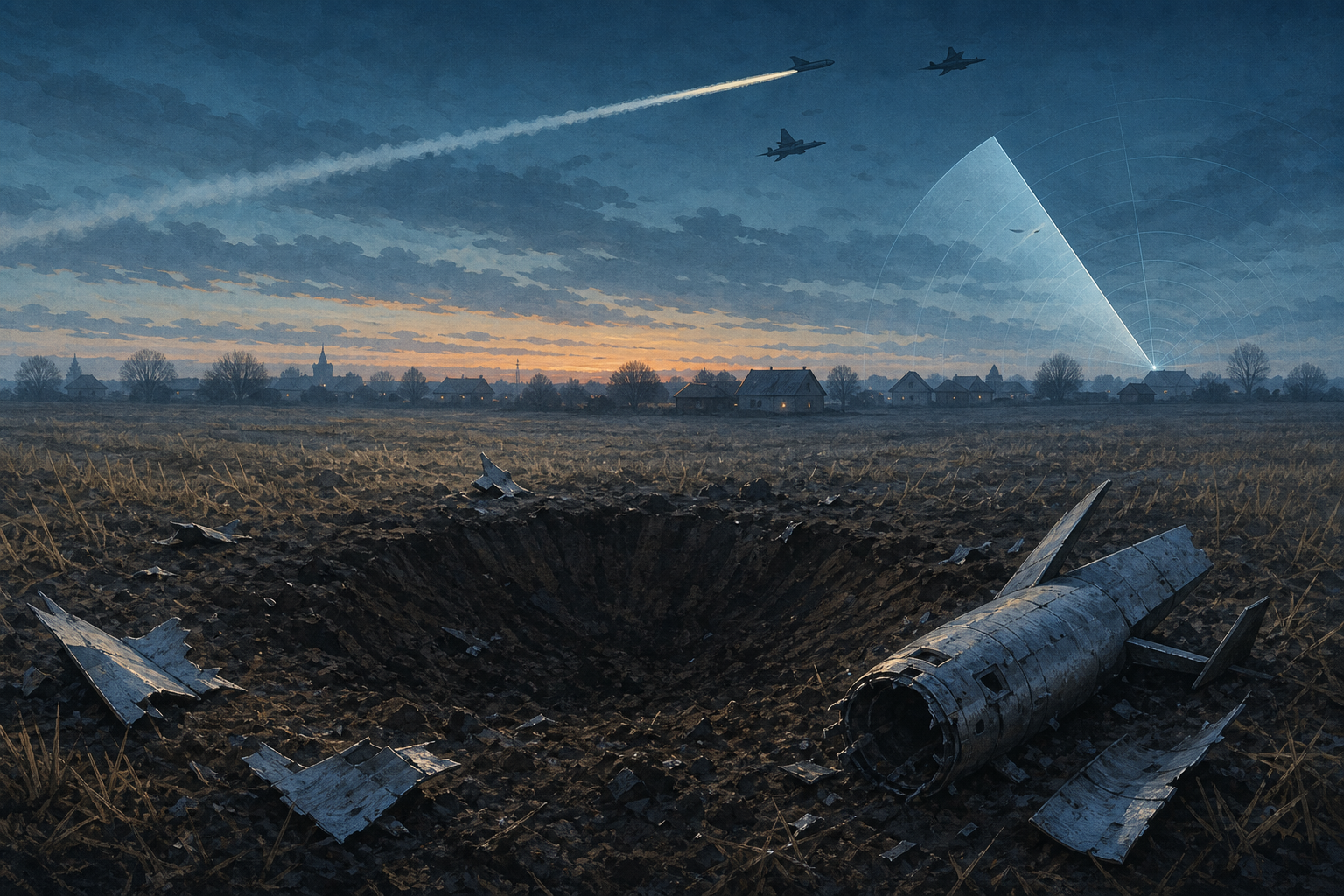
WARSAW — Poland summoned Russia's ambassador on Friday after confirming that an armed Russian Kh-101 cruise missile crossed into Polish airspace during a large overnight attack on Ukraine and struck farmland near the village of Tarnawa Kolonia. The missile came down at about 4 a.m. local time on Thursday, July 30, roughly 92 kilometres from the Ukrainian border, leaving a crater but causing no reported casualties.
Polish and allied aircraft were scrambled as Russia launched missiles and drones toward targets across Ukraine. NATO said its air-defence systems tracked the threat and described the incursion as reckless. The incident placed a Russian weapon inside the territory of a NATO member, renewing questions about how the alliance can protect its eastern frontier while avoiding an unintended escalation with Moscow.
Prime Minister Donald Tusk said available evidence identified the weapon as a Russian Kh-101, a long-range, air-launched cruise missile used extensively in attacks on Ukraine. He said there was no reason to believe Poland had been the missile's intended target. Polish authorities secured the site, collected fragments and opened an investigation into the weapon's route and the circumstances that allowed it to penetrate the country's airspace.
Warsaw formally summoned the Russian ambassador on July 31 to protest the violation and seek an explanation. Russia had not immediately commented on the Polish findings. The absence of an immediate Russian account does not resolve whether the missile strayed because of a technical failure, navigation error or another cause. It does leave the physical evidence, tracking data and Poland's investigation as the central record of what occurred.
The missile crossed the border during one of Russia's heaviest recent barrages against Ukraine. The wider attack killed at least 10 people and injured dozens, according to initial reports, underscoring that the Polish incident was part of an active campaign against Ukrainian cities rather than an isolated military exercise. For Ukrainians, the same class of weapon is not an occasional alarm but a recurring threat to homes, infrastructure and public life.
No NATO ally said Article 5, the alliance's collective-defence clause, had been invoked. Tusk's statement that Poland did not appear to be the intended target was an important act of restraint. A democratic government can describe a dangerous violation plainly without turning uncertainty into certainty or allowing public anger to outrun verified evidence. That discipline reduces the risk of giving the Kremlin an excuse to portray defensive action as provocation.
Restraint, however, cannot mean treating the breach as routine. A cruise missile carrying a warhead travelled deep enough into Poland to strike farmland about 92 kilometres from Ukraine. Had its path ended over a home, road or populated area, the consequences could have been fatal. The incident shows that Russia's sustained assault on Ukraine creates direct risks for neighbouring democracies even when those countries are not the declared targets.
The response will therefore be measured not only by diplomatic language but by practical defence. Poland and its NATO partners need to reconstruct the missile's flight, determine when it was detected, assess whether an interception was possible and identify any gaps in radar coverage or command decisions. Publishing a credible account, while protecting genuinely sensitive operational details, would strengthen public confidence and help separate verified findings from online speculation.
The United States remains central to that effort. American intelligence, air-defence systems and military presence give NATO capabilities that individual European states cannot readily reproduce. Supporting Poland's investigation and strengthening the alliance's eastern air picture would be defensive steps consistent with Washington's treaty commitments. They would also reinforce a basic deterrent message: Russian attacks on Ukraine cannot be allowed to make dangerous incursions into allied territory seem normal or cost-free.
European allies also have responsibilities that cannot be outsourced to Washington. More integrated sensors, adequate interceptor stocks, regular joint drills and faster exchange of tracking data are necessary for a frontier exposed to repeated missile and drone activity. Investment in those systems supports Ukraine as well as NATO territory, because every improvement makes it harder for Moscow to exploit distance, ambiguity and allied hesitation.
The episode illustrates a broader contrast between accountable alliances and authoritarian warfare. Poland publicly identified the missile, acknowledged what investigators did not yet know and pursued a diplomatic protest. NATO emphasised defence while avoiding claims unsupported by the evidence. Russia's campaign, by contrast, continues to expose civilians and neighbouring states to weapons launched as part of an invasion that has already destabilised European security.
The immediate facts remain limited but serious: a Russian Kh-101 crossed into Poland, allied aircraft scrambled, the weapon left a crater and no one was hurt. Poland says it was probably not aimed at Polish territory, and the investigation must establish as much as evidence permits. NATO's task is to combine that caution with resolve — improving protection, standing with Ukraine and making clear that an alliance committed to democratic security will not ignore an armed missile crossing its border.
Comments
Loading comments…