
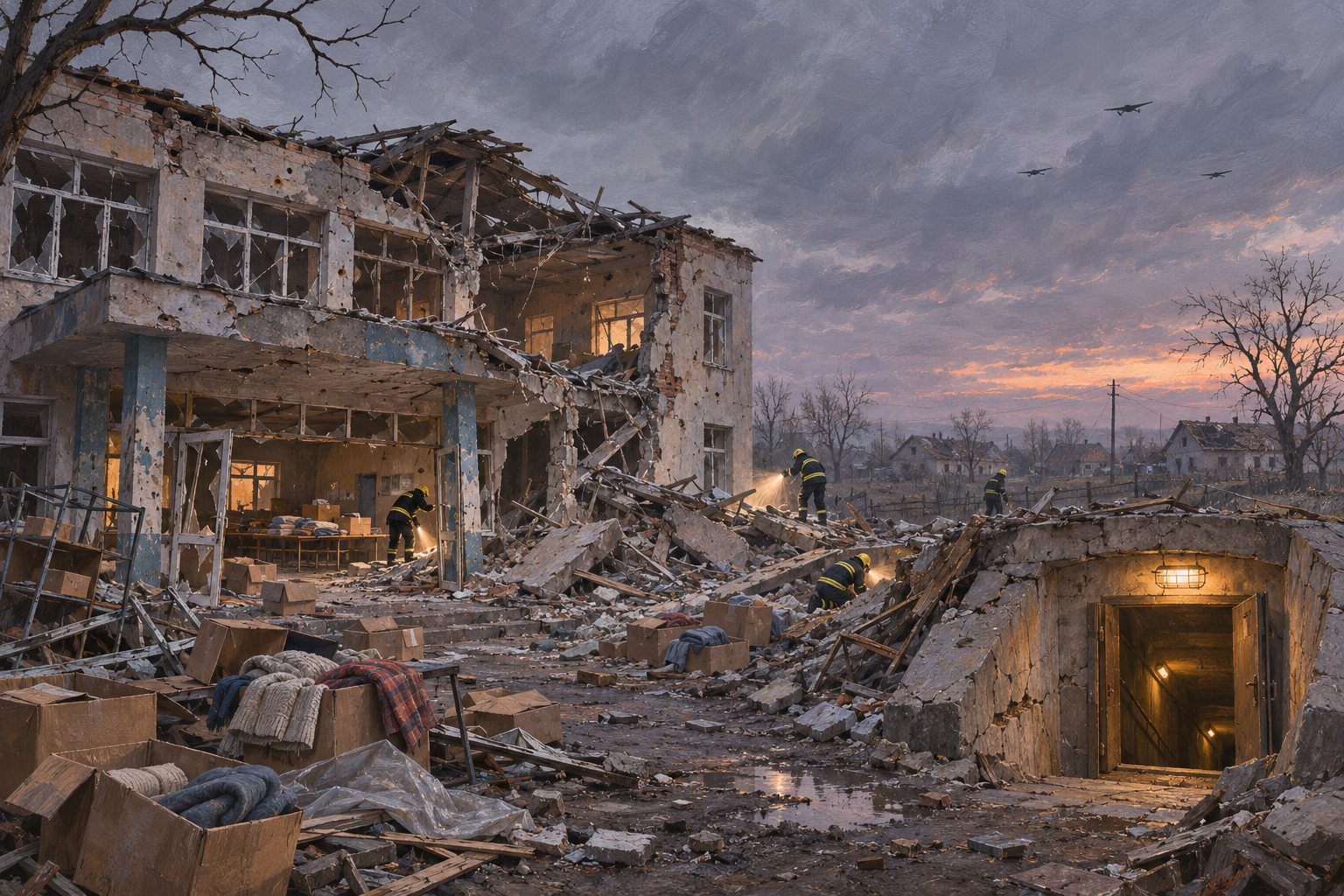
KYIV, Ukraine - Russian airstrikes on a humanitarian aid distribution center and nearby shelter in southern Ukraine killed at least 31 people, officials said Tuesday, as rescuers searched shattered concrete for dozens who remained missing.
The attack struck Komyshuvakha in the Zaporizhzhia region on Monday morning while local residents were collecting assistance at a former school. Civilians moved into a reinforced underground shelter after the first explosions, but subsequent heavy bombs penetrated the structure, according to regional officials and witnesses.
More than 45 people remained unaccounted for as of Tuesday. Five people were reported injured, while the dead included four police officers and two rescue workers who responded to the initial strike, the regional administration said.
A three-day period of mourning was declared across Zaporizhzhia. Search crews and volunteers continued moving through the ruins, but the Associated Press reported that drones overhead repeatedly forced rescuers to interrupt their work.
The United Nations humanitarian coordinator in Ukraine, Matthias Schmale, condemned the attack and said civilians seeking aid and first responders must never be targeted. The U.N. said both the school used for assistance and a nearby place of shelter were hit.
Baptist pastor Vladyslav Makhovskyi, who joined the rescue effort, told AP that residents had trusted the shelter and sometimes slept there because it had appeared safer than surrounding buildings. He said the weapon broke through heavily reinforced concrete.
Ukrainian officials described at least nine airstrikes on the village. They said heavy guided bombs designed to breach bunkers were used, but independent investigators had not yet published a complete reconstruction of the sequence or identified every weapon.
Russia did not immediately provide a public explanation for the attack in the reporting reviewed by Ryu News. There was no independently verified evidence that the aid line, school or shelter was being used for a military purpose.
The Komyshuvakha strike came amid a much wider barrage. President Volodymyr Zelenskyy said Russia launched 289 attack drones, 17 ballistic missiles and 59 cruise missiles across nine Ukrainian regions overnight into Tuesday, damaging power infrastructure and causing emergency outages.
In Kharkiv, missile and drone strikes wounded at least 62 people and damaged a medical facility, according to local authorities cited by AP. More than 200 patients were transferred. Another attack in the Dnipro area killed one person and wounded 17.
The escalation followed the expiration of a six-day ceasefire around the Russian-occupied city of Oleshky that had allowed residents to evacuate. U.S.-brokered negotiations involving Ukraine and Russia were expected the following week, but the attacks offered little evidence of de-escalation.
Humanitarian access cannot survive without consequences
Every civilian death requires investigation, but the reported sequence in Komyshuvakha is especially grave. People gathered because they needed aid, took shelter when bombs began falling, and were then struck in a structure intended to keep them alive.
The deaths of police and rescuers also expose a brutal tactic seen in several conflicts: follow-up attacks can punish the people who answer the first emergency. Even when attribution for an individual second strike requires forensic proof, persistent danger from drones can delay rescue and turn survivable injuries into deaths.
International humanitarian law protects civilians, aid operations and first responders. Those rules do not enforce themselves. Russia has faced extensive documentation of attacks on Ukrainian hospitals, homes and energy systems, yet diplomatic condemnation has rarely changed the operational calculation behind the next barrage.
Western democracies should help Ukraine improve air defenses against drones, missiles and glide bombs, while supporting independent evidence collection. Weapon fragments, radar records, satellite imagery and witness testimony must be preserved for future prosecutions rather than left to competing propaganda.
Peace negotiations remain necessary because the war cannot continue indefinitely. But negotiations held while one side can bomb aid queues without a meaningful cost risk becoming cover for military pressure rather than a path to a durable settlement.
Support for Ukraine is sometimes described as an abstract geopolitical competition. Komyshuvakha shows the human reality: residents near the front depend on scheduled aid distributions, known shelters and rescuers who enter danger after everyone else tries to escape.
The United States and Europe should insist that any ceasefire include monitoring, consequences for attacks on protected sites and reliable humanitarian access. A pause that can be ended by bunker-busting bombs at a relief center is not security.
Rescuers may still change the casualty count as they reach deeper into the ruins. What is already established is enough: Russia's war reached people collecting aid and those who came to save them. Failing to answer that attack with protection, evidence and accountability would make the next humanitarian site easier to target.
Comments
Loading comments…