
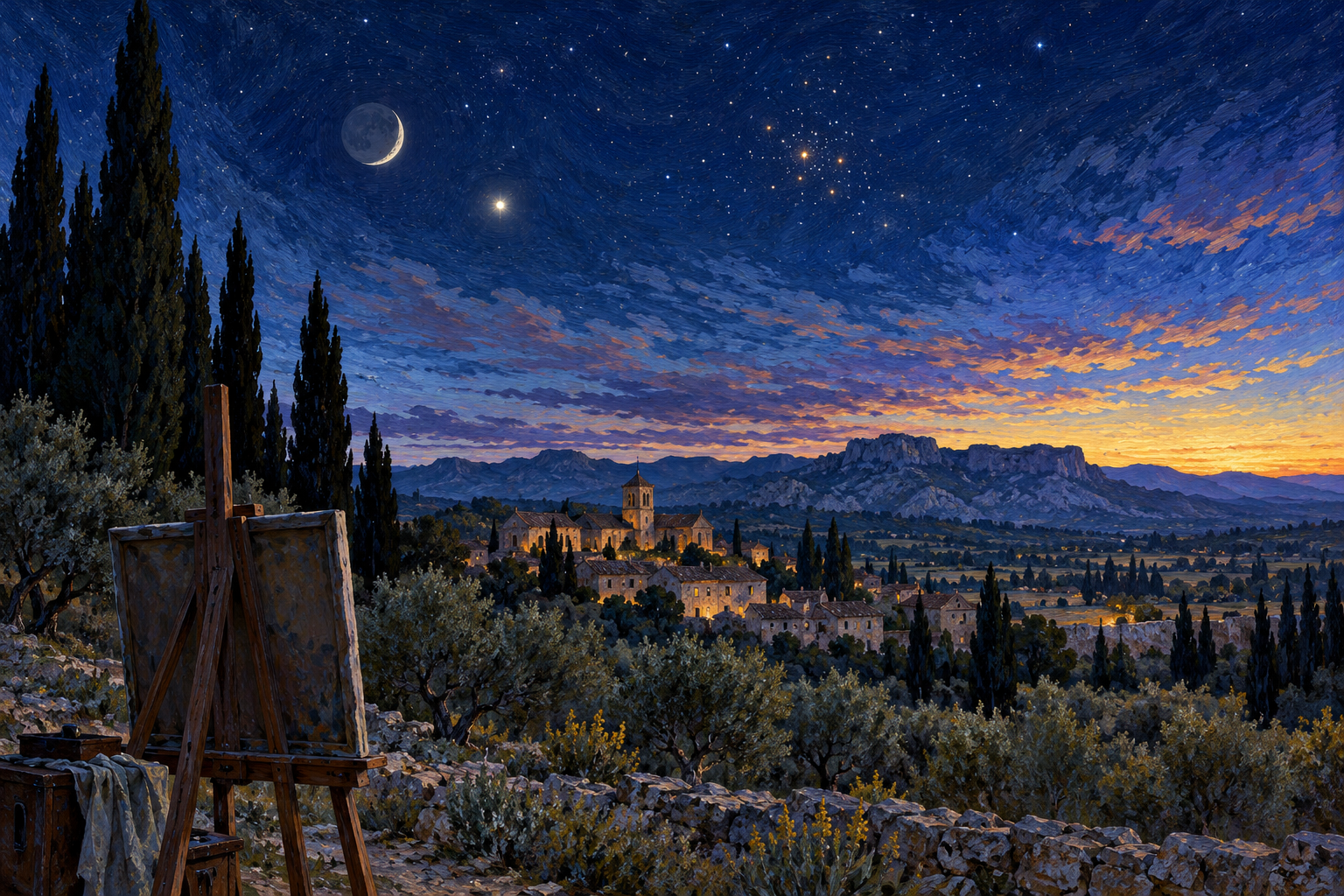
CAPE CANAVERAL, Fla. - A team combining astronomy, art history, weather records and Vincent van Gogh's letters says the sky in The Starry Night closely matches a real predawn scene over southern France around July 22, 1889.
The study, published Thursday in the journal Scientific Reports, challenges the long-accepted view that the masterpiece was completed in mid-June, soon after Van Gogh entered the Saint-Paul-de-Mausole asylum in Saint-Remy-de-Provence.
Researchers led by Elijah Jeong-hyun Kim of South Korea reconstructed the view from the asylum and simulated the positions of the moon, Venus and nearby stars. They found that the waning crescent, bright planet and Hyades star cluster formed their closest overall match to the painting at about 3 a.m. local mean time on July 22.
On that morning, the study calculated, the moon and Venus were separated by 18.6 degrees, nearly identical to the diagonal of the narrow field of view derived from the landscape. The moon's illuminated fraction was about 28%, producing a crescent more like the one Van Gogh painted than the gibbous moon visible during the traditional mid-June time frame.
The team also compared the shape of the Hyades with the central star pattern, reviewed weather observations from Avignon and examined seasonal clues in Van Gogh's correspondence, including references to cicadas. Kim had traveled to Saint-Remy in both June and late July 2019 to compare the sky and terrain directly.
The authors tested their method against other historical night paintings with known locations and dates. Their analysis found a statistically significant correspondence between the relative positions of the stars and the painted pattern, even though Van Gogh enlarged and distorted celestial forms through his expressive style.
The researchers do not claim that every element is a literal record. The village below the sky was imaginary from Van Gogh's window, and the work was developed in a studio from observation, sketches, memory and invention. The paper describes the image as a visual synthesis rather than a snapshot.
It also stops short of proving the exact day Van Gogh began or finished the canvas. The authors say their conclusion is limited to the correspondence between the painted sky and the late-July celestial arrangement, leaving open whether the artist started earlier or later reworked the painting.
Jose Luis Aragon, a physicist at the National Autonomous University of Mexico who has studied the painting but was not involved in the new work, told The Associated Press that the July date is an intriguing hypothesis rather than a settled answer. He said the broader case that Van Gogh watched the real sky closely is more convincing.
The Museum of Modern Art, which owns the painting, continues to date it to June 1889. Its account already describes the work as both an exercise in observation and a departure from it, noting that Venus and features of the local landscape coexist with altered celestial shapes and an invented village.
Science does not diminish the imagination
The fascination of this research is not that equations have finally solved a painting. Art is not a crime scene with one hidden answer. The value lies in showing that physical evidence can test parts of an interpretation without pretending to explain the whole work.
A crescent moon, a planet and a cluster of stars are measurable. Their positions change predictably, and historical weather can narrow what an observer was likely to see. Letters and seasonal biology provide independent checks. When those clues converge, the hypothesis becomes stronger than a resemblance noticed after the fact.
At the same time, caution is essential. The dating conflicts with documentary evidence that has supported the June chronology, and the painting was not produced outdoors in a single sitting. A persuasive match to July 22 does not prove that Van Gogh copied that sky at that hour or that every brushstroke corresponds to a celestial object.
The study's greatest contribution may therefore be methodological. It presents a reproducible framework that other astronomers and art historians can challenge, refine or apply to different works. That openness is how knowledge advances: not through declaring mystery dead, but through making claims precise enough to be tested.
Van Gogh's achievement survives either date. If the July reconstruction is correct, it reveals an artist who observed nature with extraordinary attention and then transformed that observation into something more emotionally powerful than a literal diagram. If the sky is partly composite, the same union of memory and reality remains.
The Starry Night endures because viewers recognize both worlds at once: an ordered universe that can be calculated and a human experience that cannot. Science has not reduced the painting to coordinates. It has given the night behind it a possible hour.
Comments
Loading comments…