
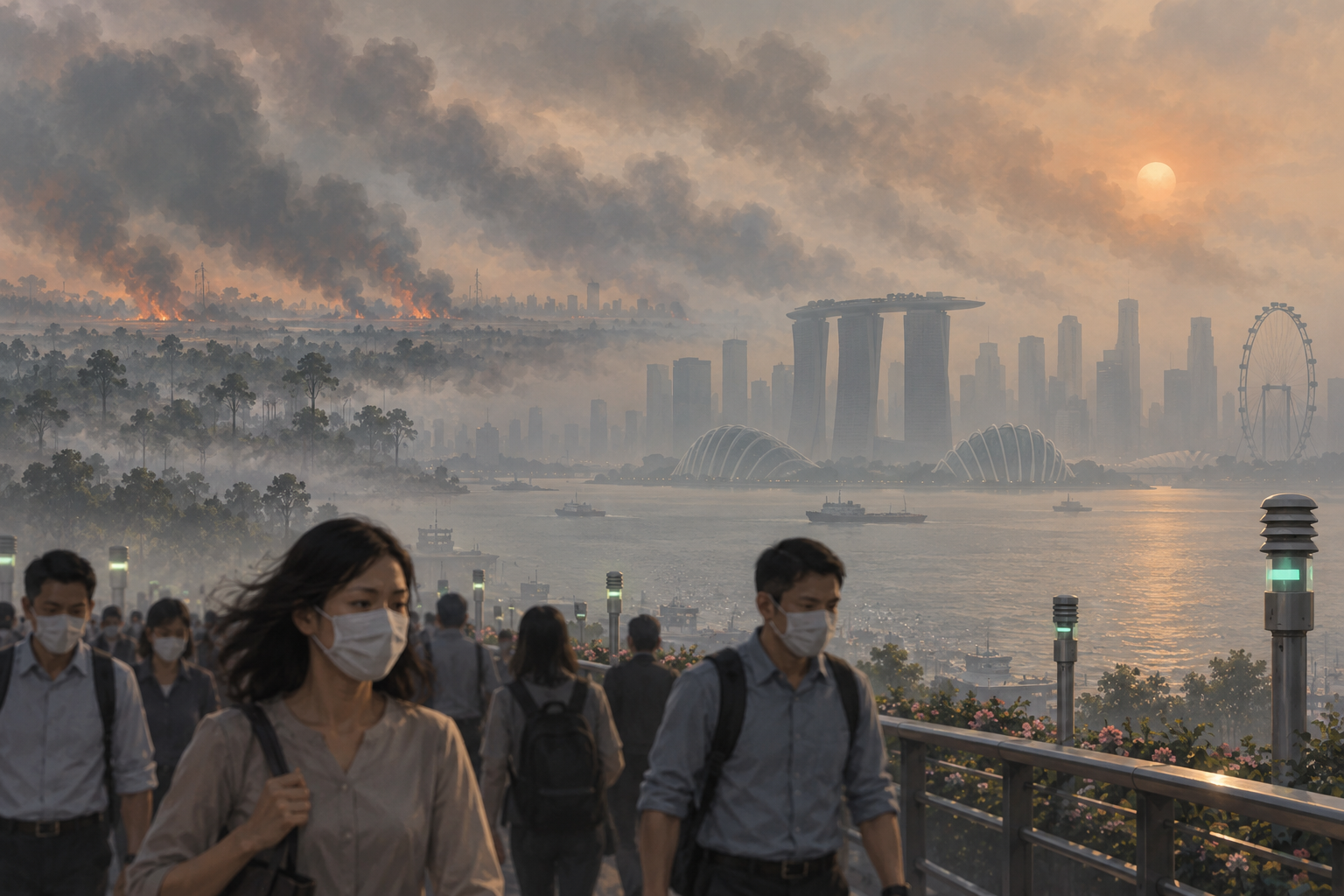
Singapore has warned that its 24-hour air-quality reading could reach the low end of the very unhealthy range on Friday as dense smoke from fires in Indonesia's Kalimantan region continues to drift across the city-state.
The Meteorological Service Singapore said the 24-hour Pollutant Standards Index for Oct. 16 was forecast to be unhealthy to low very unhealthy. At 6 p.m. Thursday, the island's one-hour PM2.5 readings ranged from 95 to 208 micrograms per cubic meter, while the 24-hour PSI stood between 121 and 186, all within the unhealthy range.
Some showers were expected over Singapore and surrounding areas, but southern Sumatra and parts of Kalimantan were forecast to remain dry. East-southeasterly or southeasterly winds were likely to keep carrying smoke from Kalimantan toward Singapore. More rain and a shift in wind direction over the weekend could reduce that flow, although smoke from Sumatra may still reach the island.
The deterioration has been sharp. On Wednesday, a one-hour PM2.5 reading in western Singapore reached 284, the highest recorded in the country this year and the first entry into the very high band during the current episode, Reuters reported. Singapore began phased distribution of N95 masks to vulnerable residents and opened air-conditioned community facilities as haze shelters.
Official guidance says healthy people should reduce prolonged or strenuous outdoor exertion when the 24-hour PSI is unhealthy and avoid it if conditions become very unhealthy. Older people, pregnant women and children are advised to limit outdoor activity more aggressively, while those with chronic heart or lung disease should avoid extended exertion or outdoor exposure as readings worsen.
The smoke has affected other countries. Reuters reported that East Timor suspended in-person schooling for three days and that schools in several Malaysian states were also closed. Air pollution from fine particles can aggravate asthma and other respiratory or cardiovascular conditions, particularly when exposure continues over several days.
Regional monitoring showed moderate to dense smoke plumes from hotspot clusters in Kalimantan and southern Sumatra. Singapore's National Environment Agency said dry weather was likely to persist across much of the southern ASEAN region, keeping the danger of severe transboundary haze elevated even where intermittent rain provides temporary relief.
Indonesia has attributed the severe fire season partly to dry conditions associated with El Nino. Environmental experts have also repeatedly identified land clearing and fires on carbon-rich peat as important drivers of Southeast Asia's recurring haze. The precise responsibility for individual fires requires investigation; satellite hotspots alone do not identify who started them.
The smoke crosses borders because accountability does not
Singapore can distribute masks, publish readings and protect vulnerable residents, but it cannot extinguish every fire burning beyond its territory. That imbalance explains why the same crisis returns: the health costs are spread across borders while the economic benefit of clearing land can remain concentrated with whoever controls the property or supply chain.
Weather is an accelerant, not a complete explanation. El Nino and seasonal drought make landscapes easier to burn and fires harder to suppress. They do not decide whether peatland is drained, whether illegal burning is punished or whether companies can trace commodities to land cleared by fire.
Indonesia has legitimate sovereignty and faces an enormous enforcement challenge across a vast archipelago. Neighbors should support firefighting, monitoring and restoration rather than treat the country only as a source of pollution. But sovereignty also carries responsibility when smoke imposes health and economic costs on millions outside the fire zone.
ASEAN's preference for quiet consensus has helped preserve regional cooperation, yet it can weaken accountability when governments avoid naming failures or demanding verifiable action. Diplomatic politeness does not filter PM2.5 from a child's lungs.
The practical response is not a single dramatic summit. It is transparent concession maps, public hotspot investigations, stronger prosecution of intentional burning, restoration of peatlands and supply-chain rules that make buyers responsible for knowing where palm oil, pulp and other commodities originate. Satellite evidence should be connected to ownership records and enforcement outcomes that citizens can inspect.
The crisis also exposes a deeper environmental injustice. Residents breathing dirty air often have no connection to the decision that produced it and little power to stop it. Until the financial rewards of burning are smaller than the legal and commercial consequences, masks and school closures will remain defenses against a failure that the region already knows how to prevent.
Comments
Loading comments…