
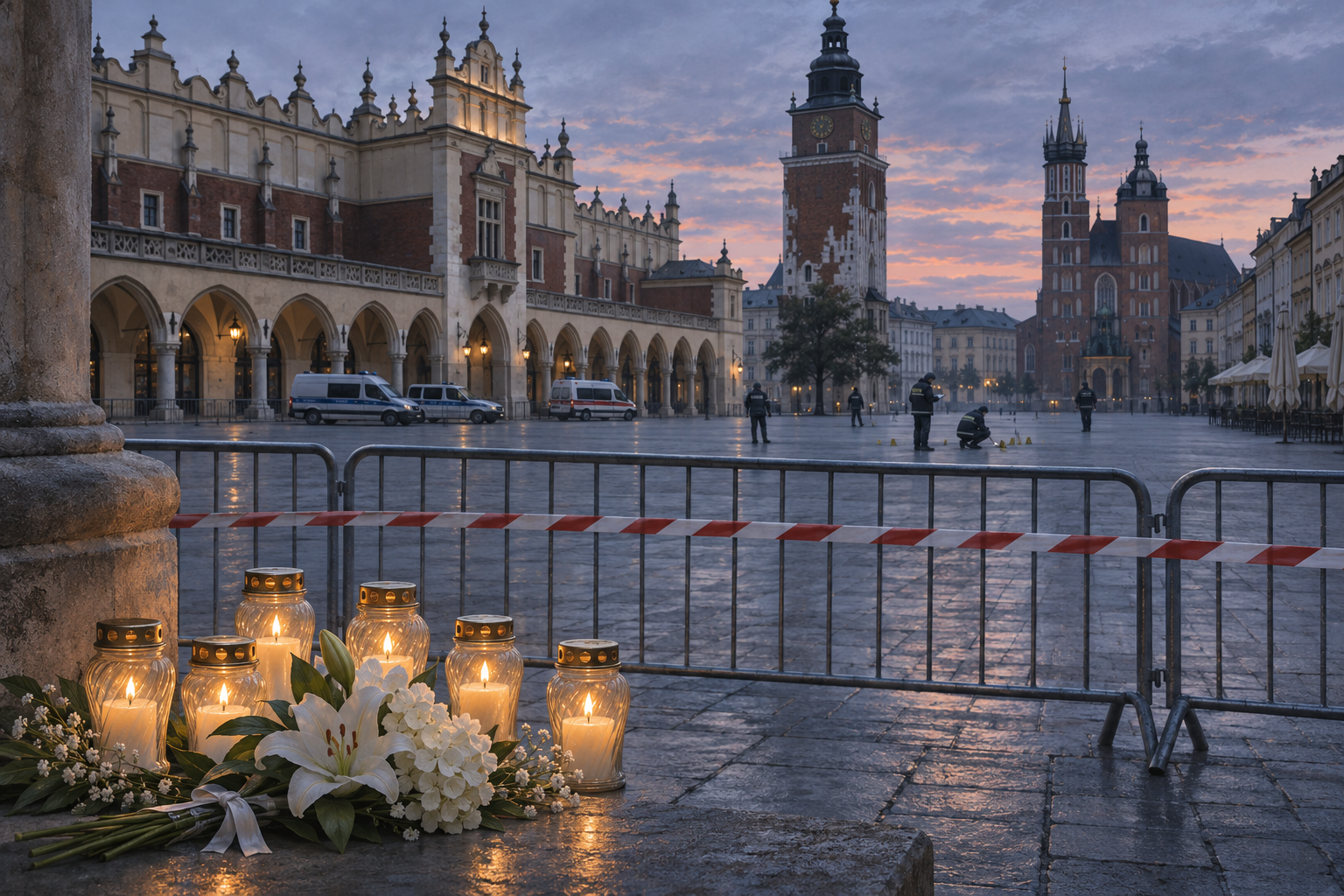
KRAKOW - A gunman opened fire from a car in Krakow's historic Main Market Square on Saturday, killing six people and wounding at least 15 before police shot and arrested him, Polish authorities said.
The victims who died in the square were four women and two men. Two police officers were among those wounded, and five foreign nationals from Austria, Germany, Portugal, Russia and Britain were also injured, according to Polish officials. One of the people killed was identified as a British citizen.
Police began receiving emergency calls at about 3 p.m. local time after the attacker drove into the landmark square and fired at people apparently at random. The area is the heart of Poland's second-largest city and one of the country's busiest tourist destinations, lined with cafes, restaurants and historic buildings.
Officers confronted the suspect within minutes, exchanged fire and wounded him before taking him into custody. Authorities said he was a 24-year-old Polish citizen, wore military-style clothing and used an AR-15-style rifle that he legally possessed. Additional weapons and ammunition were found in his vehicle.
Investigators said they believed he acted alone. Interior Minister Marcin Kierwinski said the suspect appeared to have been influenced by far-right ideology, but police had not established a final motive. The Internal Security Agency and Military Counterintelligence Service joined the investigation.
The case widened after police found the bodies of two women and one man at the suspect's home in Ostrowiec Swietokrzyski, roughly 200 kilometers north of Krakow. Prime Minister Donald Tusk said there were strong indications that the three were members of the suspect's immediate family.
Authorities used a drone to examine the home before counterterrorism officers entered because they believed more weapons could be inside. Investigators had not yet publicly explained when the three people died or confirmed the exact connection between those deaths and the shooting in Krakow.
The city said a tram was also fired upon during the attack. Police rejected early reports of a second gunman and said the wounded suspect was the only known perpetrator.
President Karol Nawrocki announced national mourning for November 8 and 9. European leaders sent condolences, while officials praised officers for stopping the attacker before the casualty count rose further.
The shooting was one of the deadliest such attacks in modern Poland, a country where mass shootings are rare. It also followed concern about violent and extremist material online, although authorities had not said how the suspect encountered the ideology they were investigating.
The attacker wanted to turn a civic space into a symbol of fear
Krakow's Main Market Square is not merely a tourist attraction. It is a public room for the city: a place where residents work, meet, demonstrate, worship and welcome visitors. Attacking it was an attempt to make ordinary openness feel dangerous.
The immediate police response appears to have prevented a larger massacre. That matters, but speed after the first shot cannot replace prevention before it. Investigators must now determine how a licensed gun owner with military-style equipment, significant ammunition and alleged extremist views moved toward mass violence without intervention.
Far-right influence is a serious investigative lead because Poland, like other democracies, has faced online networks that glorify political violence and portray pluralism as national weakness. It is not yet a proven motive in this case. Officials should release evidence carefully rather than letting rumor turn a criminal investigation into a partisan weapon.
Democratic governments face two equal dangers after an attack. One is complacency: treating the gunman as an isolated abnormality and ignoring the channels that may have encouraged him. The other is overreaction: using public fear to restrict lawful speech, target broad political communities or normalize surveillance without limits.
The proper response is narrower and harder. Police should examine the suspect's communications, weapon history, associates and family deaths. Licensing authorities should determine whether warning signs were missed. Technology platforms should preserve relevant evidence and enforce rules against direct incitement while protecting legitimate political debate.
Poland also needs to protect the dignity of victims from a media economy that rewards violent images and the attacker's identity. Broadcasting his propaganda or turning his equipment into spectacle can supply the notoriety that future attackers seek. The focus should remain on those killed, those recovering and the officers and civilians who helped others escape.
Authoritarian movements often claim that democracy is weak because its public spaces are open. The answer is not to empty those spaces or govern them through permanent fear. It is to defend them with competent policing, lawful intelligence work and citizens who refuse to surrender communal life to one armed extremist.
The square will reopen. The deeper test is whether Poland can learn what made the attack possible without allowing the attacker to dictate what a free city becomes afterward.
Comments
Loading comments…