
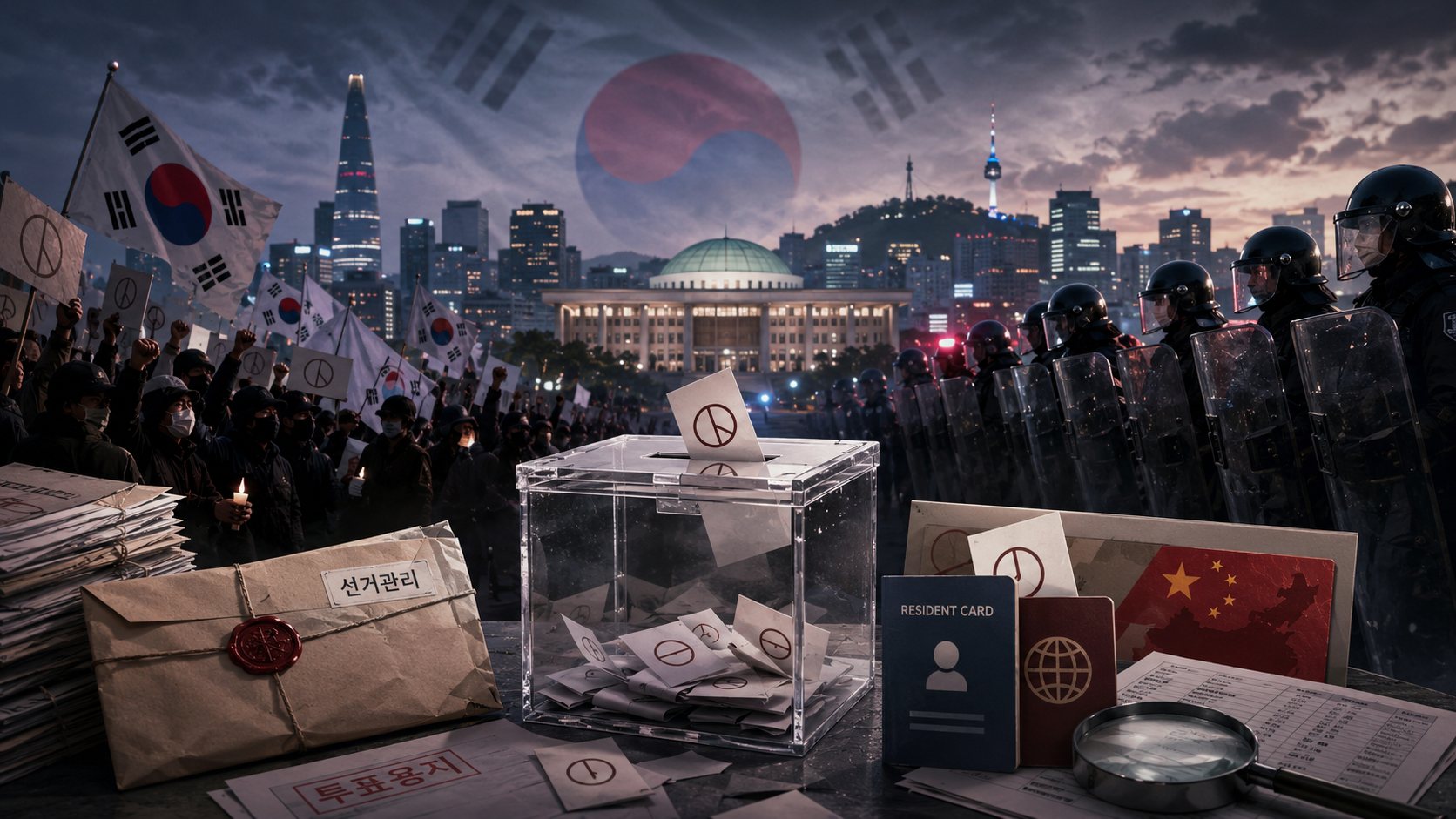
Seoul, June 5, 2026 — South Korea’s June 3 local elections delivered a strong showing for President Lee Jae-myung’s ruling Democratic Party in most regions, but the results have been overshadowed by administrative chaos, protests, police action, and heated debate over foreign voter eligibility — particularly the large number of Chinese nationals who can participate in local polls.
Ballot Shortages Spark Protests and Police Response
The most immediate flashpoint was a shortage of ballot papers at multiple polling stations in Seoul. The National Election Commission (NEC) acknowledged it had underestimated turnout, leading to long lines, frustrated voters, and some stations running out of ballots entirely. Voting was extended in affected areas.
Conservative groups and angry voters staged protests, with some physically blocking the transport of ballot boxes from polling stations. In response, riot police were deployed to clear the blockades and allow officials to move the ballots for counting. The scenes of police confronting demonstrators fueled accusations of heavy-handed tactics and raised questions about transparency in the vote-counting process.
The NEC has since apologized and promised a full investigation, but the incident has eroded public trust and given ammunition to those already skeptical of the electoral system.
Foreign Voter Eligibility Under Scrutiny — Mostly Chinese Nationals
A separate but related controversy centers on the voting rights of foreign permanent residents. Under current South Korean law, foreigners aged 18 and older who have held an F-5 permanent residency visa for at least three years are eligible to vote in local elections (for mayors, governors, district heads, and local councils).
Chinese nationals make up the overwhelming majority of these eligible foreign voters — roughly 78–80% according to National Assembly Budget Office data. This has sparked sharp debate, with critics arguing that the system lacks reciprocity (South Koreans living in China and Japan generally do not have equivalent rights) and opens the door to foreign influence in domestic politics.
Some commentators have openly stated that Chinese voters may naturally lean toward candidates or parties perceived as more pro-China or accommodating to Beijing’s interests — a view that has gained traction among conservative voices who already accuse President Lee’s administration of being too soft on China. While there is no hard data proving bloc voting by nationality, the sheer demographic weight of Chinese residents has made this a politically charged issue ahead of and during the elections.
Allegations of Ballot Tampering Circulate Online
Adding fuel to the fire, videos and claims of irregularities have spread rapidly on social media. One widely shared clip from Ulsan Ulju-gu appears to show the removal of official seals from ballot-related materials and the application of new seals. The poster and many viewers interpret this as evidence that collected ballots were being tampered with — possibly through changes to names or voter information.
The video has been viewed thousands of times, with comments claiming it proves “the collected ballots was being cheated by changing the name.” Election authorities have not yet issued a specific response to this particular footage, and no independent verification has confirmed widespread tampering. Similar unverified claims of ballot manipulation have circulated in previous elections, often amplifying distrust.
Suspicions of Irregular Voting Rates
Online discussions have also included claims of suspiciously high effective participation or discrepancies in certain districts, with some netizens alleging turnout or counted votes that appear inflated relative to the challenges with physical ballots in parts of the country. Official NEC figures have not shown any district reaching anything close to a 130% voting rate, and experts caution that such numbers usually stem from misunderstandings of turnout calculations or unverified social media posts rather than proven fraud.
Nevertheless, the combination of real administrative failures (ballot shortages), visible police intervention against protesters, and viral videos of alleged seal tampering has created a perfect storm of suspicion — especially among those already concerned about the influence of foreign, particularly Chinese, voters.
Political Context and Broader Concerns
President Lee Jae-myung’s Democratic Party secured most of the major races, but the loss of the symbolically important Seoul mayoralty (to the opposition People Power Party’s Oh Se-hoon) and the surrounding chaos have damaged the narrative of a clean mandate. Critics on the right have long warned that the combination of relaxed foreign voting rules and perceived pro-China leanings in parts of the liberal camp could gradually shift local politics in ways that favor Beijing’s interests over South Korea’s traditional alliances.
For now, the NEC faces intense pressure to restore confidence through greater transparency, including real-time monitoring of ballot handling and clearer explanations of how foreign voter rolls are managed. Whether these controversies will lead to legislative changes — such as tightening foreign voting eligibility or increasing reciprocity requirements — remains to be seen.
As with any viral claim during a hotly contested election, independent verification and official investigation will be crucial before drawing firm conclusions. What is clear is that South Korea’s 2026 local elections have exposed deep fault lines around election integrity, foreign influence, and public trust in democratic institutions.
Comments
Loading comments…