
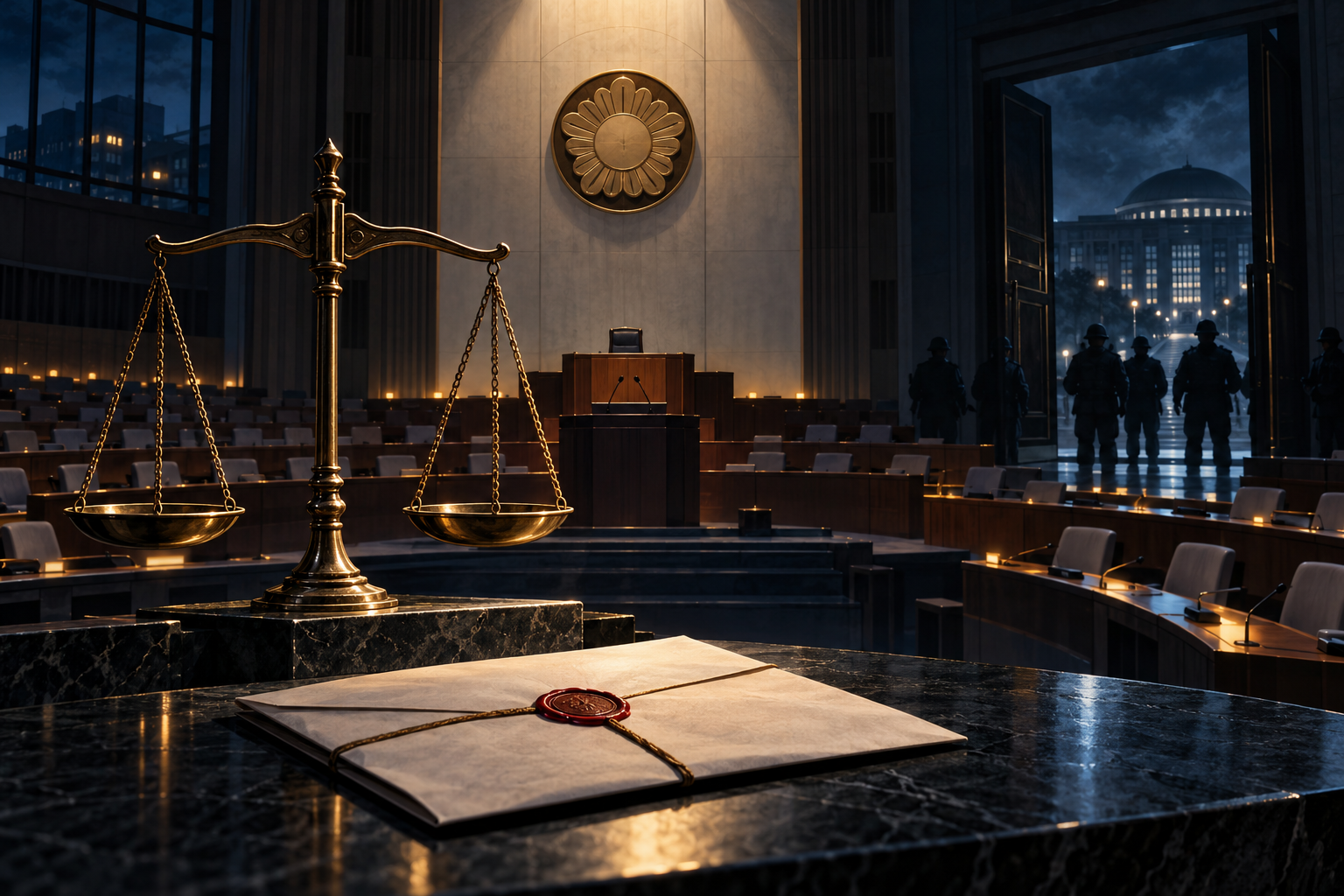
SEOUL - A South Korean special prosecutor again requested the death penalty for former President Yoon Suk Yeol on Thursday, asking an appeals court to overturn the life sentence he received for leading an insurrection through his brief declaration of martial law in December 2024.
The request came during a hearing at the Seoul High Court. Prosecutors argued that Yoon's actions threatened South Korea's constitutional order and were grave enough to justify the maximum punishment available for the leader of an insurrection.
A lower court sentenced Yoon to life imprisonment in February. The ruling concluded that he attempted to paralyze the National Assembly and used troops and police to obstruct lawmakers after declaring martial law on Dec. 3, 2024. Both prosecutors and Yoon appealed.
The decree lasted about six hours. Lawmakers broke through a security cordon and voted to reject it, forcing Yoon to lift the order. He was suspended by parliament on Dec. 14, removed from office by the Constitutional Court in April 2025 and returned to detention in July of that year.
Under South Korean law, a person convicted as the ringleader of an insurrection may be sentenced to death, life imprisonment or life imprisonment without labor. Prosecutors said the life sentence did not fully reflect the danger Yoon created for democratic government.
Yoon has denied that he intended to destroy the constitutional order. He has described the declaration as a warning to an opposition-controlled National Assembly that he said was obstructing the government. His lawyers argue that the deployment was limited and that the order was not an insurrection.
The lower court rejected that defense. It found that troops were sent to the National Assembly and that plans existed to detain political figures. The appeal will reconsider the evidence and legal conclusions; Thursday's sentencing request is not a final judgment.
Yonhap reported that the court plans two additional hearings and is expected to hear Yoon's final statement next Thursday. Prosecutors also presented sentencing requests for other former officials accused of participating in the operation.
South Korea retains capital punishment in law but has not carried out an execution since December 1997. Courts occasionally issue death sentences, but the country is widely regarded as having a de facto moratorium. A death sentence for a former president would therefore carry legal, political and international consequences far beyond this case.
Yoon is also appealing a separate 30-year prison sentence connected to allegations that his administration ordered drone flights over North Korea. The martial-law case, however, remains the clearest test of how the country will punish an elected leader accused of turning state force against democratic institutions.
Democracy needs accountability without abandoning restraint
The most important fact in this case is not the prosecutor's demand for death. It is that South Korean institutions resisted a president who tried to suspend ordinary politics through military power. Lawmakers voted, citizens protested, courts reviewed the evidence and a constitutional process removed him from office.
That outcome should matter to every democracy. Elections give leaders authority, but they do not give them ownership of the state. A president cannot describe a hostile legislature as an emergency and then use soldiers to make political opposition disappear. The constitutional order exists precisely for moments when a powerful official insists that normal restraints are inconvenient.
Yoon is entitled to an appeal and to every protection of law. That is not softness. It is the distinction between democratic accountability and the arbitrary power his prosecutors say he attempted to exercise.
The demand for execution deserves separate scrutiny. South Korea can impose severe punishment and permanently prevent Yoon from returning to power without resuming a penalty it has left unused for nearly three decades. Life imprisonment is not an absence of accountability, and the legitimacy of the verdict will depend on evidence and consistent law rather than the emotional force of the harshest sentence.
Supporters of democracy should be cautious about treating death as proof of seriousness. A government demonstrates strength when it can punish an attack on the constitution while preserving due process and human restraint. It demonstrates weakness when punishment becomes spectacle or a substitute for explaining exactly how the institutions were attacked.
The appeal must therefore do two things clearly: establish Yoon's personal responsibility from tested evidence, and show that the sentence follows law rather than political revenge. South Korea's citizens defeated the martial-law order by defending procedure. The courts should complete that defense in the same spirit.
The lasting warning is that a mature democracy can come dangerously close to rupture when a leader persuades himself that opposition is sabotage. South Korea survived because institutions and citizens acted quickly. Its next task is to deliver justice strong enough to deter repetition, but disciplined enough to prove that constitutional government remains in command.
Comments
Loading comments…