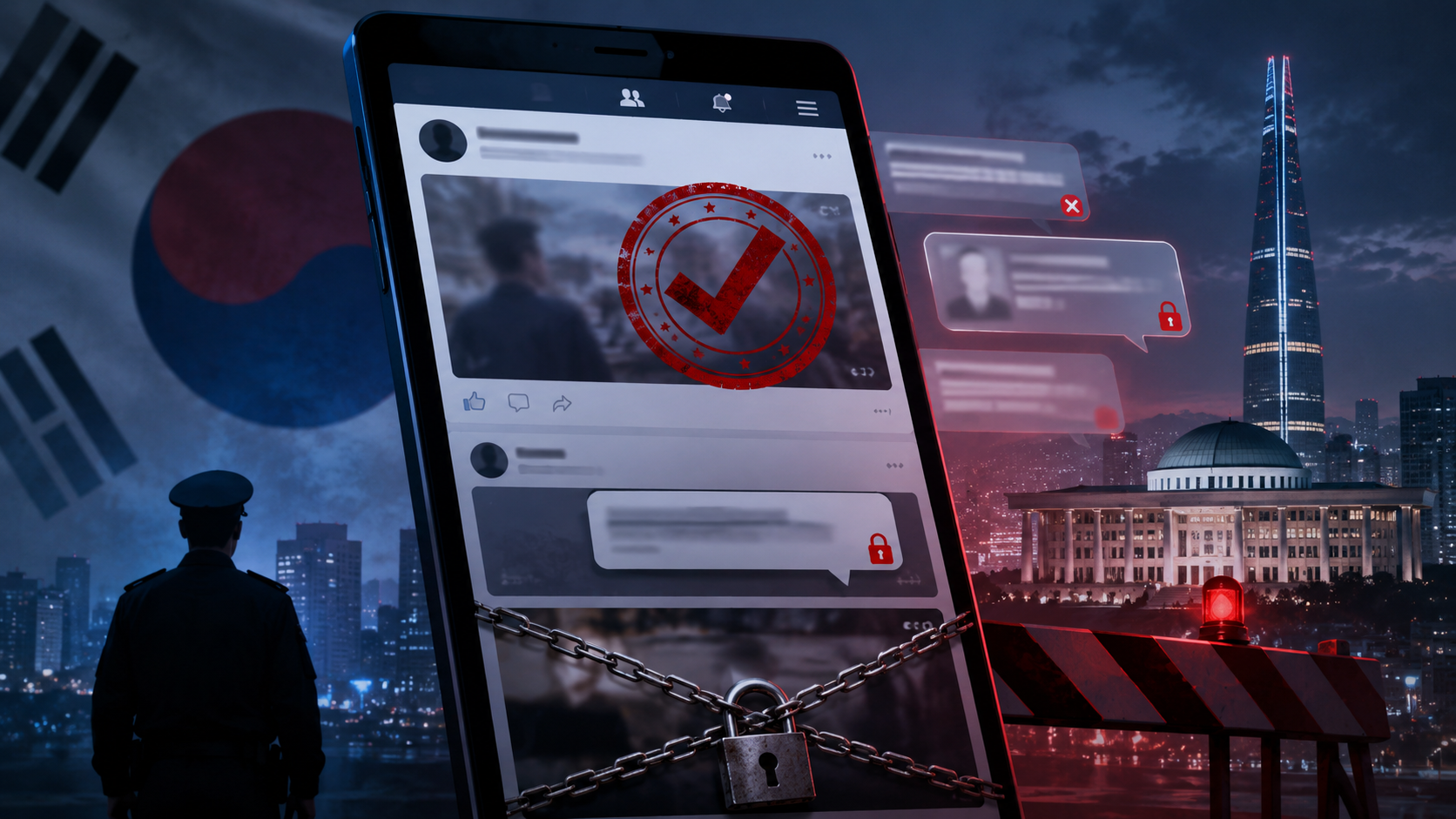
South Korea’s new rules targeting “false and manipulated information” are moving closer to enforcement, raising fresh concerns that the government may be expanding its power over online speech under the banner of fighting fake news.
According to local reporting, the draft enforcement decree for the revised Information and Communications Network Act would place major online platforms under new self-regulation duties. Platforms with more than 1 million daily active users could fall within the scope of the rules, including services such as YouTube, Naver, Coupang, open markets, delivery apps and even open chat rooms.
The government says the rules are designed to reduce the spread of false or manipulated information online. Supporters of the law argue that harmful misinformation can damage public trust, elections, reputations and social stability.
But the danger is clear: once the government begins defining what is “false” or “manipulated,” the line between fighting misinformation and restricting free speech can become dangerously thin.
Under the broader law, courts may impose heavy damages for false or fabricated information, and repeat distributors could face large penalties. Reports say some creators and online operators may face fines of up to 1 billion won if they repeatedly distribute information judged to be false or manipulated.
The problem is not that fake news should be ignored. Deliberate fraud, deepfakes and malicious disinformation can cause real harm. The problem is whether the new system gives too much power to regulators, courts and large platforms to decide which speech survives online.
This is especially concerning in politics. Many important debates begin with claims, allegations, leaks, suspicions or incomplete information. If people fear punishment for discussing controversial issues, they may stop asking difficult questions altogether.
That would be a serious threat to democracy.
South Korea already has a highly active online political culture, where YouTube channels, independent commentators and social media users play a major role in shaping public debate. Placing these voices under stronger legal pressure could push platforms to remove content too aggressively, simply to avoid fines or lawsuits.
That is where the danger of self-censorship begins. A platform may not wait for a court decision. It may delete controversial speech early, block accounts, or suppress content because the legal risk is too high.
The timing also makes the issue politically sensitive. South Korea has already faced election controversies, public protests and deep political division. In this environment, any law controlling online speech must be written with extreme caution.
A democracy should fight false information with transparency, open evidence, public debate and independent fact-checking. It should not rely mainly on punishment, platform pressure and fear.
If the government wants public trust, it must clearly explain how the law will be enforced, who decides what is false, how appeals will work, and how political criticism will be protected.
Otherwise, South Korea’s new “fake news” rules may become something far more dangerous: an online gag rule dressed up as public protection.
Comments
Loading comments…