
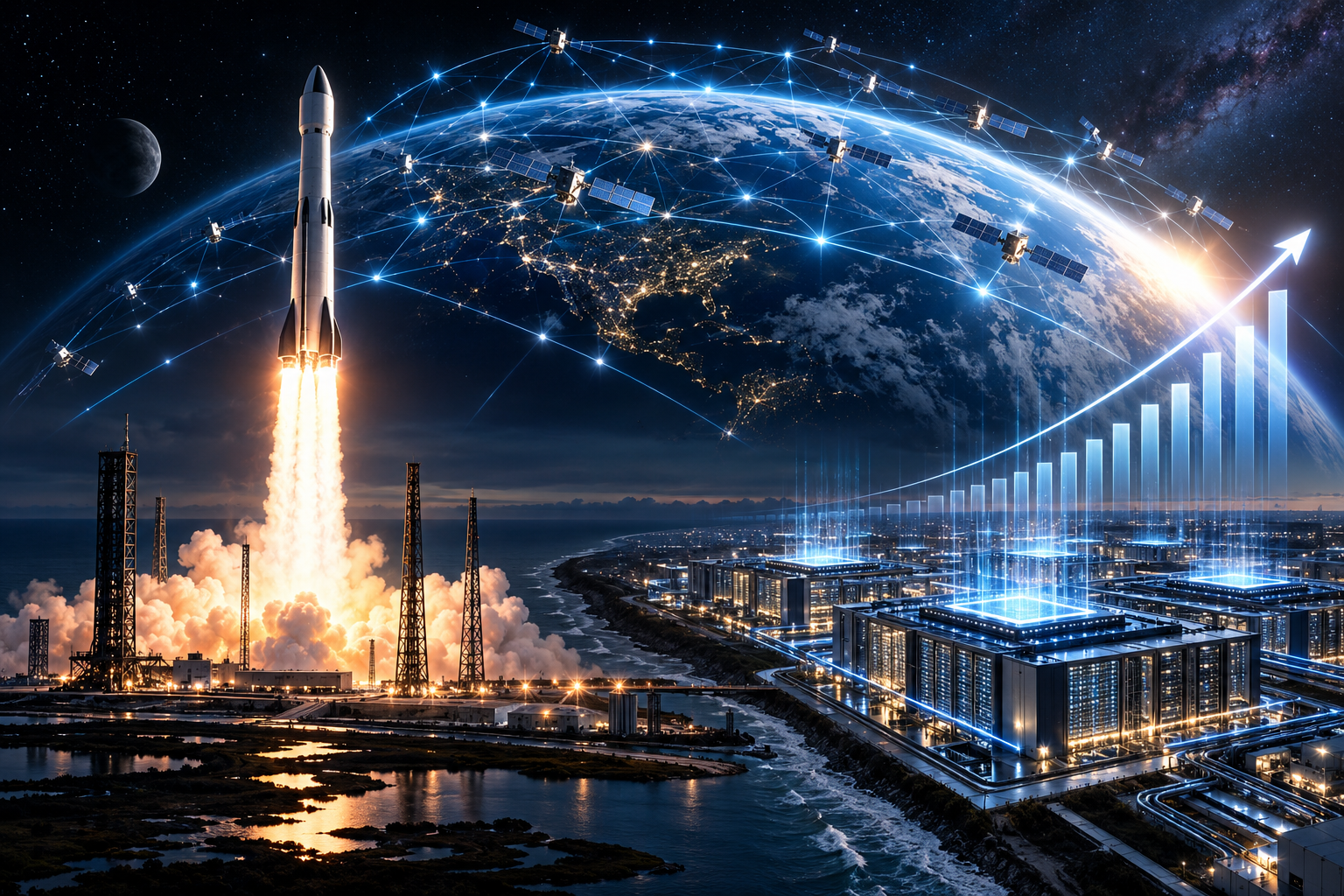
NEW YORK - SpaceX reported a $4.4 billion third-quarter profit on Tuesday as its artificial-intelligence and satellite-connectivity businesses expanded sharply, while chief executive Elon Musk confirmed that independent board committees are examining a possible merger with Tesla.
The newly public company recorded $14.575 billion in revenue for the three months through September, up 161% from $5.576 billion a year earlier, according to its filing with the Securities and Exchange Commission. Net income reversed a $1.1 billion loss in the same quarter of 2025, and operating income reached $2.791 billion.
Artificial intelligence was the largest source of revenue. SpaceX's Super Intelligence segment generated $7.56 billion, up from $813 million a year earlier, and moved to an operating profit of $431 million. The company attributed the increase to cloud-service agreements, its acquisition of the coding company Cursor and growing adoption of its Grok products.
Starlink and other connectivity services remained the strongest source of operating profit. Connectivity revenue rose 69% to $5.248 billion, with operating income of $2.367 billion. SpaceX reported 13.6 million consumer subscribers at the end of September, up from 7.2 million a year earlier, alongside growth in government, aviation, maritime and enterprise customers.
The original space business generated $1.767 billion in revenue but recorded a $7 million operating loss as research spending on Starship continued. SpaceX completed 35 launches during the quarter, including its first revenue-generating Starship mission, which placed 26 next-generation Starlink satellites into orbit.
The growth required extraordinary investment. Total capital expenditure reached $19.593 billion for the quarter, including $16.444 billion for AI infrastructure. That total was nearly three times the $6.88 billion spent a year earlier and more than four times the company's quarterly net income.
On the earnings call, Musk said SpaceX and Tesla had formed special committees of independent directors to explore a combination. He described himself as conflicted and said he could not participate directly in the discussions. Musk also cautioned that a deal was not certain and noted that approval from Tesla shareholders would be a major hurdle.
The companies increasingly overlap in AI chips, computing, robotics, communications and energy systems. But no transaction terms, valuation, timetable or regulatory plan have been announced. A review by independent committees is the beginning of a governance process, not an agreement to merge.
Growth has created power as well as profit
The quarter shows how far SpaceX has moved beyond rocket launches. Starlink produces recurring subscription revenue, government contracts connect the company to national infrastructure, and the AI division now sells more than the space operation. That combination is unusually powerful because it links orbit, communications, computing and software inside one corporate group.
For the United States, this can be a strategic advantage. An American company able to launch satellites, operate a global network and build advanced computing infrastructure strengthens the country's position against state-backed competitors. SpaceX has also forced older aerospace institutions to move faster and lower costs.
But scale creates dependencies. Governments, militaries, airlines, businesses and households increasingly rely on systems controlled by one company and ultimately influenced by one chief executive. A merger with Tesla could add vehicles, batteries, robotics and a major public shareholder base to that structure. Efficiency may improve, but so could concentration of power.
Independent committees are therefore essential, not ceremonial. Musk leads both companies and would sit on both sides of any transaction. Directors must test whether the price, ownership structure and strategic benefits are fair to each group of shareholders. Regulators would also need to examine competition, national-security exposure, data control and the practical difficulty of separating services if the combined company later failed.
The profit figure should also be read beside the spending. SpaceX generated impressive income, but its capital expenditure was far larger. AI infrastructure can produce valuable services, yet the industry is committing vast sums before long-term demand and returns are fully proven. Fast revenue growth does not remove the risk that technology, electricity costs or customer budgets change.
Public ownership brings a useful discipline. Investors can inspect SEC filings, compare segment performance and question related-party transactions. That transparency should deepen if merger talks proceed. The stronger the company becomes, the less acceptable it is to ask the public to rely on personality or vision alone.
SpaceX delivered a remarkable quarter and strengthened America's lead in several critical technologies. The next test is whether it can turn enormous investment into durable cash generation while giving shareholders, regulators and government customers confidence that corporate power is matched by accountable governance.
Comments
Loading comments…