
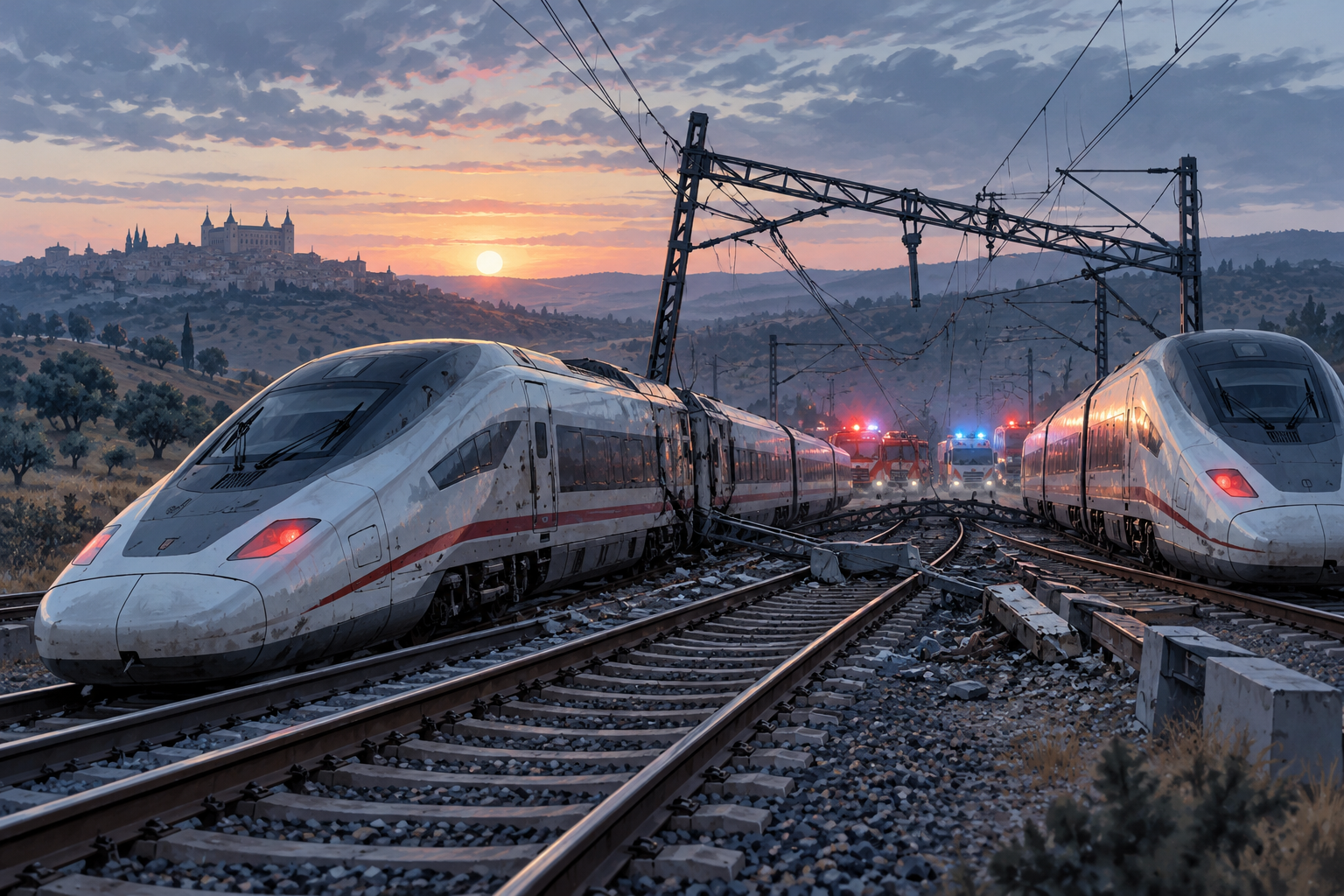
URDA, Spain - Spain began three days of national mourning after two high-speed trains collided near Urda in Toledo province on Wednesday, killing at least 68 people and sending dozens more to hospitals in the country's second fatal high-speed rail disaster this year.
Authorities in Castilla-La Mancha said 58 people were receiving hospital treatment as rescue crews searched damaged carriages for survivors and victims. The toll remained provisional late Wednesday while emergency workers continued moving through the wreckage.
Spain's rail infrastructure operator said both trains were traveling south from Madrid toward Seville. A state-owned Renfe train struck the rear of a private Iryo train that had stopped on the tracks, according to reporting by The Associated Press. Two rear carriages of the Iryo service and the front of the Renfe train derailed.
Renfe said its AVE service had left Madrid's Puerta de Atocha station at 8 a.m. and was scheduled to reach Seville at 10:39 a.m. The company activated its crisis team and victim-assistance plan, while traffic between Madrid, Ciudad Real and Andalusia was suspended.
Prime Minister Pedro Sanchez visited the crash site and declared three days of mourning. He said Spain needed stronger safety measures and called it unacceptable for the country to suffer two major high-speed rail accidents in less than a year.
The cause had not been established. Officials opened an investigation into why the Iryo train was stopped and how another high-speed service was able to reach it. Transport Minister Oscar Puente described the circumstances as difficult to explain, while Sanchez promised that any negligence or technical failure would be identified.
Wednesday's collision came nine months after 46 people were killed in a crash near Adamuz in southern Spain. Both disasters involved trains operated by Renfe and Iryo on routes connecting Madrid with Andalusia.
Before 2026, Spain's dedicated high-speed lines had recorded no fatal accident since the network opened in 1992, according to AP reporting. Decades of investment created Europe's largest high-speed rail system and the world's second largest after China's, turning fast intercity rail into a source of national pride and an alternative to short-haul air travel.
That record makes the events of this year especially alarming. Two disasters do not by themselves prove one common cause, and investigators must resist pressure to announce conclusions before examining signaling data, train controls, dispatch decisions and maintenance records. But the recurrence makes a narrow explanation of a single bad moment harder for the public to accept.
Trust now depends on an investigation the public can examine
Modern rail safety is built in layers. Signals, automatic controls, dispatch procedures, communications and human oversight are supposed to prevent one failure from becoming a mass-casualty collision. When two high-speed trains occupy the same path, the central question is not merely which person or device failed first. It is why the remaining safeguards did not stop the sequence.
Spain now faces a credibility test as well as a technical investigation. The government must publish a clear timeline, preserve electronic records and explain which safety systems were active. It should separate verified findings from political argument and give investigators the independence needed to challenge Renfe, Iryo, the infrastructure operator and the ministry itself.
The timing adds pressure. Spain is approaching a national election, creating incentives for the government to minimize institutional responsibility and for opponents to declare a systemic collapse before the evidence is complete. Neither response serves the victims. Democratic accountability requires disclosure, not slogans.
False claims also spread quickly after disasters. Spanish fact-checkers reported that there was no evidence supporting online speculation about sabotage. Until investigators produce evidence, public officials and media organizations should not fill uncertainty with dramatic theories that can distract from real safety failures.
The railway's scale makes honest scrutiny more important. Millions of passengers depend on the network precisely because high-speed rail is expected to be exceptionally controlled and predictable. Confidence cannot be restored by citing the system's past reputation alone. It must be earned again through evidence, corrective action and visible enforcement.
The immediate priority remains the victims, the injured and families waiting for confirmed information. The longer responsibility remains unclear, however, the greater the obligation on Spain's institutions to show that national pride will not be used as a shield against hard questions.
A safe transport system does not promise that no machine will ever fail. It promises that failures will be caught before people die, and that when the system fails, the truth will be pursued without political protection.
Comments
Loading comments…