
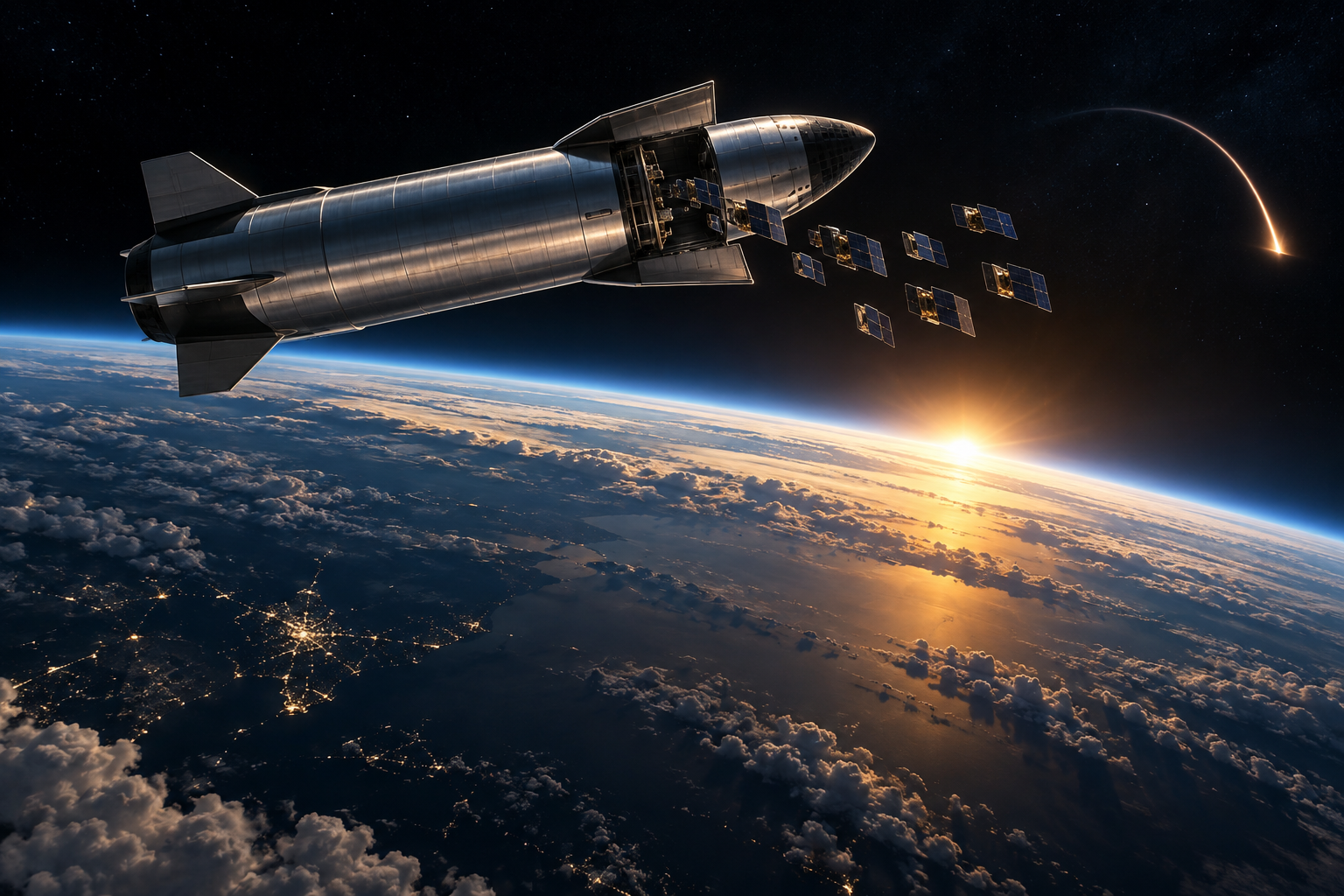
STARBASE, Texas - SpaceX's Starship reached Earth orbit for the first time Monday and deployed 26 next-generation Starlink satellites, crossing a major threshold for the largest and most powerful rocket ever built.
The 407-foot spacecraft lifted off from SpaceX's Starbase facility in South Texas on its 14th full-scale test flight. Earlier missions had deliberately followed suborbital paths, briefly entering space before returning to Earth. This flight completed an orbital insertion burn and accelerated to about 17,500 mph at an altitude near 170 miles.
The mission nearly stopped during the climb when one of Starship's engines shut down prematurely. Flight controllers spent several minutes assessing whether the vehicle retained enough redundancy to enter orbit and later perform a controlled deorbit. They ultimately allowed the flight to continue, and the spacecraft released all 26 Starlink V3 satellites.
SpaceX had planned a flight lasting nearly 10 hours and roughly six trips around Earth, followed by a Pacific splashdown west of Chile. Controllers instead brought Starship down after about three hours because of the engine issue. The spacecraft reentered over the Pacific and splashed down north of Hawaii before tipping over and erupting in flames. SpaceX said it shortened the flight out of caution.
The Super Heavy booster was not scheduled to return to its launch tower. It attempted a landing burn and made a hard splashdown in the Gulf after eight of 13 planned engines reignited, according to SpaceX's mission information. The company has previously caught Super Heavy with mechanical arms but did not attempt that maneuver on Monday.
The new Starlink satellites were the first operational payload carried to orbit by Starship. Their deployment matters because it moved the vehicle beyond an empty test article and demonstrated the basic sequence required for commercial missions: reach a stable orbit, open the payload bay, release useful hardware and return under control.
NASA Administrator Jared Isaacman congratulated SpaceX on the flight. NASA is relying on a modified Starship to land astronauts on the moon under the Artemis program, making the rocket's progress a matter of national space policy as well as private business.
A milestone, not the end of the test program
Reaching orbit is a genuine engineering victory. It proves that the integrated Starship system can survive launch, complete orbital insertion and deliver payload at the speed required to remain around Earth. That is substantially different from touching space on a suborbital trajectory.
But the shortened flight and engine failure also show why milestone language must not become mission-accomplished language. SpaceX still needs to demonstrate dependable engines, repeatable heat-shield performance, controlled landings and rapid reuse. The central promise of Starship is not simply that it can reach orbit. Other rockets already do that. Its promise is that both stages can return, be serviced quickly and fly again at a cost that changes what the United States can place in space.
That distinction matters for Artemis. A lunar lander cannot be treated like a test vehicle that is successful because engineers learn from a dramatic splashdown. Human missions require margins, redundancy and predictable operations across multiple launches and in-space refueling. Monday's decision to end early was therefore encouraging in one respect: controllers prioritized a safe deorbit over completing every planned objective.
America's space advantage has long come from combining public purpose with private competition. NASA supplies demanding missions, technical oversight and taxpayer support; companies bring speed, capital and different engineering approaches. That arrangement can outperform centralized state programs, but only if government remains an exacting customer rather than a spectator impressed by spectacle.
Congress and NASA should protect alternative capabilities while Starship develops. Depending too heavily on one vehicle or one company creates schedule and national-security risk, even when that company is the industry leader. Competition keeps prices honest and gives the country options when hardware fails.
The orbital flight nevertheless expands what is technically credible. A reusable heavy-lift system could deploy large satellites, support lunar infrastructure and give the United States unmatched logistics in space. Those are commercial opportunities, but they are also strategic assets in a period when rival powers are investing heavily in launch capacity.
Flight 14 did not prove full reusability, and it did not complete its planned duration. It did prove that Starship can enter orbit and deliver a real payload. The next measure of progress will be less dramatic but more important: whether SpaceX can turn a historic first into a safe, repeatable American capability.
Comments
Loading comments…