
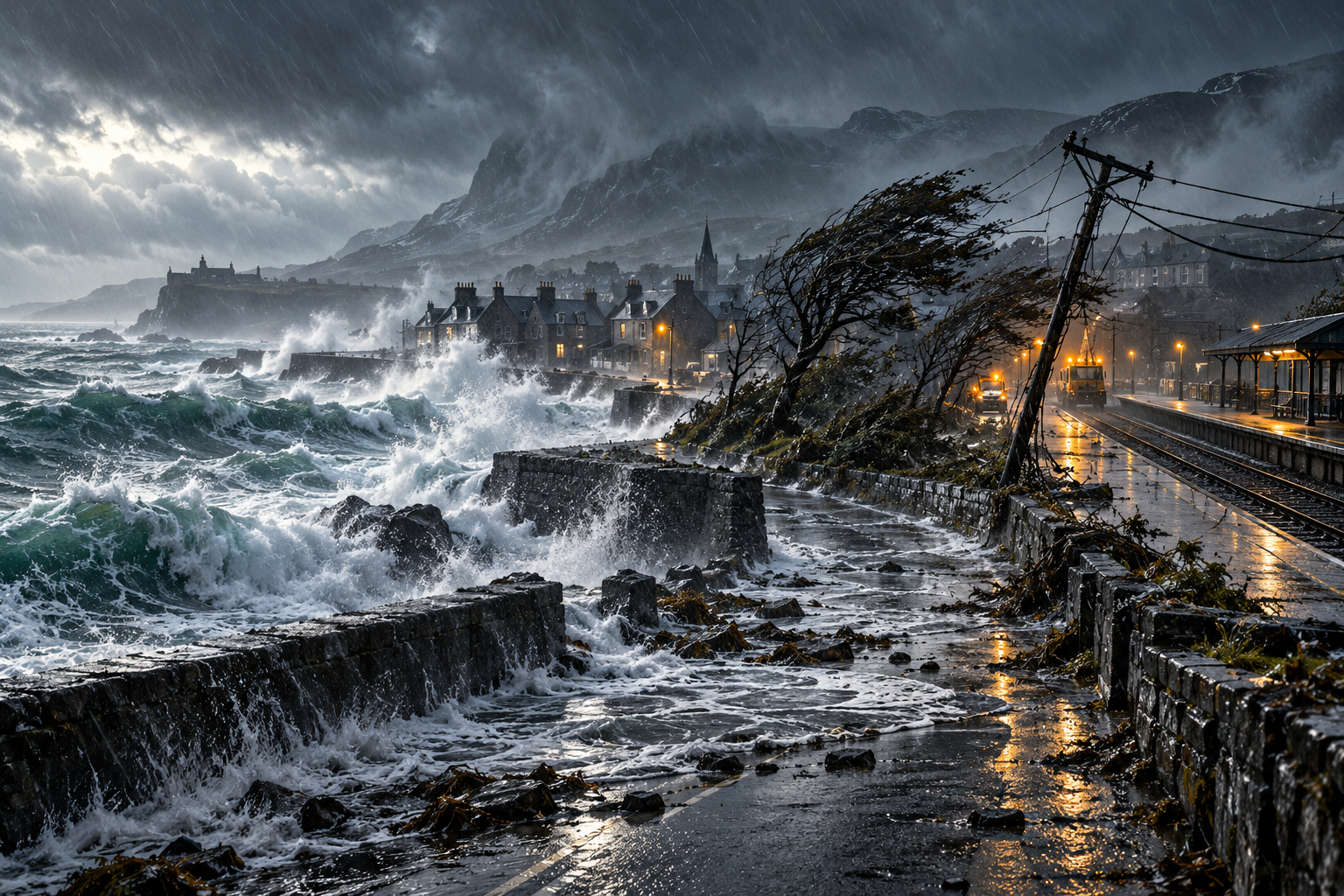
LONDON - Storm Boelo battered Scotland, Northern Ireland and northern England on Sunday, cutting electricity to tens of thousands of properties and disrupting roads, railways, ferries and airports only two days after another powerful storm struck southern Britain.
The Met Office said gusts reached 84 mph in Argyll and Bute, Scotland. Amber wind warnings covered Scotland and parts of northern England, while flood warnings spread across several regions and authorities urged people to avoid exposure to flying debris and dangerous coastal waves.
The Associated Press reported that about 82,000 homes were affected by outages as Boelo moved across the country. Separate network updates showed the scale continuing to change throughout the day as engineers restored some connections and new damage was identified.
SSEN, which operates the electricity network in northern Scotland, said that by 7 p.m. it had restored service to more than 54,000 customers but 38,000 homes in its area remained without power. The company warned that fallen trees, flooding and unsafe wind speeds were blocking access to damaged equipment. It expected most remaining customers to be reconnected Monday, though some repairs could continue into Tuesday.
In northwest England, SP Electricity North West reported earlier Sunday that more than 57,000 homes had lost supply. Ireland also suffered widespread disruption, with about 18,000 homes, farms and businesses reported without power during the storm.
Floodwater closed roads and entered communities along Scotland's west coast. Rail and ferry operators canceled or suspended services, while airports reported delays. The storm continued east into continental Europe, where strong winds caused cancellations at Amsterdam's Schiphol Airport.
Three crew members aboard the freight ship UHL Freedom were injured after the vessel temporarily developed engine trouble north of the Dutch island of Schiermonnikoog. Two were airlifted to a hospital, while the ship continued under limited power with an emergency tug standing by.
Boelo arrived directly behind Storm Austen, which brought damaging winds to southern England and Wales on Friday. Britain's National Grid said power had been restored to more than 131,000 properties affected by Austen by Saturday evening, leaving repair teams with little recovery time before the second system arrived.
Forecasters warned that more high wind and heavy rain could reach northern Scotland on Tuesday. SSEN said it had activated resilience plans and warned more than 220,000 vulnerable customers before Boelo arrived. Hundreds of additional staff, tree-clearing crews and welfare teams were assigned to restoration work.
Back-to-back storms expose the cost of narrow safety margins
No single windstorm proves a long-term climate trend, and responsible reporting should resist using one weekend as evidence for every wider claim. What Boelo clearly demonstrates is more immediate: essential systems become fragile when damaging events arrive faster than communities and crews can recover.
An electricity network can be designed to survive individual faults. Its margin shrinks when saturated soil loosens tree roots, floodwater blocks access roads and crews finish one emergency only to meet the next. The danger is cumulative. The second storm does not begin from zero; it strikes infrastructure and people already tired by the first.
Britain's warning systems and restoration plans prevented a difficult event from becoming a larger catastrophe. Utilities positioned staff, contacted vulnerable customers and rerouted power remotely where possible. That preparation deserves recognition. It also cannot replace physical investment in stronger poles, better vegetation management, flood-resistant substations and local backup power for clinics, care homes and communications.
The outage figures reveal how quickly a modern society can lose ordinary security. Heating, refrigeration, phone charging and medical equipment all depend on a grid that is mostly invisible until it fails. Compensation for food and emergency accommodation helps households after the damage, but resilience means reducing the number forced to make those claims.
There is a political temptation to treat severe weather as an unavoidable act of nature and restoration as the only meaningful measure of success. That standard is too low. Governments and regulated utilities decide how much spare capacity exists, how frequently trees are cleared, which communities receive flood defenses and whether rural areas wait longer for repairs.
Boelo also crossed national boundaries without regard for jurisdiction, disrupting Ireland, Britain and northern Europe in one moving system. Forecast data, aviation warnings, maritime rescue and grid planning work best when countries cooperate. Weather resilience is practical public safety, not an ideological luxury.
The storm will pass, and most lights will return quickly. The harder question is whether lessons survive after the headlines fade. Back-to-back gales have shown where the margin is thin. Repairing the wires is urgent; strengthening the system before the next sequence is the real test.
Comments
Loading comments…