
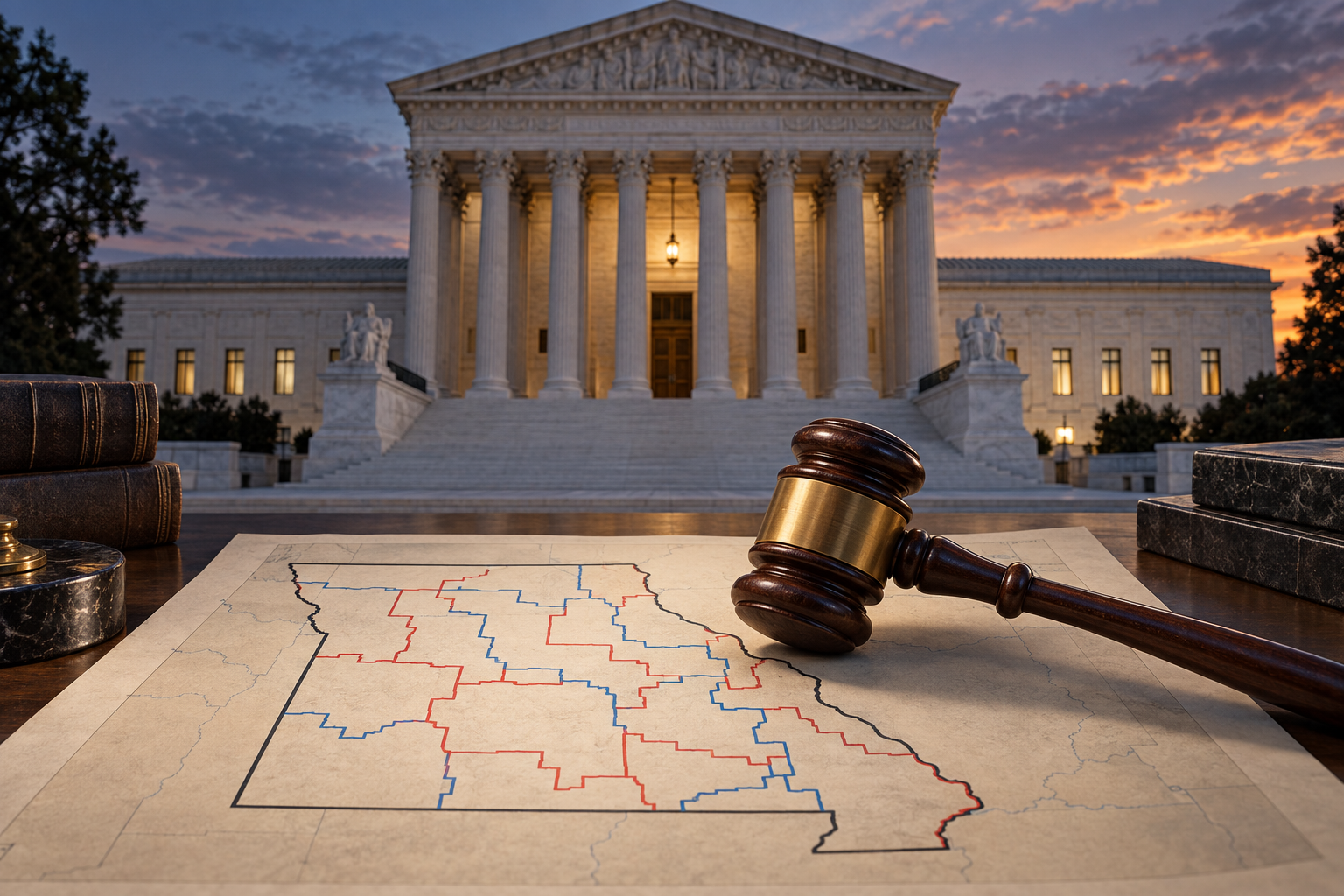
WASHINGTON - The U.S. Supreme Court on Friday blocked Missouri from using a newly drawn congressional map in the November midterm election, ending the latest round of a legal fight that had shifted between state and federal courts while voting was already underway.
The unsigned ruling leaves Missouri's 2022 congressional districts in effect for the general election. No justice publicly dissented. The court halted decisions by a federal district judge and the 8th U.S. Circuit Court of Appeals that would have required the state to use a Republican-backed map enacted in 2025.
The justices said changing maps during an active election would create electoral chaos. Absentee voting began this week under the 2022 boundaries, thousands of ballots had already been mailed, and some voters had already cast ballots. The court directed the lower federal courts not to prohibit use of the 2022 map or require use of the 2025 version.
Republicans currently hold six of Missouri's eight U.S. House seats. The newer map, promoted by President Donald Trump and Republican Gov. Mike Kehoe, redrew Democratic Rep. Emanuel Cleaver's Kansas City-based district and was designed to improve the party's chance of winning a seventh seat. Cleaver and Republican state Sen. Rick Brattin remain the general-election candidates even though they competed in August primaries held under the newer boundaries.
The dispute intensified after opponents gathered signatures for a statewide referendum on the map. The Missouri Supreme Court ruled on September 3 that the petition was valid and that the new boundaries could not take effect unless voters approved them in November. The U.S. Supreme Court declined to disturb that result twice, but a federal appeals panel later said using different maps for the primary and general election would violate the Constitution. Friday's order stopped that ruling.
Missouri Secretary of State Denny Hoskins called the decision disappointing but welcomed final clarity. Cleaver said it strengthened his reelection prospects and affirmed voters' referendum rights. Opponents of the new map said they would continue campaigning for its rejection at the ballot box.
The immediate result favors Democrats, but the deeper principle should not depend on which party benefits. Election rules require a point at which they become stable. When ballots are printed, mailed and returned, moving district lines again risks confusing voters, misdirecting campaign resources and weakening confidence in the count. The Supreme Court's conservative majority did not need to endorse either party's map to recognize that practical reality.
Republicans have a legitimate political interest in drawing maps permitted by state and federal law, just as Democrats do in states they control. But power is not the same as unlimited authority. Missouri's constitution gives citizens a referendum process, and the state Supreme Court unanimously concluded that the petition prevented the 2025 map from taking effect before the public voted. Attempting to route around that judgment through conflicting federal orders placed partisan advantage ahead of orderly administration.
The episode also exposes the danger of aggressive mid-decade redistricting. Maps are normally redrawn after the census so districts reflect population changes. Reopening them between censuses solely because a party sees an opportunity turns representation into a permanent contest of tactical boundary changes. If every state government answers another state's gerrymander with its own, voters become pieces moved by politicians rather than citizens choosing their representatives.
That does not make the 2022 map perfect or remove politics from redistricting. It does mean that changes should occur through a lawful, transparent process with enough time for candidates, administrators and voters to understand them. The referendum gives Missourians a direct way to decide whether the 2025 plan should govern future elections.
For conservatives, respect for federalism should include respect for state constitutional processes even when their result is inconvenient. For progressives, Friday's result should not become an excuse to defend partisan maps elsewhere. A durable democratic standard must survive a reversal of political fortunes.
The court's intervention restored a workable rule for this election: use the map under which voting has begun, then let Missouri voters address the disputed plan through the process available to them. In a close contest for control of Congress, that restraint matters. The legitimacy of the result will depend not only on which party wins, but on whether citizens can trust that the rules stopped changing before their ballots were counted.
Comments
Loading comments…