
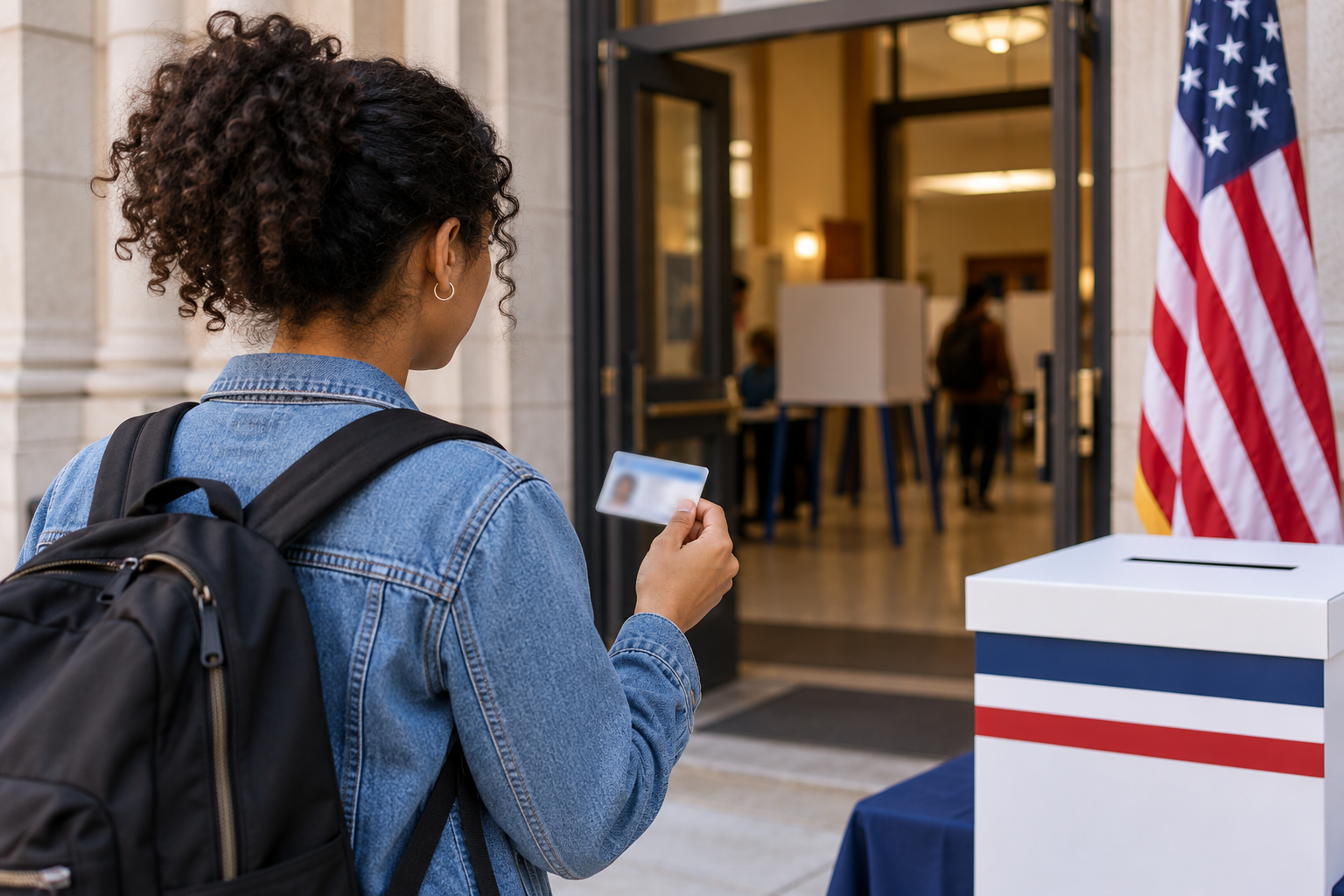
WASHINGTON - The Supreme Court on Thursday cleared the way for New Hampshire to fully enforce restrictions on using student identification cards to obtain a ballot in the November midterm elections.
The justices granted an emergency request backed by state officials and the Republican National Committee, putting on hold part of a lower-court order that had preserved a limited role for student IDs. Justice Ketanji Brown Jackson was the only member of the court to publicly dissent.
The unsigned order relied on the principle that federal judges should be cautious about changing election procedures close to voting day. It did not finally decide whether New Hampshire's policy is lawful. The underlying lawsuit will continue after the election.
New Hampshire's HB 323 removed student cards from the list of photo identifications expressly accepted when a voter requests a ballot. Secretary of State David Scanlan then issued guidance saying student IDs could not be used when registering, seeking an absentee ballot or checking in at the polls.
Voting-rights groups challenged both the law and the guidance. A federal judge allowed the statute itself to remain in force but blocked the secretary's broader instruction, reasoning that state law still gave election officials a safety valve to consider other evidence that reasonably established a person's identity. The Supreme Court's action stayed that portion of the ruling for the midterms.
The decision arrived less than two weeks before New Hampshire voters choose candidates in a closely watched U.S. Senate race. State Rep. Donald McFarlane, the bill's sponsor, said college cards do not have the same issuance controls as government identification and called the ruling a victory for consistent standards and public confidence.
Opponents argue that the rule creates a needless obstacle for eligible students, particularly those who do not drive or have not obtained a state non-driver card. Local election officials told New Hampshire Public Radio that relatively few students appear with no identification other than a school card, suggesting the statewide numerical effect may be limited. For an individual eligible voter caught by the rule, however, the consequence is not small.
Students and first-time voters should consult the New Hampshire secretary of state's current instructions before Election Day rather than relying on older campus guides or social-media summaries. The legal position changed during October, and the Supreme Court order controls the coming election while the case proceeds.
Clear rules protect both access and trust
There is a legitimate democratic interest on both sides of this dispute. A state may demand dependable proof that the person receiving a ballot is the registered voter. Uniform, government-issued identification is easier for poll workers to recognize, harder to manipulate and less likely to produce inconsistent decisions across towns.
But election integrity is not served by confusing lawful voters or by treating young citizens as presumptively suspect. A student card is not proof of citizenship, yet neither is an ordinary driver's license by itself. The practical question is whether the complete registration and identification system verifies eligibility without creating arbitrary traps.
That is why timing matters. Rules announced, blocked and restored in the final weeks of a campaign invite mistakes even when every institution is acting in good faith. The Supreme Court's close-to-election doctrine is meant to reduce that disruption. It is a procedural judgment, not proof that the state has won the constitutional argument.
New Hampshire now carries a responsibility to make the approved alternatives easy to understand and reasonably available. If the state insists that a school card is not reliable enough, it should ensure that eligible voters can obtain accepted identification promptly and that local officials receive one clear set of instructions.
The plaintiffs, meanwhile, deserve a full hearing after the ballots are counted. Courts should examine whether the secretary's guidance actually follows the statute and whether the burden falls unfairly on a specific class of voters. Those questions should be resolved with evidence rather than campaign-season slogans.
America's election system depends on two promises at once: only eligible voters cast ballots, and every eligible citizen has a fair chance to cast one. Treating either promise as optional weakens the other. The strongest outcome is not a partisan victory but a stable rule that voters can follow, administrators can enforce and courts can defend well before the next election begins.
Comments
Loading comments…