
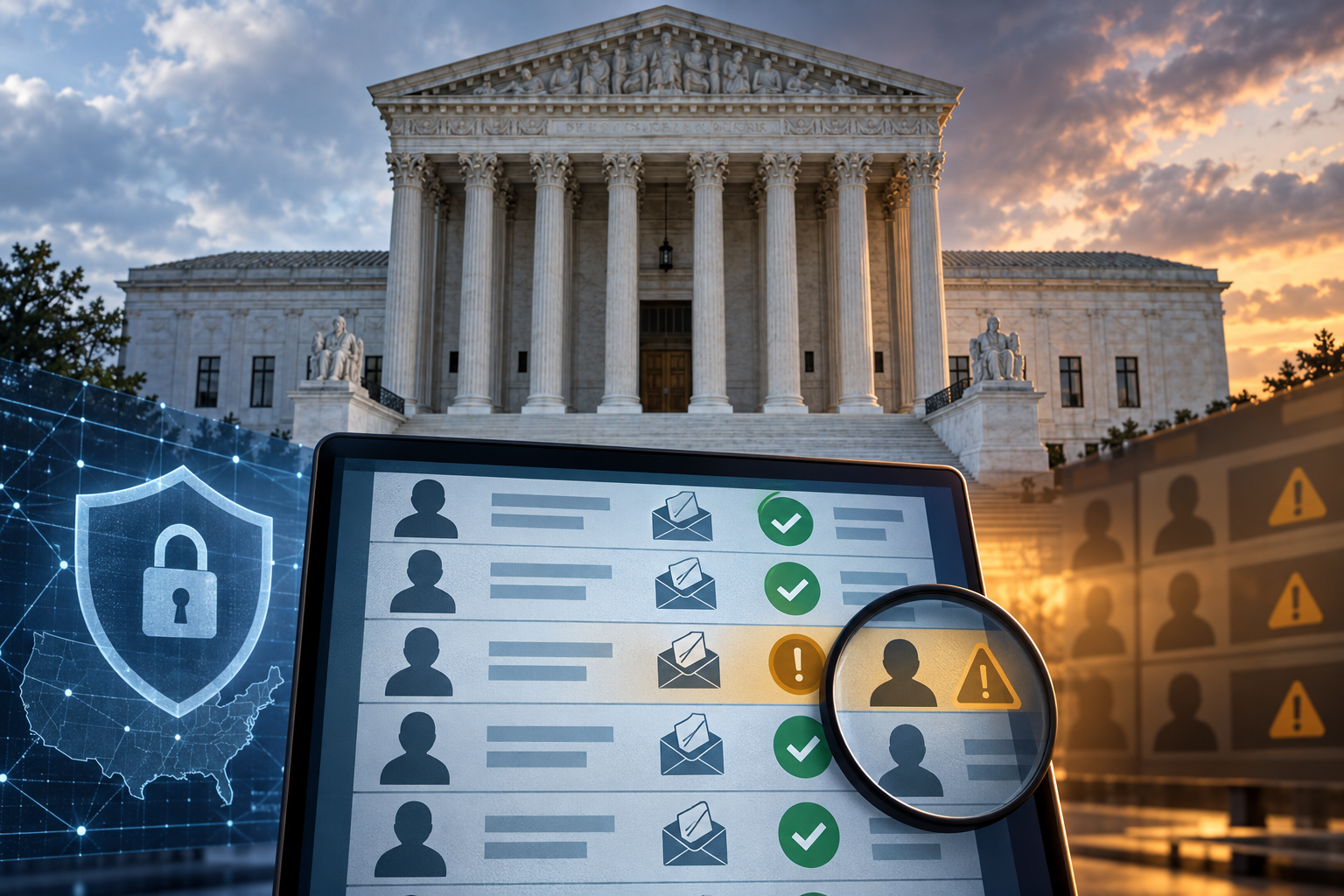
WASHINGTON - The U.S. Supreme Court has temporarily allowed states to use an expanded federal citizenship database to check voter eligibility, lifting lower-court restrictions before the November midterm elections.
The 6-3 emergency order issued Friday concerns the Department of Homeland Security's Systematic Alien Verification for Entitlements program, known as SAVE. Participation by states is voluntary. The order puts on hold a June ruling by U.S. District Judge Sparkle Sooknanan, who found that the Trump administration's revised use of the system was unlawful and raised privacy and wrongful-removal risks.
The court's majority said a 1996 law authorizes Homeland Security to obtain citizenship and immigration information from other federal agencies and obliges the federal government to answer states seeking to verify citizenship. The unsigned order allows the administration to use what it considers the program best suited to that work while the case continues.
Justices Ketanji Brown Jackson, Elena Kagan and Sonia Sotomayor dissented. Jackson argued that the program had long been understood to fall under federal privacy protections and warned that lawful voters could be burdened or removed because of inaccurate matches. The challengers, including voting-rights organizations, said they would continue their case in federal district court.
SAVE was originally created to help government agencies determine eligibility for public benefits. The Trump administration expanded its search capabilities last year so election officials could submit voter information for citizenship checks. At least 67 million voter registrations have been scanned through the program, the Associated Press reported.
The database is not error-free. Officials in Travis County, Texas, reviewed 97 voters flagged as apparent noncitizens and concluded that at least 10 percent, and possibly as many as 21 percent, were U.S. citizens, according to the AP. Homeland Security has defended its work as careful and professional. Noncitizen voting in federal elections is already illegal and research has found it to be exceptionally rare.
The immediate effect on the midterms may be limited because federal law generally prevents systematic voter removals within 90 days of an election. States can still use the database as one part of list maintenance, but a computer result does not automatically establish that a person is ineligible.
Election integrity requires accuracy and due process
American elections should be restricted to eligible citizens. That is a legitimate rule, and states have a legitimate responsibility to maintain accurate voter rolls. Pretending that verification itself is improper weakens confidence and leaves officials without tools to resolve genuine questions.
But a patriotic commitment to election integrity must protect eligible Americans with equal force. Naturalized citizens, military families, people who changed names and voters whose government records are incomplete should not lose a constitutional right because separate databases fail to agree. A system that removes lawful voters to catch a tiny number of unlawful registrations would replace one integrity problem with a more serious one.
The responsible path is not to abandon SAVE or to treat it as an unquestionable national voter list. It is to use any match as a lead requiring confirmation. States should provide written notice, disclose the basis for a flag, allow enough time to correct the record and prohibit cancellation based solely on an inconclusive database response. Every removal should leave an auditable trail available to courts and election observers.
Transparency is especially important because the administration has framed noncitizen voting as a widespread threat while available research says it is rare. Americans do not need exaggerated claims from either side. They need public numbers showing how many records were checked, how many people were initially flagged, how many were confirmed ineligible and how many flags proved wrong.
The Supreme Court's order is temporary, not a final judgment on the entire program. The underlying case will continue, and the lower courts will still examine statutory and privacy questions. That legal process should not become an excuse for states to rush broad removals close to an election.
Democracy is strengthened when citizens know that only eligible ballots count. It is also strengthened when every eligible citizen can vote without being trapped by a government data error. Those principles are not rivals. With verification, notice, human review and public auditing, states can pursue both. Without those safeguards, a tool presented as protecting confidence may instead damage it.
Comments
Loading comments…