
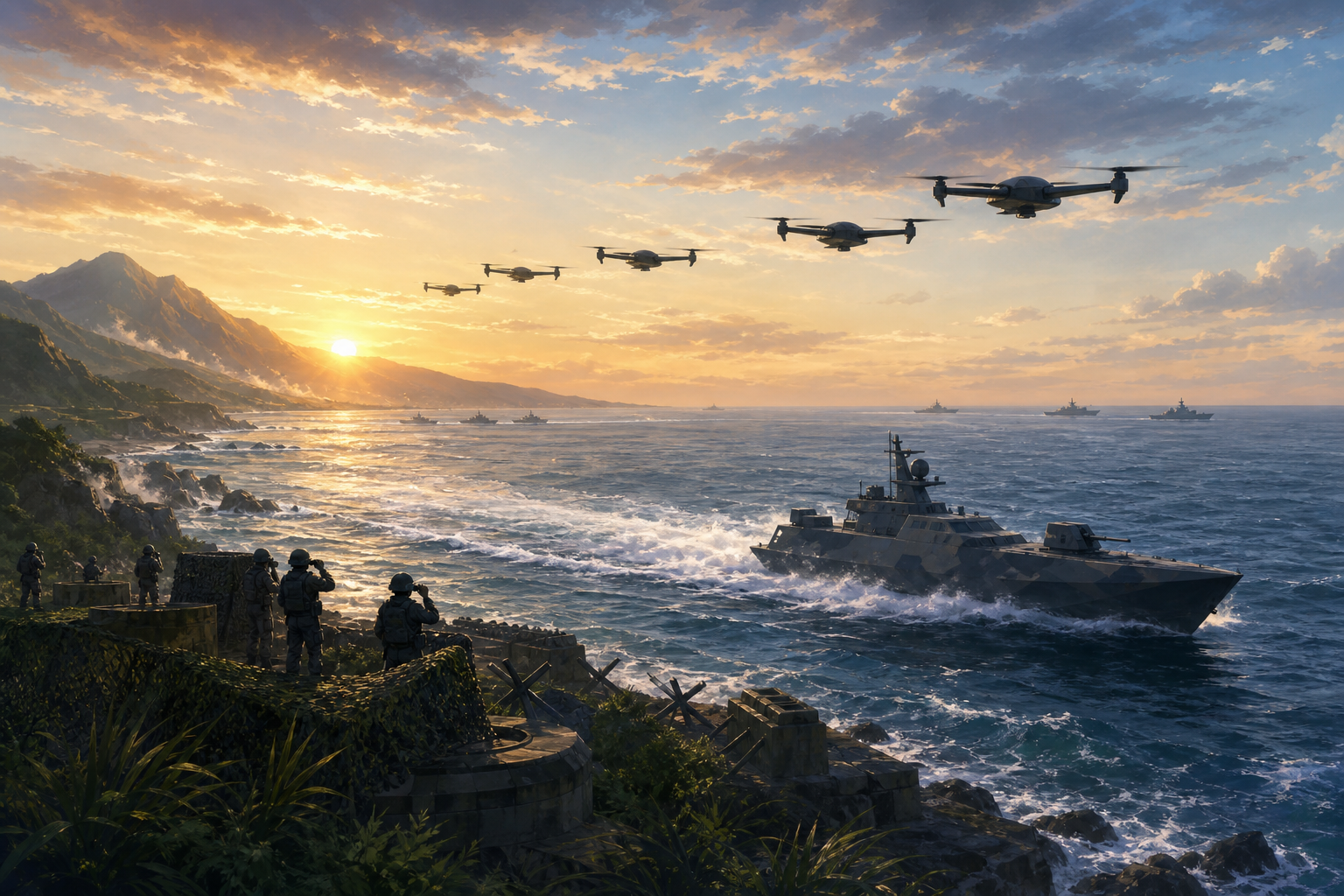
KAOHSIUNG, Taiwan - Taiwan tested fast missile boats, low-flying attack drones and Coast Guard vessels in a coastal-defense exercise on Saturday, August 8, as the island's armed forces rehearsed how they would respond to a potential assault from China.
President Lai Ching-te observed the drill at a naval base in the southern city of Kaohsiung during the annual Han Kuang exercises. He boarded a fast attack missile boat, addressed sailors taking part and watched small drones fly in formation over the beach and sea, according to Reuters journalists at the exercise.
Lai said the exercise was intended to test command coordination, combat responsiveness and homeland-defense capabilities using real troops, terrain and equipment. He said the government would continue strengthening the military and Coast Guard in response to external threats, without naming China in that part of his remarks.
The ten-day field exercise began Wednesday and is built around Taiwan's preparations to resist an invasion. Taiwan's Defense Ministry said its 2026 Han Kuang planning moves from gray-zone pressure through a transition to war and a simulated armed attack by the People's Liberation Army. The exercise includes force preservation, counter-landing operations, coastal strikes, defense in depth and sustained operations.
Saturday's demonstration highlighted the overlap between naval and civilian maritime forces. An Anping-class Coast Guard catamaran participated alongside naval assets. The class is based on the navy's agile Tuo Chiang design and can support military operations in wartime. Lai had watched missile launchers being fitted to another Anping-class ship two days earlier.
China's Communist government claims democratic Taiwan as its territory and has not renounced the use of force. Taiwan rejects Beijing's sovereignty claim and says the island's future can be decided only by its people. Beijing calls Lai a separatist and has refused his repeated offers of dialogue, while Chinese military aircraft and ships operate around Taiwan with growing frequency.
The exercise does not mean an invasion is imminent. Military drills are planned events, and governments use them both to test forces and send political signals. The important question is whether the scenarios expose real weaknesses and produce changes, rather than simply generating impressive images for the public.
Taiwan's geography makes coastal denial central to its survival. A larger attacker would need to move troops and supplies across the strait, establish a beachhead and keep vulnerable transport routes open. Fast missile craft, mobile launchers, drones, sea mines and dispersed command systems are designed to make that operation slower, costlier and less predictable.
This is where the interests of Taiwan and the United States align. Washington does not need Taiwan to mirror the People's Liberation Army platform for platform. It needs the island to field resilient systems that can survive an opening strike, continue communicating and deny a quick victory. American arms deliveries, training and intelligence cooperation matter most when they reinforce that practical strategy.
The harder reality is that deterrence depends on what an authoritarian leadership believes it can get away with. Beijing's pressure is not limited to preparations for open war. It includes daily air and maritime activity, cyber operations, political isolation and economic coercion intended to exhaust Taiwan and make resistance appear futile. A free society can be weakened gradually if its people are persuaded that surrender is safer than preparation.
Preparedness also has to remain democratic. Defense budgets require legislative scrutiny, procurement failures should be exposed, and military leaders must answer for whether equipment works. Transparency can look slower than centralized command, but it is a source of strength when it produces public consent and corrects mistakes before a crisis.
Saturday's coastal drill was therefore more than a display of boats and drones. It tested whether separate services can operate together in the narrow period when warning becomes conflict. Every successful link - from detection to command, targeting, movement and resupply - raises the price of aggression. Every failure gives Taiwan a problem it still has time to fix.
Peace in the Taiwan Strait will not be preserved by pretending the threat is imaginary. It is more likely to endure when Beijing sees that Taiwan can resist, the United States and its allies will not be divided, and an attempted conquest would fail to deliver the quick political victory on which coercion depends.
Comments
Loading comments…