
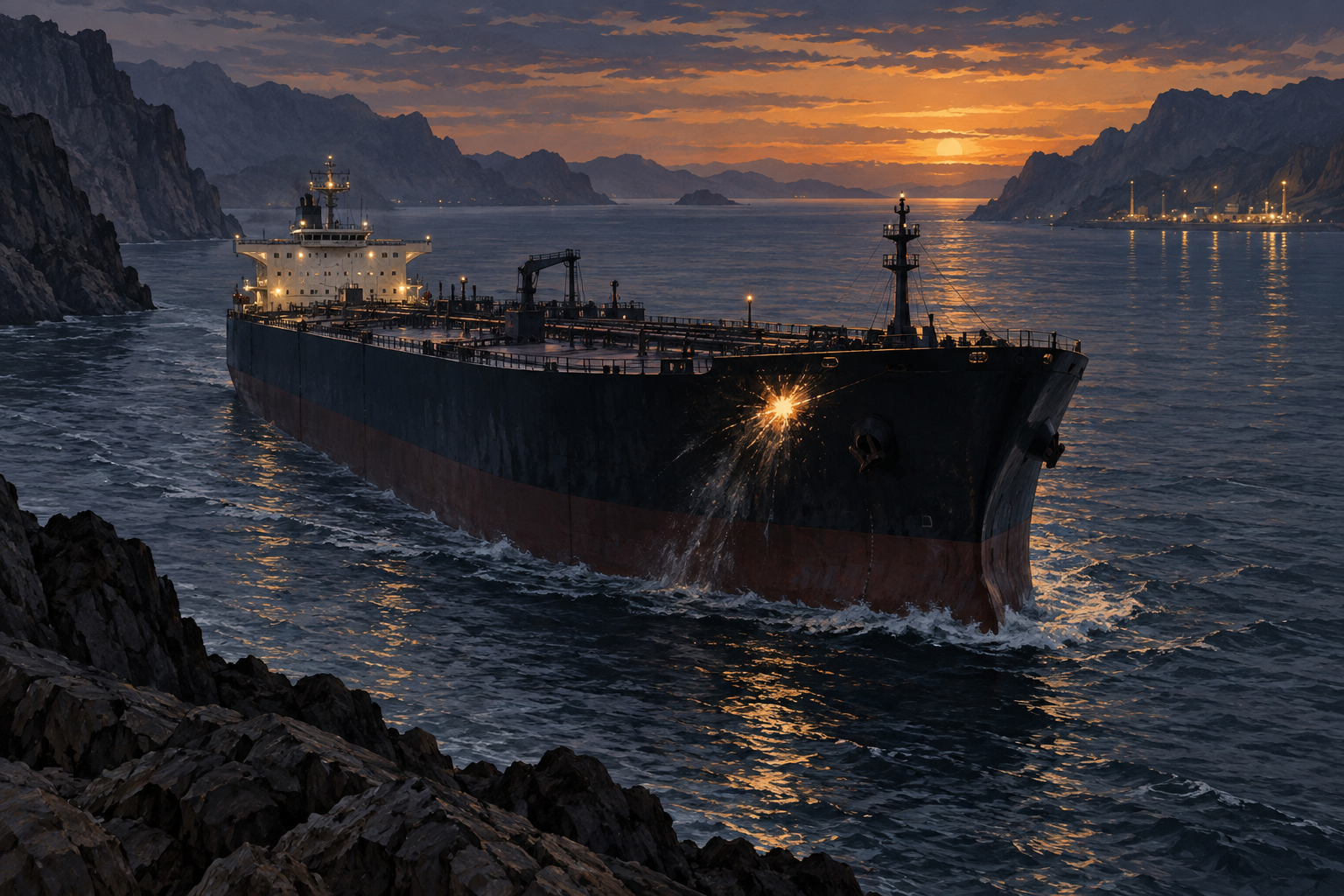
DUBAI - A tanker entering the Strait of Hormuz was struck by an unidentified projectile on Monday, leaving two crew members with minor injuries, according to the United Kingdom Maritime Trade Operations center. The vessel was reported to be continuing toward its next port under its own power.
UKMTO said it received the report from military authorities. It did not identify who fired the projectile, the weapon used, the vessel's name or its cargo in the public details cited by the Associated Press and Reuters. No environmental damage had been reported at the time of the advisory. Those omissions matter: the strike is confirmed by a maritime security alert, but responsibility for it is not.
The incident occurred as some tankers resumed voyages through the narrow waterway between Iran and Oman, although traffic remained well below normal levels. Before the war, roughly 20 million barrels of oil a day passed through Hormuz, about one-fifth of the world's supply, according to figures cited by the Associated Press.
The waterway has become a central pressure point since the United States and Israel launched strikes against Iran in February. Tehran has asserted control over much of the strait, while shipping companies, insurers and governments have faced repeated decisions over whether and how to move cargo through dangerous waters.
Monday's incident came amid fresh warnings from Iran's Revolutionary Guard. A spokesperson said Iran would broaden its tactics and targets if the United States escalated the conflict. The warning is significant context, but it is not proof that Iran or any other force launched the projectile that hit this tanker. An honest account must keep the two facts separate.
Reuters reported that both injuries were minor. The ship's ability to continue its voyage suggests that the immediate damage was limited, but a minor strike in Hormuz can have effects far beyond one vessel. Crews may refuse assignments, insurers may raise premiums, and shipowners may delay sailings until they can judge whether the route remains safe.
Those costs move quickly through the global economy. Oil prices, fuel bills, freight rates and production schedules all reflect the risk that a key supply artery could be interrupted. Monday's U.S. stock rally followed a decline in oil prices, showing how sensitive financial markets remain to even a modest change in expectations about Gulf shipping.
The crew should not be treated as an abstraction in that calculation. Merchant mariners are civilian workers operating the infrastructure of trade. When they are injured by a projectile, governments owe them more than a market commentary. They need prompt medical care, a credible investigation and clear warnings for other ships using the route.
There is also a strategic temptation to fill gaps in the evidence with a familiar culprit. Iran's threats and its control over nearby waters make its conduct a legitimate subject of scrutiny. They do not establish attribution for this particular event. Claiming certainty before investigators can examine the vessel, trajectory and debris would weaken the case for any later diplomatic or military response.
The United States and its partners should instead concentrate on verifiable maritime awareness, rapid public reporting and coordination with commercial operators. Shared radar, ship tracking, forensic analysis and clear transit advisories can narrow the space for deniable attacks. They also reduce the risk that one ambiguous impact triggers an escalatory decision based on rumor.
Keeping Hormuz open is a public good, but its protection cannot rely indefinitely on individual ship crews taking all the risk while states argue over who is responsible. Governments that depend on the route should share intelligence, define escort and response rules, and pursue diplomacy that restores predictable passage without rewarding coercion.
The tanker is still moving, and the crew's injuries were reported as minor. That is the immediate relief. The wider warning is harsher: a single unexplained strike in a narrow sea lane can force the world's largest economies to price in the possibility of a much larger disruption. Until the attacker is identified and navigation becomes reliably safe, that uncertainty remains part of every voyage.
Comments
Loading comments…