
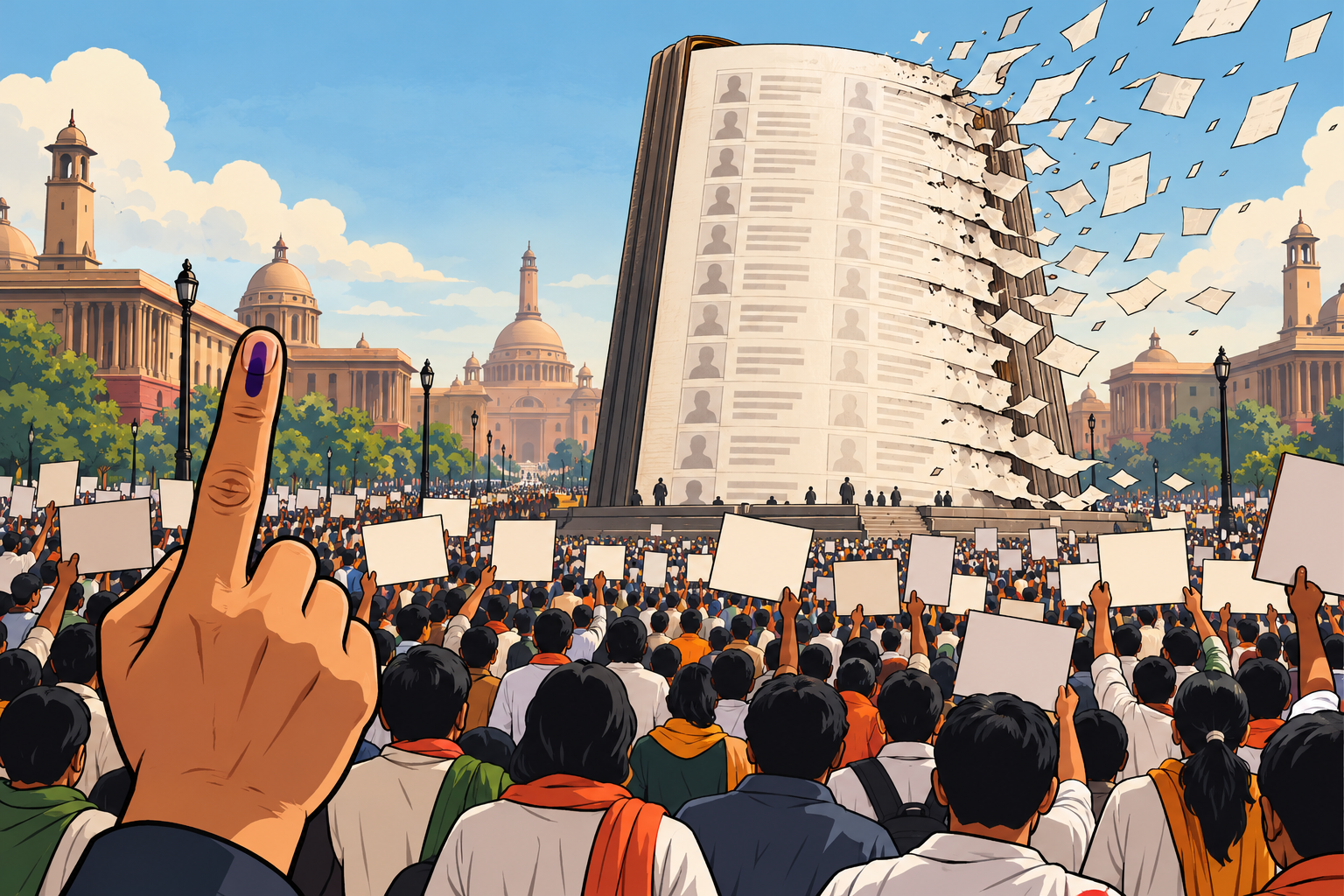
NEW DELHI - Thousands of protesters marched in India's capital Sunday to demand the resignation of Chief Election Commissioner Gyanesh Kumar over a voter-roll revision that has removed more than 130 million names since last year.
Rahul Gandhi, a leader of the opposition Congress Party, led the demonstration at Ramlila Maidan with other opposition figures and members of a youth protest movement. Security forces deployed around the central Delhi venue with shields, batons and riot-control vehicles, but the gathering remained peaceful.
The protesters say the Special Intensive Revision has wrongly excluded eligible citizens and disproportionately affected Muslims, poorer voters and other groups less likely to support Prime Minister Narendra Modi's Bharatiya Janata Party. Gandhi called the deletions a theft of citizens' political voice and demanded Kumar leave office.
One protester told Reuters that four members of her family had been marked as having moved away from a home where they had long lived. Such individual accounts do not establish the national pattern alleged by the opposition, but they show the practical burden placed on citizens when an official record changes.
The Election Commission says the revision is necessary to remove duplicate, deceased, relocated and otherwise ineligible entries from lists covering roughly one billion voters. It denies favoring the BJP and says eligible people removed by mistake can re-enroll.
Government officials accused the opposition of using the dispute to undermine democratic institutions. Health Minister Jagat Prakash Nadda described Sunday's rally as an orchestrated attempt to create disorder in the name of democracy.
The controversy intensified after The Indian Express reported that Kumar's two fellow election commissioners had raised at least 14 formal objections in 10 months. Their concerns included changes to the Form 6 registration process, increasing central control over voter databases and decisions they said were taken without proper commission approval.
The Election Commission acknowledged the internal notes but described disagreement as part of normal institutional decision-making. In an affidavit to India's Supreme Court, it said the major orders establishing and expanding the revision were approved unanimously by all three commissioners.
The affidavit also confirmed that the two commissioners wrote to the cabinet secretary, while disputing claims that the revision itself lacked collective approval. That distinction leaves serious questions about implementation even if the broad policy was unanimous.
The commission ordered a review of its voter-roll software in September after the internal dispute became public. Opposition demonstrations have continued for more than a month, creating the most sustained political crisis Modi has faced in years, although his government remains stable and the next general election is not scheduled until 2029.
Removing 130 million entries does not mean 130 million eligible voters were permanently disenfranchised. Draft-roll deletions can include duplicates, deaths and people who moved, and some citizens can restore their names. The central question is how many valid voters were removed, whether they received effective notice and whether correction procedures work before an election.
A democracy this large must make verification visible
Every credible election system maintains accurate rolls. Leaving duplicate or ineligible records untouched creates opportunities for error and fraud, while outdated addresses make election administration harder. The opposition cannot prove manipulation merely by pointing to a very large number.
Yet scale changes the burden of proof. When a process removes more names than the population of Japan, officials cannot answer public concern with a promise that mistakes can be fixed. They must publish detailed reasons, geographic patterns, restoration rates and audit results that independent experts can test.
India remains a competitive democracy with courts, opposition parties, journalists and citizens capable of challenging power. Sunday's peaceful rally demonstrates that strength. But democratic institutions weaken when criticism is treated as disloyalty or when technical systems become too centralized for local officials and the public to inspect.
The internal objections reported by The Indian Express are especially important. A unanimous vote on the overall revision does not prove that every software change, form alteration or deletion rule was lawful. Institutional disagreement should produce a documented resolution, not disappear behind collective responsibility.
Modi's government benefits politically when doubts about the voter list remain unresolved, even without proof that it ordered improper deletions. That makes transparency an obligation, not a concession. The Election Commission must be independent enough to publish facts that may inconvenience the ruling party.
The opposition also has responsibilities. Claims of mass theft should be tied to verifiable records rather than anger alone, and supporters must protect peaceful protest from intimidation or violence. Exaggeration can make genuine errors easier for officials to dismiss.
The cruel reality of administrative power is that a citizen can retain every constitutional right on paper and still lose a vote because a database says the person moved. India can avoid that outcome by opening the revision to serious audit, giving voters direct notice and guaranteeing a rapid appeal before ballots are cast. A billion-person democracy requires not only clean lists, but public confidence in every step used to clean them.
Comments
Loading comments…