
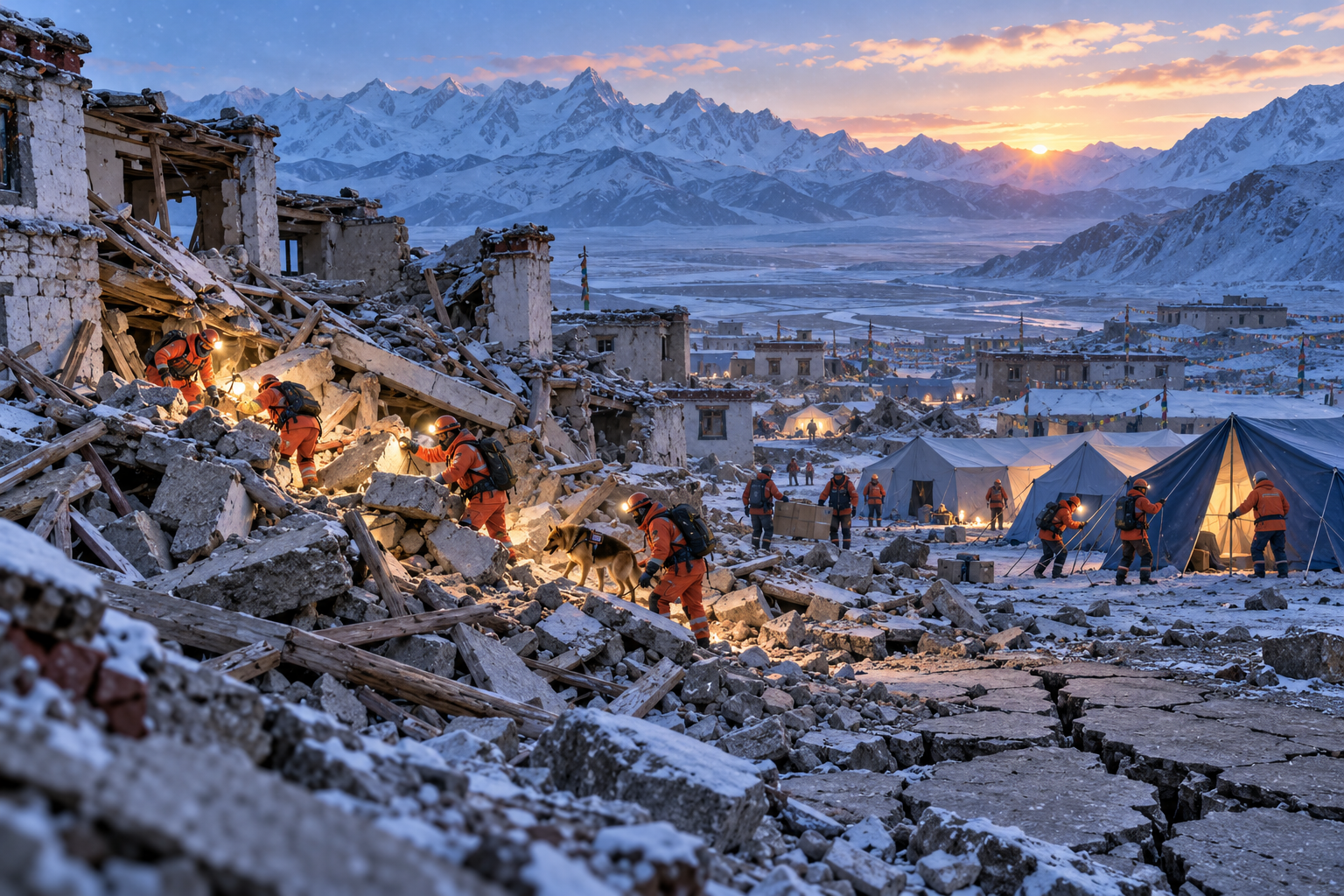
BEIJING - Rescue teams searched remote villages in China's Tibet region Friday after a magnitude 7 earthquake killed at least 16 people, injured at least 65 and collapsed hundreds of homes around the high-altitude city of Nagqu, according to local authorities and Chinese state media.
The earthquake struck at 10:33 p.m. Thursday local time. The U.S. Geological Survey placed its epicenter about 191 kilometers east-northeast of Nagqu and measured a depth of 18 kilometers. China's earthquake agency also reported a magnitude of 7, while placing the source at a shallower depth.
The official death toll remained at 16 on Friday. Reuters reported that the number of injured had risen to 65, while earlier reporting by The Associated Press put the count at 54. The changing figures reflect an active rescue operation in an isolated area where damaged communications have slowed the flow of information.
At least 339 homes collapsed, AP reported. More than 12,000 people were moved to safer locations, according to Xinhua figures cited by Reuters. State media said authorities delivered thousands of tents, prefabricated housing units, folding beds, flashlights and winter clothes as nighttime temperatures fell.
Nagqu sits north of the regional capital, Lhasa, on the Tibetan Plateau. Parts of the city are about 4,800 meters above sea level, where low oxygen, cold weather and long travel distances complicate heavy rescue work. Snow was forecast in the affected area over the next several days.
More than 5,000 rescuers and support personnel from three counties were deployed, AP reported. Teams completed repeated house-to-house searches while emergency workers inspected unstable buildings and rockslides. A section of National Highway 317 was closed to ordinary traffic so rescue and official vehicles could pass, and railway operators halted trains through parts of the region.
Aftershocks created a continuing danger. The China Earthquake Networks Center recorded hundreds of smaller tremors, while the USGS listed several shocks between magnitude 4.3 and 5.2. Authorities warned that already damaged buildings could fail and that rockfalls could block roads into scattered settlements.
Chinese President Xi Jinping ordered an all-out rescue and medical response Friday morning. The disaster is the strongest earthquake recorded in China since January 2024, Reuters reported. A magnitude 7.1 earthquake in neighboring Qinghai in 2010 killed nearly 2,700 people, illustrating the risks faced by communities across the plateau.
Rescue must come before control of the story
The immediate duty is uncomplicated: reach trapped residents, provide medical care and shelter displaced families before snow and cold produce a second wave of harm. China has substantial military, engineering and logistics capacity, and deploying it rapidly to isolated Tibetan communities is exactly what a powerful central government should do.
But the quality of a disaster response is measured by more than the number of personnel shown in official footage. Supplies must reach small villages as well as visible urban sites, survivors need accurate information about aftershocks and unsafe buildings, and local officials must be able to report shortages without fearing that bad news will be treated as disloyalty.
Nearly every early casualty and damage figure has come through Chinese authorities or state-controlled media. That does not make the reports false, but it does make independent access important. Journalists, humanitarian specialists and local residents should be able to document conditions without censorship. Transparent reporting helps rescue commanders identify missed communities and gives families confidence that losses are not being hidden.
Tibet makes that principle especially important. Beijing tightly controls foreign access and political expression in the region, and information restrictions can leave outsiders dependent on government accounts. An earthquake is not a political attack, and questions about casualty data should not become propaganda from any side. The answer is verifiable evidence, open access and regular public updates.
The destruction also exposes a longer-term engineering challenge. High-altitude settlements contain older homes built from stone, earth and timber alongside newer concrete structures. Retrofitting vulnerable buildings, enforcing construction standards and keeping emergency routes open are less dramatic than a mass rescue deployment, but they decide how many people survive the next earthquake.
Authorities should eventually publish village-level casualty and damage data, explain how relief was distributed and allow an independent assessment of building failures. International seismic data can establish where and how strongly the earth moved; only open local reporting can show why some homes endured while others collapsed.
For now, rescuers are working against cold, altitude and time. Their effort deserves support, and the people of Nagqu deserve more than ceremonial concern. They need shelter through the winter, honest accounting of what happened and reconstruction that treats remote Tibetan lives as equally valuable long after the cameras leave.
Comments
Loading comments…