
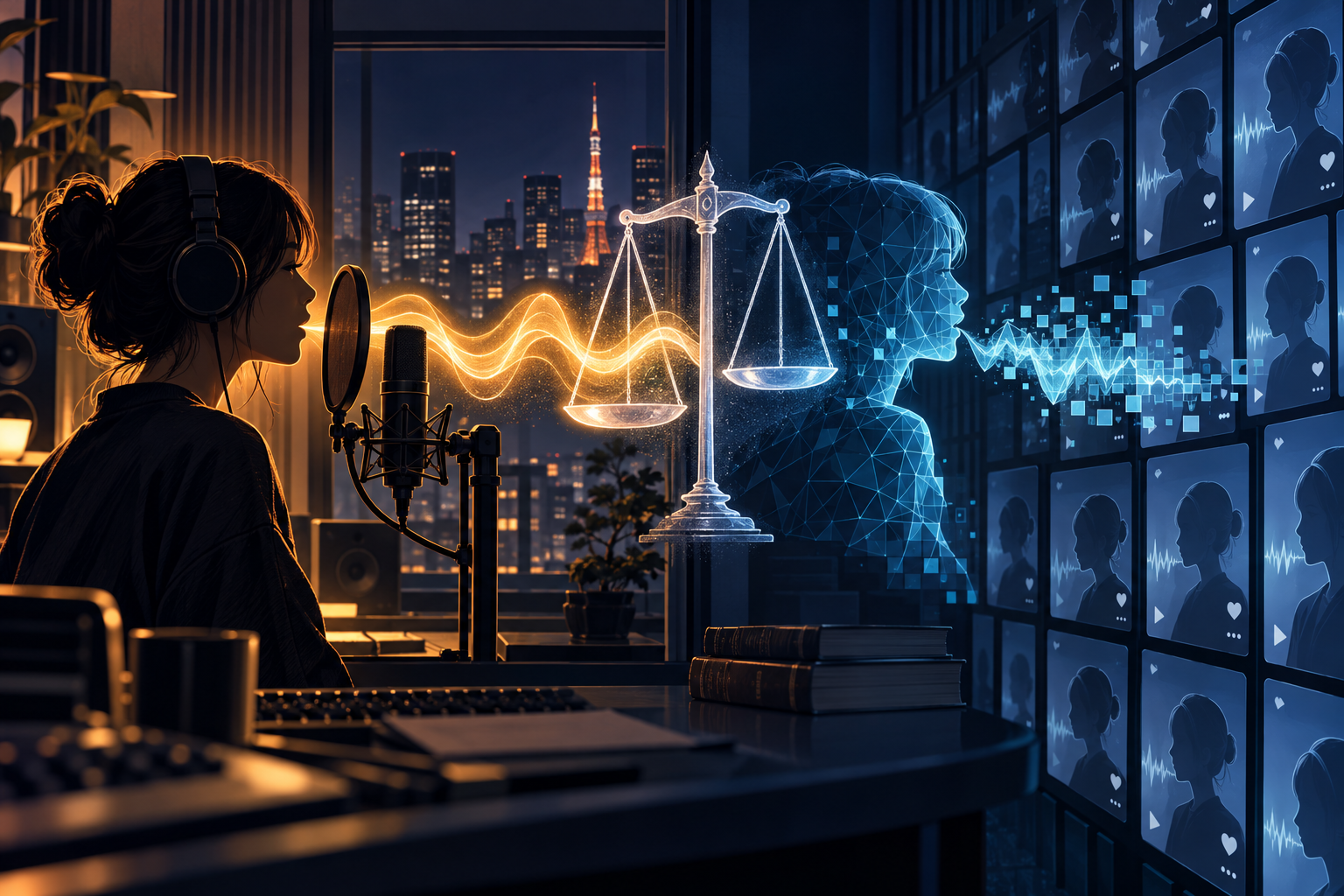
TOKYO - The Tokyo District Court has recognized for the first time in Japan that a person's distinctive voice can be protected under publicity rights, setting an important legal standard as artificial intelligence makes convincing vocal imitation cheap and widely available.
The ruling came in a case brought by prominent voice actor Kenjiro Tsuda against the operator of TikTok. Tsuda said an anonymous account used an AI-generated imitation of his deep baritone to narrate more than 180 videos about urban legends and paranormal subjects without his permission.
Presiding Judge Aya Takahashi said the human voice can symbolize an individual's personality in the same way as a portrait. Unauthorized use intended to exploit the commercial appeal of a recognizable voice can therefore infringe publicity rights, according to the ruling described by the Associated Press and Japanese media.
The decision was a partial victory rather than a complete win for Tsuda. The court dismissed his demand that TikTok remove the disputed videos because the account had already closed and the material was no longer available. The judgment established a legal principle but did not issue the takedown order he requested.
Tsuda is known for roles including Kento Nanami in the anime series Jujutsu Kaisen. His lawsuit said the account drew viewers by using a voice associated with him to deliver content that he had not performed or approved. The account had accumulated more than 200,000 subscribers by late 2025, according to court reporting.
The defendant argued that the narration was an AI-generated voice that merely resembled Tsuda and that it did not damage his reputation. Japanese reporting said TikTok also maintained that the underlying model had been trained on another person's voice and produced a generic male sound.
The case is significant because publicity rights in Japan have traditionally protected the commercial value of names and images. The court extended that reasoning to vocal identity at a moment when actors, singers and broadcasters are increasingly finding synthetic versions of their voices in advertisements, entertainment and social-media videos.
The ruling does not mean every imitation, parody or synthetic voice is automatically unlawful. The court's reasoning focused on recognizable identity, unauthorized use and an evident purpose of taking advantage of commercial appeal. Future cases will still have to examine evidence, context, consent and the way a voice is used.
A voice is labor, identity and trust
AI voice tools can be valuable. They can help people who lose the ability to speak, make media accessible in more languages and let performers license their work for new productions. The technology itself is not the offense. The problem begins when another person captures the economic value of a recognizable identity without permission.
For a professional voice actor, vocal character is not an incidental trait. It is the product sold to audiences and the result of years of training, performance and reputation. If a platform account can copy that signature, generate hundreds of clips and attract advertising revenue, the human performer bears the reputational risk while the imitator collects the benefit.
Consent must therefore become the dividing line. Clear contracts can authorize a specific model, purpose, duration and payment. Performers should be able to revoke future uses when agreed conditions are violated. Companies buying synthetic narration should also retain records showing where training material came from and whether the speaker authorized it.
Platforms have responsibilities as well. They cannot inspect every upload before publication, but they can build rapid complaint channels, preserve evidence and act against accounts that repeatedly trade on deceptive identity. Closing an account only after litigation leaves creators carrying costs that a global technology company is better positioned to prevent.
American lawmakers should study the Japanese decision. The United States leads in AI research and should not smother useful innovation with rules so broad that ordinary tools become legally dangerous. But leadership also requires protecting property, contracts and individual identity. A market works when creators can choose whether and how their work is sold.
The darker future is not machines replacing every artist overnight. It is thousands of anonymous operators taking small pieces of human identity because each individual theft is too expensive to challenge. Courts can stop some abuses, but legislation and platform standards are needed before imitation becomes the default and consent the exception.
Tokyo's ruling is narrow, and Tsuda did not receive the deletion order he sought. Its principle is still important: a human voice has commercial and personal value even when software produces the final audio file. Technology changes the method of copying. It should not erase the person whose identity gives the copy its value.
Comments
Loading comments…