
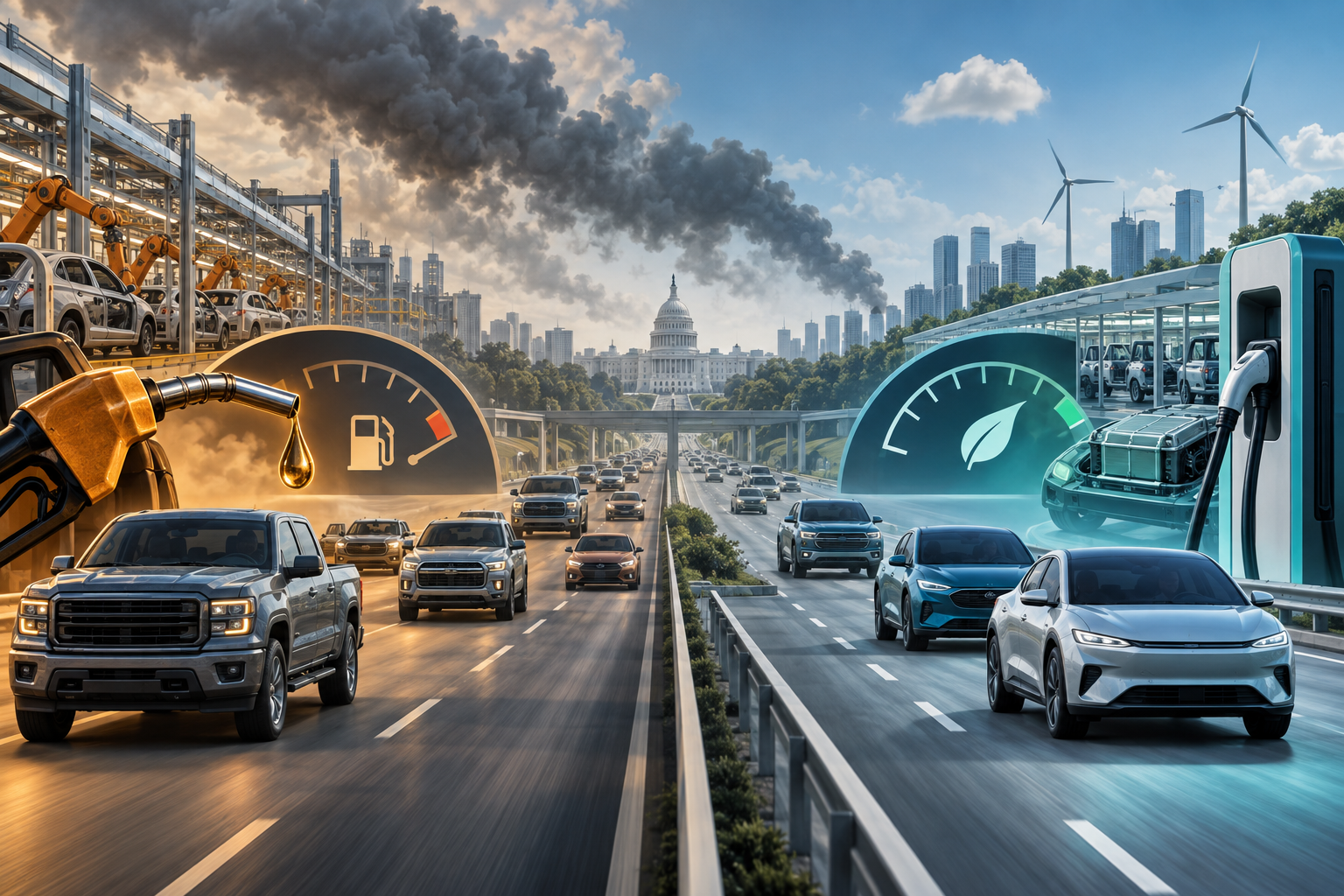
WASHINGTON - The Trump administration has finalized lower federal fuel-economy standards for passenger cars and light trucks, replacing rules that had pushed automakers toward a much more efficient fleet by 2031.
The National Highway Traffic Safety Administration estimates the new rules will produce a combined fleetwide average of about 34.9 miles per gallon in model year 2031. That is higher than the 30.1 mpg average for model year 2024 but well below the roughly 50.4 mpg projected under the previous standards.
The rule, announced Monday by Transportation Secretary Sean Duffy, amends requirements covering model years 2022 through 2031 and changes parts of the compliance system, including how some vehicles are classified. The administration calls the package the Safer Affordable Fuel-Efficient Vehicles Rule III.
President Donald Trump and Duffy presented the change as relief from what they call an illegal electric-vehicle mandate. The administration estimates it will reduce the average price of a new vehicle by $1,300 and save Americans $138 billion over five years. It also argues that lower prices will allow more families to replace older cars with newer, safer models, preventing serious injuries and deaths.
The Alliance for Automotive Innovation, which represents major automakers, welcomed the decision. Its president, John Bozzella, said the previous requirements were out of step with market conditions and customer demand and that the final rule gives manufacturers a more realistic path.
Environmental groups sharply disagreed. They warned that a less efficient fleet will burn more gasoline over its lifetime, increase household spending at the pump and produce more carbon dioxide, soot and smog-forming pollution. Transportation accounted for about 28 percent of U.S. greenhouse-gas emissions in the latest federal estimate cited by the Associated Press.
The previous policy did not order every consumer to buy an electric vehicle. It set average efficiency requirements that automakers could meet through a mixture of more efficient gasoline engines, hybrids, electric vehicles and other technology. Trump's criticism refers to the pressure those standards placed on manufacturers to sell a growing share of low- or zero-emission models.
The timing adds another dimension. The new rule was released as conflict around Iran and the Strait of Hormuz continued to unsettle global oil markets. A vehicle purchased under the 2031 standards could remain on American roads for more than a decade, making today's regulatory choice relevant to future fuel bills and energy security.
Affordability is real, but so is the lifetime cost
The administration is right to take vehicle affordability seriously. New cars and trucks have become difficult for many working families to finance, and rules that raise the sticker price can keep people in older vehicles. Consumers also need products that fit their work, travel distances and access to charging rather than choices designed only around Washington's preferred technology.
But the price on the dealer's window is not the full cost of ownership. Families pay for fuel every week, and an inefficient vehicle can erase an upfront saving over years of driving. Government estimates depend heavily on future gasoline prices, technology costs and assumptions about how long people keep their cars. Those assumptions should be published clearly rather than compressed into a campaign-ready savings figure.
Energy security also deserves more weight. The United States is a leading oil producer, yet American prices still respond to wars, shipping disruptions and decisions by foreign producers. Improving mileage reduces exposure to those shocks. Relaxing efficiency while an unstable Middle East is pushing energy risk back into public view is strategically difficult to defend unless the promised affordability gains prove substantial.
The best American policy should not force one drivetrain on every household, but neither should it shelter domestic manufacturers from global competition. Chinese companies are investing aggressively in batteries, electric vehicles and supply chains. If U.S. automakers use regulatory relief to delay innovation, they may enjoy a short-term advantage at home while losing future markets abroad.
A durable standard would reward measurable efficiency, allow several technologies to compete and tighten only at a pace supported by infrastructure and supply chains. Congress and regulators should also preserve transparent labeling so buyers can compare purchase price, fuel spending and emissions without political slogans.
The final rule gives automakers breathing room and may lower some vehicle prices. It also shifts fuel and pollution costs into the future. Americans deserve honest accounting of both sides. Consumer choice is meaningful only when buyers can see what a cheaper vehicle today may cost them at the pump tomorrow.
Comments
Loading comments…