
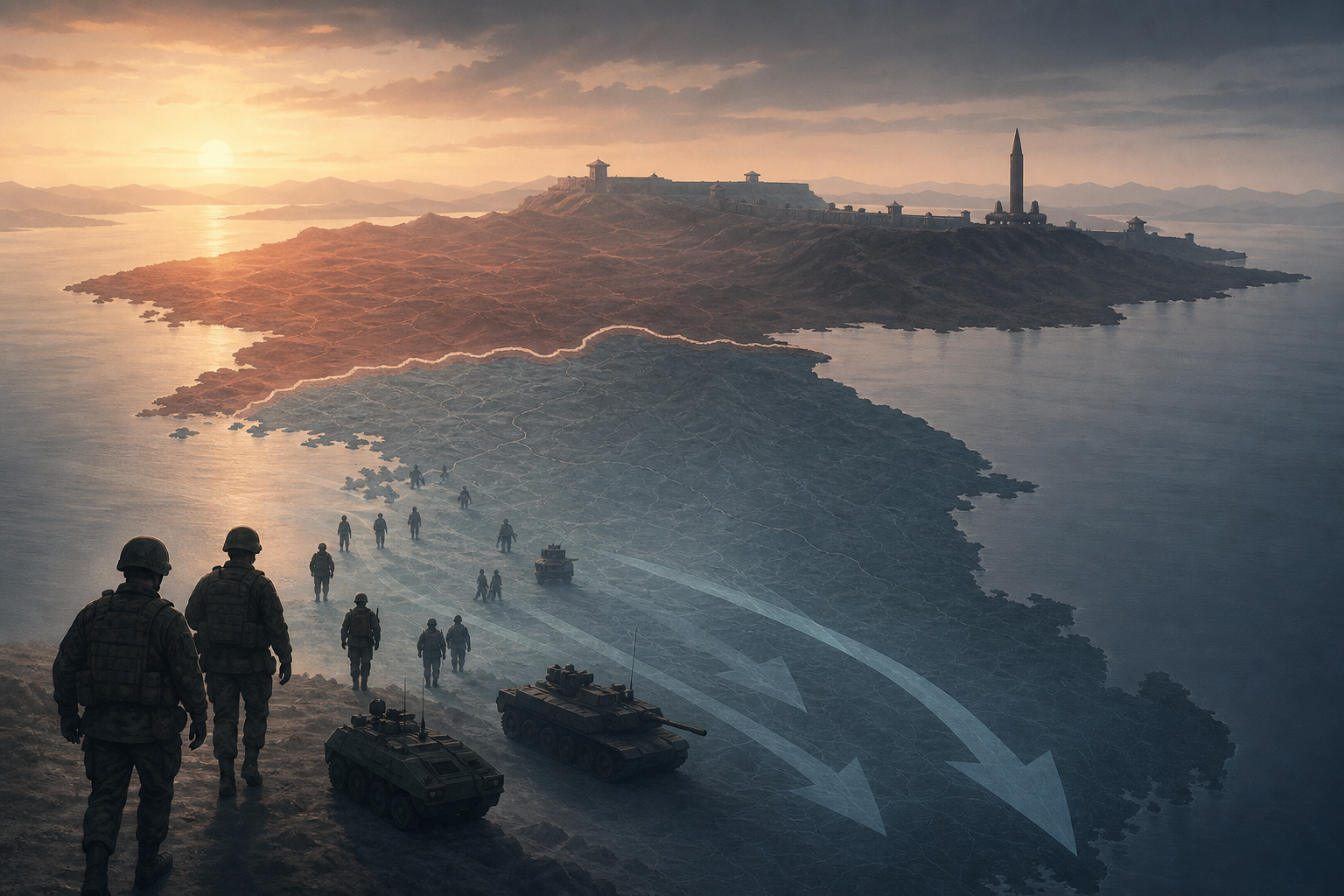
WASHINGTON - President Donald Trump ordered the Pentagon on Sunday to substantially reduce annual military exercises with South Korea just as the allies were beginning one of their two major combined drills, abruptly changing a long-planned test of their readiness against North Korea.
Trump announced the order on social media, saying the Ulchi Freedom Shield exercises were costly and sent what he called an inappropriate and hostile signal to Pyongyang. He cited his relationship with North Korean leader Kim Jong Un and said South Korea had declined a request to join the United States in its campaign to denuclearize Iran.
The 11-day exercise was designed to involve about 18,000 South Korean troops, according to The Associated Press. Planned activities included joint command operations, live-fire training, precision targeting, maneuver across water obstacles and the distribution of prepositioned equipment. South Korea's Defense Ministry said the exercise began Monday local time as scheduled, but the practical meaning of Trump's reduction order was not immediately clear.
The decision came only days after North Korea resumed ballistic missile testing in defiance of United Nations restrictions. The United States, South Korea and Japan condemned those launches. Pyongyang, as it has before previous exercises, described the allied training as a rehearsal for aggression and threatened a strong response.
Trump wrote that it was too late to cancel the exercise outright and said he had instructed Defense Secretary Pete Hegseth to reduce it. The announcement did not say which units, field events or command activities would be removed, and it did not announce a reduction in the roughly 28,500 U.S. troops normally stationed in South Korea.
The order also marks a rapid change in tone. During a May meeting at the Pentagon, Hegseth praised South Korea's plan to increase defense spending and take greater responsibility for security on the peninsula. He held up Seoul's approach as an example of alliance burden-sharing. On Sunday, the president instead presented South Korea's refusal to join an unrelated war as a reason to limit training central to the defense of both countries.
There is a legitimate diplomatic argument for adjusting military exercises when doing so wins a specific and verifiable concession. Trump reduced or suspended major exercises during his first term while negotiating directly with Kim. But those talks collapsed in 2019, North Korea retained its nuclear weapons, and its missile arsenal continued to grow. A gesture is not a strategy unless the other side gives something measurable in return.
The immediate military danger is not that one smaller exercise makes South Korea defenseless. The alliance has trained together for decades, maintains detailed war plans and possesses overwhelming conventional capability. The larger risk is cumulative: readiness fades when complex tasks are not rehearsed, officers lose practice coordinating under pressure, and an adversary begins to believe political hesitation will limit an allied response.
Predictability matters as much as scale. Exercises can be modified through quiet planning with Seoul, giving commanders time to preserve the most important training goals. A last-minute public order tied to a separate dispute over Iran makes the alliance look transactional. That weakens the assurance Washington wants democratic partners to feel and strengthens the argument of authoritarian governments that American commitments depend on the president's latest grievance.
South Korea is a sovereign ally, not an auxiliary force required to join every U.S. campaign. Washington can fairly demand more defense spending and a larger South Korean role on the peninsula. It can also debate the cost and design of exercises. But punishing Seoul's decision on Iran by reducing preparation against North Korea mixes two theaters in a way that may satisfy political anger while creating a strategic opening.
Kim's government has repeatedly used negotiations and pauses to seek sanctions relief, time and legitimacy while conceding little that cannot be reversed. That does not mean diplomacy should stop. It means diplomacy should be tested against actions: missile launches halted, inspectors admitted, facilities dismantled and communications restored.
America's alliances are among its greatest advantages over China, Russia, Iran and North Korea. Those rivals can threaten neighbors, but they cannot easily reproduce a voluntary network of capable democracies. Preserving that advantage requires allies to contribute more, and it requires Washington to treat joint defense as a durable commitment rather than leverage in an unrelated dispute.
The reduced exercise may still retain its essential command and field components. Until the Pentagon explains what is changing, however, uncertainty itself becomes the story. North Korea will watch the training that disappears, South Korea will measure the reliability of American consultation, and other allies will ask whether their own security arrangements can be altered overnight.
Comments
Loading comments…