
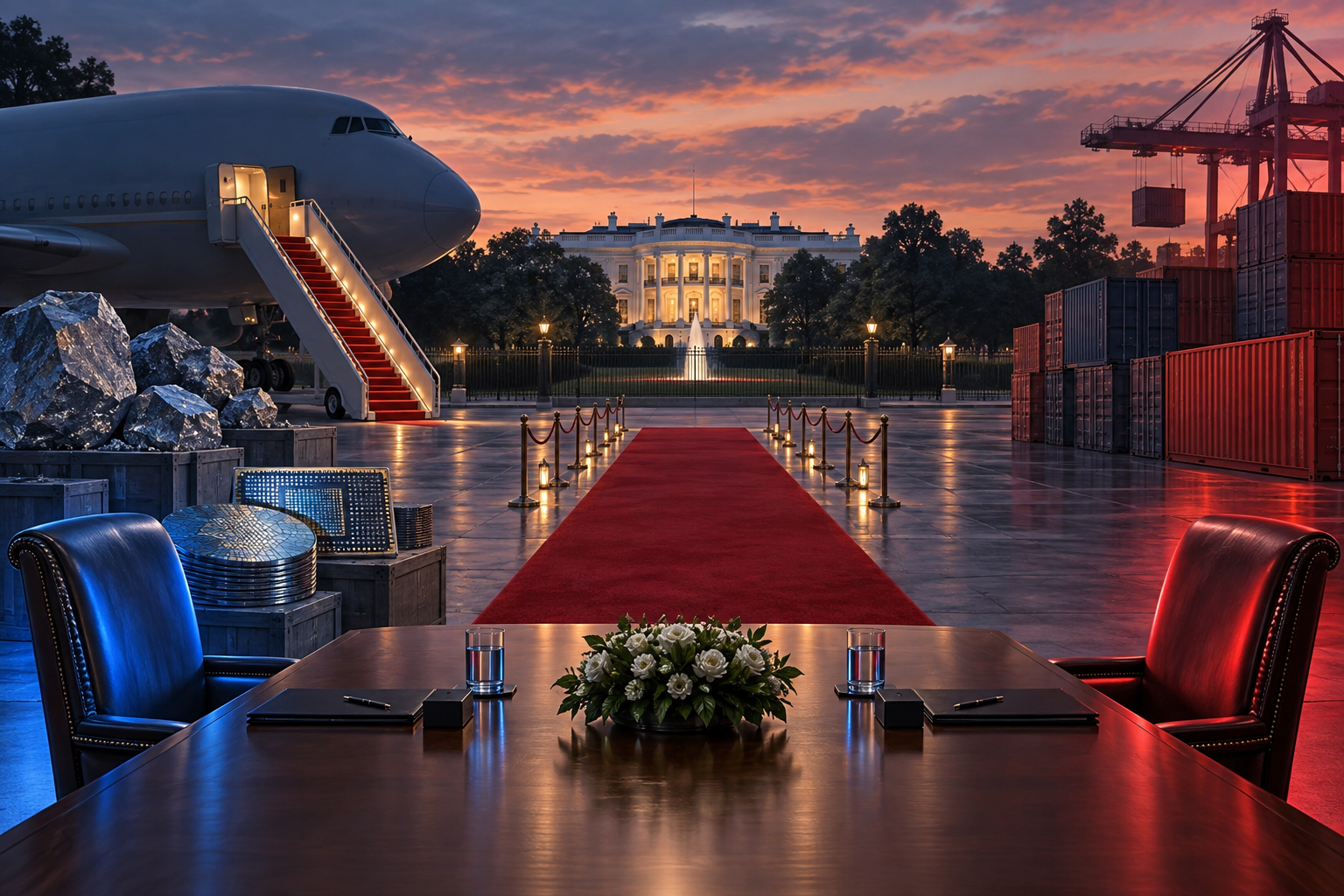
WASHINGTON - President Donald Trump plans to greet Chinese President Xi Jinping at Joint Base Andrews on Wednesday as Xi arrives for the first U.S. state visit by a Chinese leader in more than a decade, according to senior administration officials.
The airport welcome is unusual because Trump generally receives foreign leaders at the White House. It begins a carefully choreographed visit that will move to the White House on Thursday for an indoor arrival ceremony, a review of troops in the Rose Garden and closed-door talks between the leaders.
Trump and first lady Melania Trump will host Xi and his wife, Peng Liyuan, at a state dinner in the East Room on Thursday. Both leaders are expected to deliver remarks. The White House said invited business figures include Amazon founder Jeff Bezos, Elon Musk, Google chief executive Sundar Pichai, Dell chief executive Michael Dell, Nvidia chief executive Jensen Huang and OpenAI chief executive Sam Altman.
Xi and Peng are scheduled to return to the White House on Friday for a private tea with the Trumps and a tour of the National Archives during the United States' 250th anniversary year. Xi last made a U.S. state visit in September 2015, during the Obama administration.
The substance of the trip remains less settled than the ceremony. U.S. officials said the two governments may discuss reducing tariffs on a narrow category of nonstrategic goods, but they did not identify the products or announce a completed agreement. Artificial intelligence, China's supply of rare-earth minerals and broader trade questions are also expected to be on the agenda.
China dominates the processing of many rare earths used in electronics, energy systems and military equipment. Beijing has used export restrictions as leverage during trade disputes, while the Trump administration has pursued new partnerships intended to make U.S. supply chains less vulnerable. Officials said they did not expect Washington to trade away sensitive export controls simply to obtain more mineral supply.
The visit follows Trump's trip to China in May. A White House fact sheet from that meeting said the leaders agreed to pursue strategic stability based on fairness and reciprocity. It also listed Chinese commitments involving U.S. aircraft, agricultural products, beef access and critical-mineral supply, while announcing that Xi would visit Washington in the fall.
A state visit can lower the risk of miscalculation between nuclear powers and create channels for resolving disputes. Direct communication is valuable, especially when the two countries are competing across trade, technology, military power and influence in Asia. The question is not whether Trump should speak with Xi. It is whether ceremony produces results that can be measured after the motorcade leaves.
Personal diplomacy carries a particular risk when dealing with the Chinese Communist Party. Xi's government can offer access, purchases or temporary regulatory relief while retaining a state-directed industrial system built for long-term advantage. Beijing's leverage in rare earths did not appear overnight; it was accumulated through years of policy, subsidy, market control and Western dependence.
The United States should therefore judge any agreement by enforcement rather than atmosphere. Purchase commitments need deadlines and verification. Market-access promises need to survive pressure on individual American companies. Limits on technology transfers must account for attempts to obtain capabilities through investment, cyber activity, talent recruitment and the use of foreign AI services.
Washington also gains leverage when it acts with democratic allies. Japan, South Korea, Australia, Canada and European partners possess minerals, advanced manufacturing, research institutions and markets that can reduce dependence on China when coordinated. Treating those countries as disposable bargaining targets makes Beijing's divide-and-pressure strategy easier.
Trump's willingness to use tariffs helped put structural problems with China at the center of U.S. politics, but tariffs alone did not erase Chinese manufacturing dominance. The next stage requires industrial capacity, allied supply chains, export-control discipline and investment in American energy, chips and research. A dinner cannot substitute for that work.
The airport greeting will give Xi a powerful image of respect. Trump should use the access it creates, but the United States does not need to confuse hospitality with trust. A confident democracy can welcome a rival leader while insisting on reciprocity, protecting its technology and speaking plainly about the coercive power of an authoritarian state. The success of this visit will be found in verifiable concessions, not the photographs.
Comments
Loading comments…