
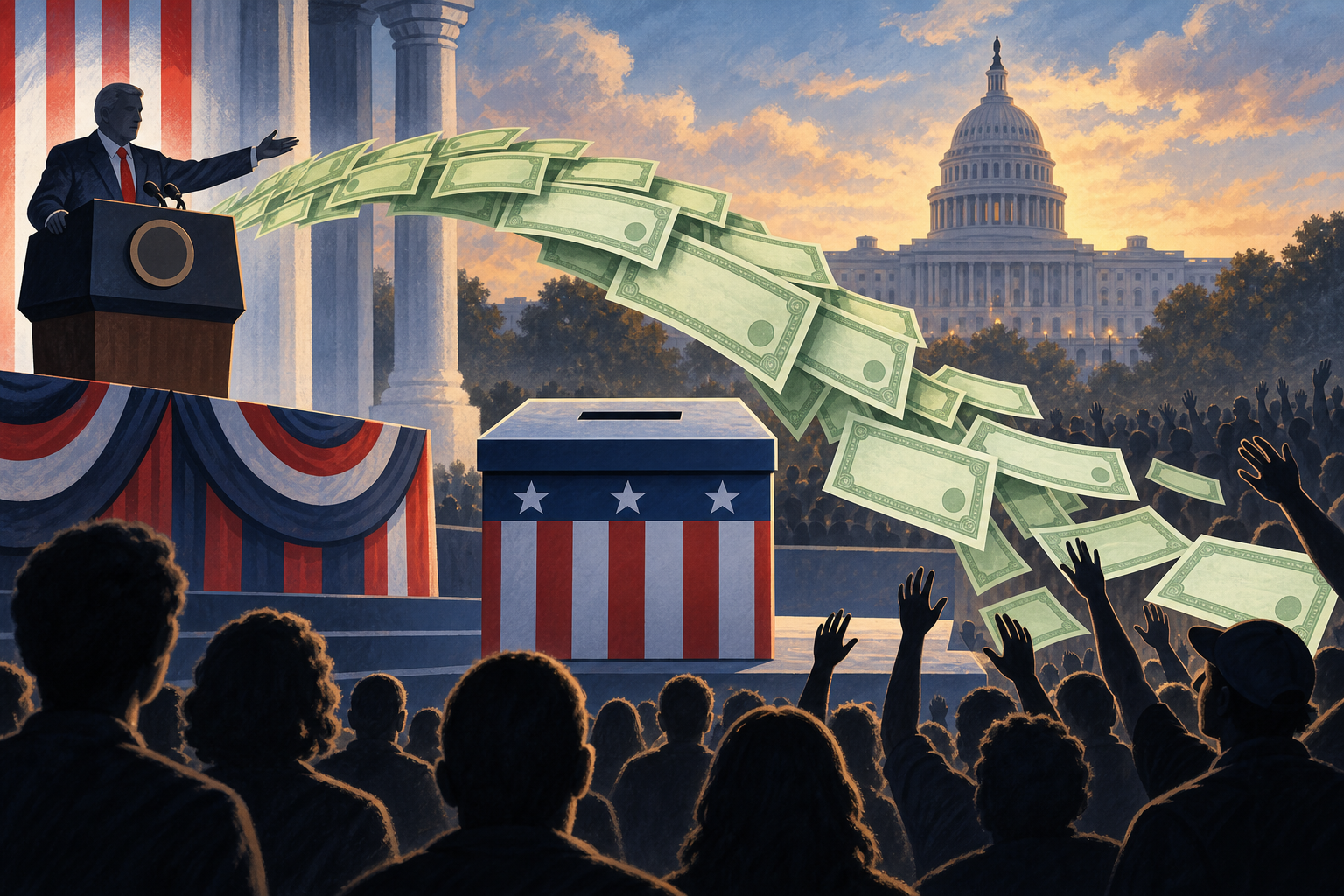
DALLAS - President Donald Trump promised to send every adult American citizen a $5,000 payment if Republicans retain control of both chambers of Congress in November's midterm elections, presenting the proposal during the party's convention without a detailed funding or implementation plan.
If Republicans win the House and Senate, Trump said, adult citizens would receive what he called a Trump Dividend. He also said the money would have to be spent inside the United States. The pledge came during his Wednesday night address at the Republican gathering in Dallas.
Trump did not explain who would qualify beyond adult citizenship, when payments would arrive, whether income limits would apply or which federal revenue would finance them. Reuters reported that no further details were immediately available.
The Associated Press estimated that universal $5,000 payments would cost about $1.23 trillion. The calculation is broadly consistent with an adult citizen population of roughly 245 million. That expense would be separate from ordinary federal programs and would require Congress to authorize or otherwise approve the spending.
Vice President JD Vance later suggested wealthy people might not receive the payment and said tariff revenue could help fund it. Those comments introduced conditions that were not part of Trump's initial universal pledge. AP reported that the proposed total would far exceed the tariff revenue available to support it.
The White House did not provide AP with further details. The proposal also arrives as the national debt has exceeded $40 trillion and the annual federal budget deficit is approaching $2 trillion, leaving no existing surplus from which a conventional dividend could be paid.
Trump made the promise as Republicans face a difficult midterm environment and as he seeks to make his own record central to congressional races. The November result will determine control of the House and Senate during the final two years of his presidency.
There is an understandable appeal in returning money to citizens when government revenue rises. Americans have endured inflation, high borrowing costs and expensive essentials. A government that taxes efficiently and spends less should allow families to keep more of what they earn.
But a dividend normally comes from a surplus, not from additional borrowing. Sending more than $1 trillion while the government is already deeply in deficit would transfer the cost to future taxpayers, potentially add inflationary pressure and make interest payments on the debt even harder to control.
Tariffs do not remove that arithmetic. They are collected from importers at the U.S. border, and part of the cost can be passed to American businesses and consumers through higher prices. Calling tariff revenue foreign money does not make it free, especially when the proposed payout is much larger than the revenue collected.
The political condition creates a separate concern. Legal experts cited by AP said a universal payment would not amount to buying individual votes because citizens would qualify regardless of how, or whether, they voted. Legality, however, is not the only democratic standard.
Public money should not be described as a reward voters receive only after choosing one party. Presidents may campaign on tax cuts, benefits and spending programs, but responsible proposals include legislation, eligibility rules, fiscal estimates and an explanation of tradeoffs. Without those details, a trillion-dollar promise functions more as electoral pressure than governing policy.
Republicans in Congress now have a duty to say whether they support the proposal and how they would pay for it. Fiscal conservatism cannot mean demanding restraint from social programs while treating a vast election-season payment as exempt from scrutiny. Democrats should answer with their own budget priorities rather than dismissing the financial strain families feel.
American democracy is strongest when voters are offered clear choices backed by honest numbers. A $5,000 payment may be popular, but popularity does not balance a budget or create constitutional authority. Until the administration produces a bill and credible financing, the pledge should be understood as a campaign promise, not money Americans can count on receiving.
Comments
Loading comments…