
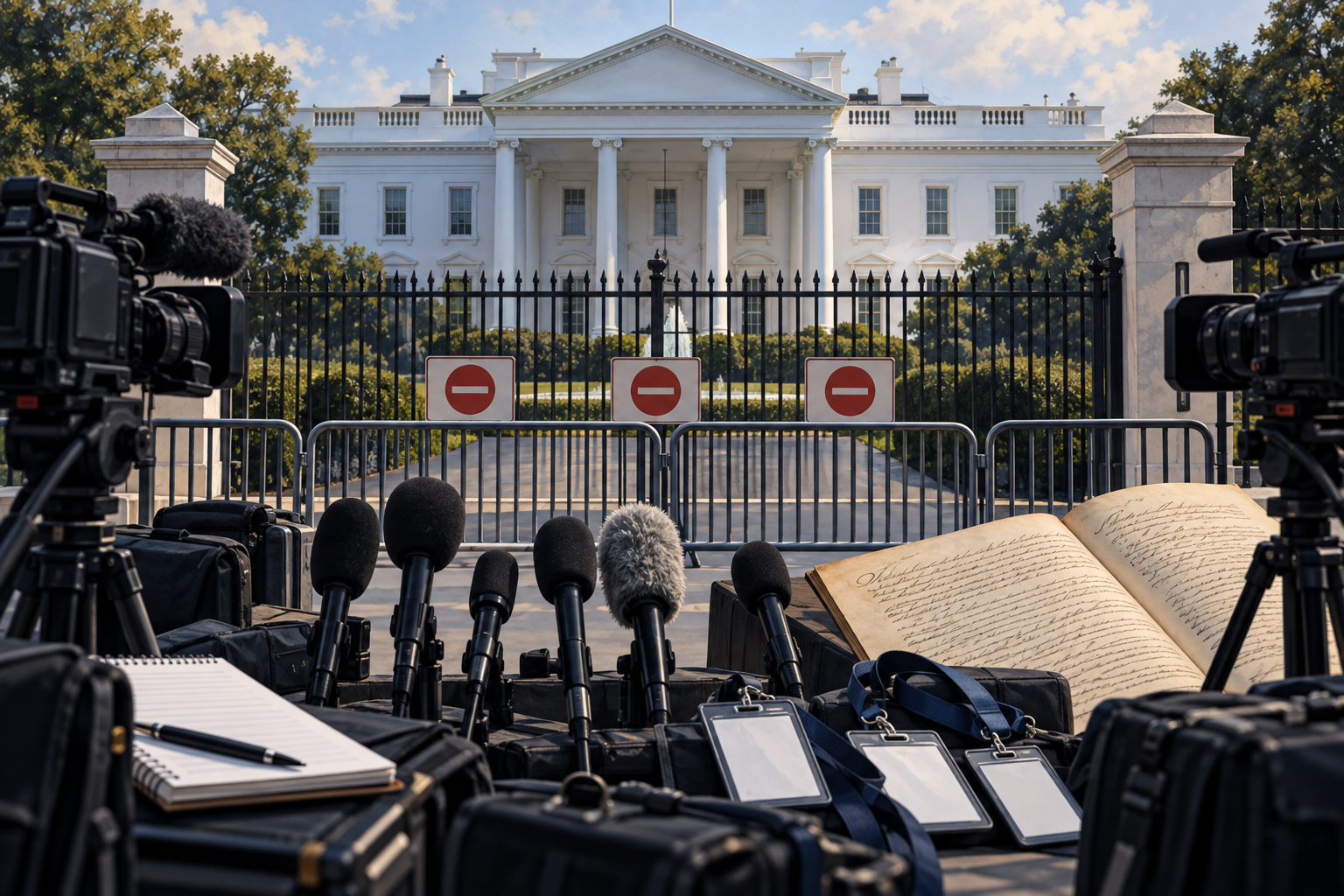
President Donald Trump said Friday that he was banning CNN, MS NOW and Politico from the White House, escalating his conflict with news organizations whose coverage he has repeatedly attacked. Trump announced the move on Truth Social and said it would take effect immediately, while also threatening similar action against other outlets.
Trump accused the three organizations of publishing false reporting about him and his administration. Asked about the decision during an Oval Office event, he said he wanted honest coverage and described the action as the result of stories accumulated over the past two years. He did not identify a specific report that triggered the announcement.
The practical meaning of the ban was not immediately clear. Trump gave no detailed instructions explaining whether the outlets would lose permanent credentials, be excluded from the press pool, or simply be denied entry to smaller presidential events. Reporters from the affected organizations remained on White House grounds late Friday, according to multiple news reports, indicating that the announcement had not yet produced a complete physical exclusion.
CNN said it stood behind its White House team and called any implemented ban an unconstitutional interference with reporting. Politico said it would continue covering the administration and would defend its First Amendment rights. The White House Correspondents' Association also defended the targeted journalists, arguing that constitutional press protections do not depend on whether a president approves of an outlet's questions or coverage.
The dispute arrives with unresolved legal questions already surrounding White House access. Trump previously restricted Associated Press access after the organization declined to adopt his preferred name for the Gulf of Mexico. In his first term, the White House revoked CNN correspondent Jim Acosta's credential after a contentious news conference, but a federal judge ordered the pass restored and the administration later abandoned the effort.
Courts have recognized that the government has more discretion over tightly restricted spaces such as the Oval Office than over general press facilities, but it cannot simply administer access arbitrarily. That distinction will matter if Friday's statement becomes an enforced policy. A temporary seating decision, a pool rotation, and a viewpoint-based prohibition on entire organizations are not legally or democratically equivalent.
The United States has always had a combative press and presidents who believed they were treated unfairly. The American answer has not been to demand friendliness. It has been to protect a competitive information system in which officials can rebut stories, journalists can investigate power, and courts can decide whether either side has crossed a legal line. That structure is often noisy, but it is one of the country's strategic strengths.
A White House may reasonably enforce security rules, space limits and professional standards. It may publicly challenge factual errors and demand corrections. The danger begins when access becomes a reward for favorable coverage, because every future administration can use the same weapon against a different set of critics. Citizens then receive a narrower view of government selected by the government itself.
The consequences extend beyond the daily briefing room. Pool reporters provide an independent record when presidents travel, meet foreign leaders or respond to crises. If participation depends on political approval, the public record itself becomes vulnerable to selective access. Even Americans who dislike the affected outlets have an interest in rules that cannot later be turned against sources they trust.
Trump's supporters are entitled to distrust major outlets, and the media are not immune from bias, mistakes or groupthink. Those concerns make transparency and competition more important, not less. The proper test is evidence: publish the disputed facts, release records when possible, and let rival journalists examine the case. Exclusion avoids that contest rather than winning it.
For now, the announcement remains partly a threat because its enforcement was still uncertain Friday. What happens next will show whether institutions treat the episode as another political confrontation or as a genuine access policy requiring legal review. The larger principle should remain clear: a confident American government does not need a protected information environment. It should be able to withstand scrutiny in public.
Comments
Loading comments…