
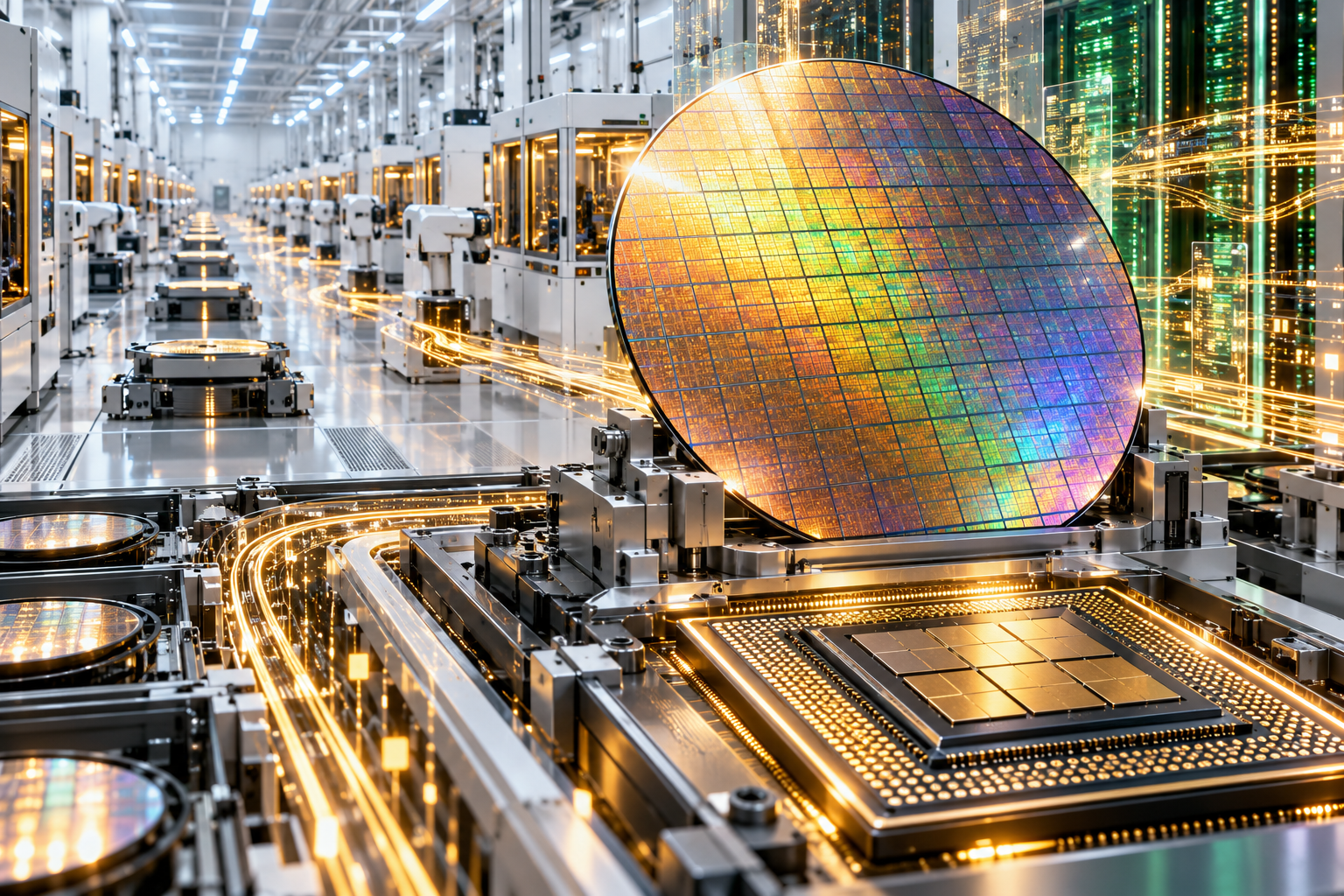
Taiwan Semiconductor Manufacturing Co. reported another record quarter as demand for the advanced chips powering artificial intelligence systems continued to exceed the company's ability to supply them.
TSMC said net income reached NT$763.06 billion, about $24 billion, in the July-to-September quarter, up 68.7% from a year earlier. Consolidated revenue rose 50.9% to NT$1.494 trillion. Measured in U.S. dollars, revenue was $46.72 billion, an increase of 41.2% year over year and 16.2% from the previous quarter.
The company's profitability also climbed. Gross margin was 66.4%, operating margin was 58.7% and net profit margin was 51.1%, according to the earnings release filed with the U.S. Securities and Exchange Commission.
Leading-edge production accounted for most of the business. Chips made with processes of 7 nanometers or more advanced generated 79% of wafer revenue. The newest 2-nanometer process contributed 8% in its first major ramp, while 3-nanometer chips represented 33%, 5-nanometer 28% and 7-nanometer 10%.
Chief Executive C.C. Wei said during the earnings conference that the AI market remained very strong and that demand was still far above TSMC's current capacity. The company forecast fourth-quarter revenue of $52.3 billion to $54.3 billion and a gross margin between 65% and 67%, supported by continued demand and a steep increase in 2-nanometer output.
The results matter well beyond Taiwan's stock market. TSMC manufactures processors for major U.S. technology companies including Nvidia and Apple, and its production is widely treated as a measure of how quickly the global AI buildout is expanding. The company makes more than 90% of the world's most advanced chips, according to the Associated Press.
TSMC is also considering another U.S. expansion. Wei said teams had been sent to Texas to evaluate potential investment and that the company was discussing a role in Elon Musk's planned Terafab manufacturing complex. He stressed that any fabrication operation involving TSMC would have to be run by TSMC. No agreement has been announced.
The Texas study comes alongside a far larger commitment in Arizona. AP reported that TSMC has pledged $265 billion for U.S. facilities there, including an additional $100 billion announced in July. The company raised its 2026 capital-spending plan to between $60 billion and $64 billion, from an earlier range of $52 billion to $56 billion.
Management nevertheless warned that the boom is uneven. Wei said consumer and price-sensitive markets were being challenged by higher component costs and broader economic uncertainty, prompting cautious planning for 2027.
The AI race now runs through a democratic island
TSMC's results reveal a hard truth behind the language of artificial intelligence: software ambitions are constrained by physical factories, specialized equipment, reliable electricity and manufacturing knowledge accumulated over decades. Capital alone cannot instantly reproduce that system.
For the United States, the record quarter is both good news and a strategic warning. American firms lead much of the AI design market, but their most capable chips still depend heavily on a company headquartered in Taiwan, an open democracy living under sustained military pressure from communist China.
Beijing claims Taiwan and has not renounced the use of force. That does not mean conflict is inevitable, but it makes concentration of advanced production a global vulnerability. A disruption in the Taiwan Strait would not remain a regional problem; it could halt data-center construction, weaken industrial output and shake financial markets across the democratic world.
U.S. manufacturing expansion is therefore not a rejection of Taiwan. It is an insurance policy that should deepen the partnership. Arizona and a possible Texas project can add geographic resilience, while Taiwan remains the center of process innovation and skilled production. The challenge is to expand capacity without pretending that buildings alone can duplicate TSMC's operating culture.
The condition Wei attached to a Texas partnership is revealing. TSMC is willing to discuss collaboration, but it will not casually surrender control of the methods that make its factories productive. In an industry where yield, precision and institutional discipline decide success, operational control is not a technical detail.
The wider lesson is that democratic alliances need industrial depth. Open societies cannot protect technological leadership only through export restrictions or speeches about innovation. They must train workers, build power and water infrastructure, secure equipment supply chains and give trusted companies a predictable environment for enormous long-term investments.
TSMC's record profit shows that the AI boom is real at the manufacturing layer. It also shows where the power sits: with the company capable of turning designs into working silicon at scale. The nations that keep that capability secure, distributed and aligned with democratic partners will shape the next phase of the digital economy.
Comments
Loading comments…