
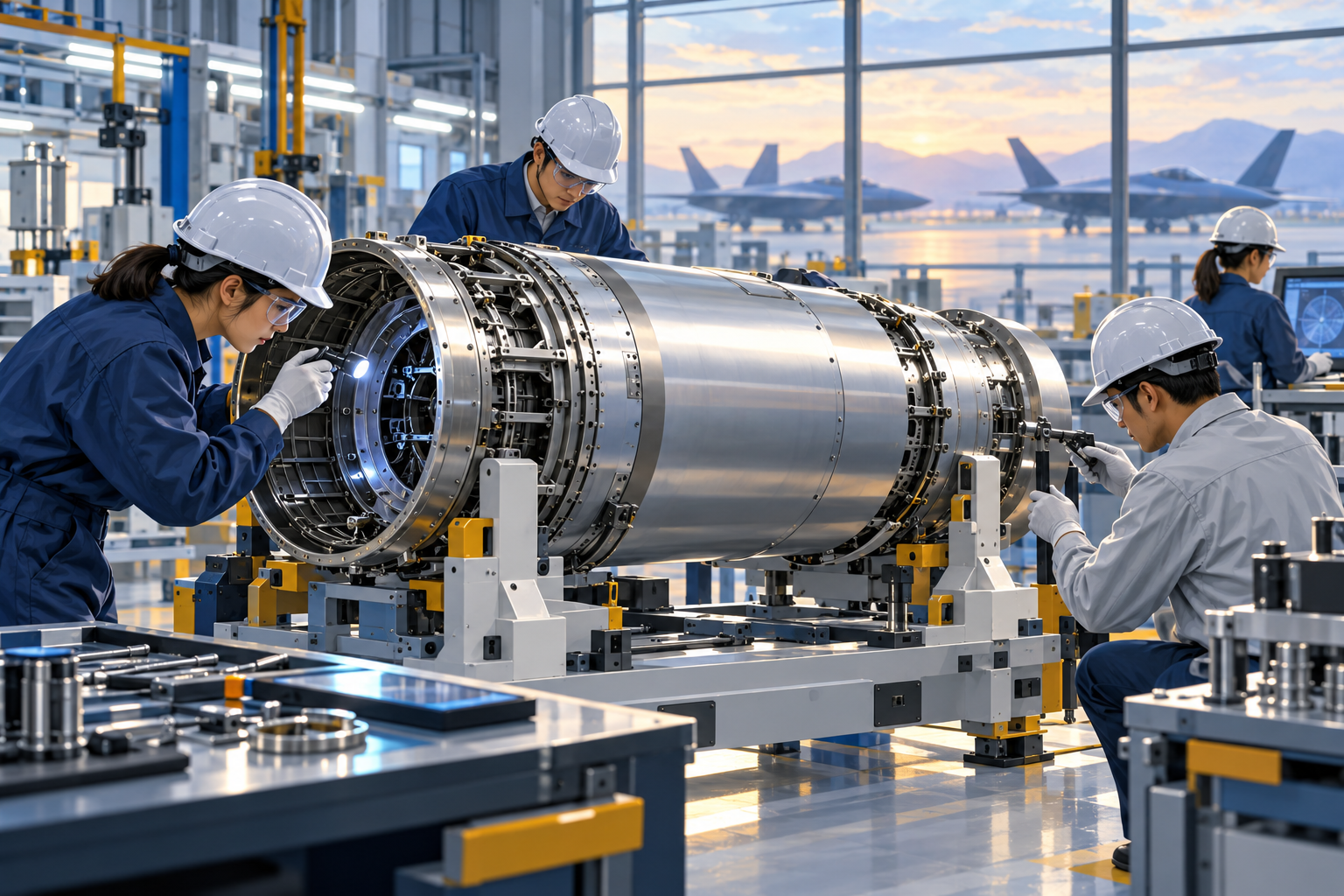
CEBU, Philippines - The United States and Japan agreed Wednesday to establish a final assembly and inspection facility in Japan for a widely used air-to-air missile, a step intended to expand allied production capacity as security pressure grows across the Indo-Pacific.
Japanese Defense Minister Shinjiro Koizumi announced the agreement after a 30-minute meeting with U.S. Defense Secretary Pete Hegseth on the sidelines of a regional defense gathering in Cebu. Japan's Defense Ministry said the facility will support final assembly and checkout of the Advanced Medium-Range Air-to-Air Missile, known as AMRAAM.
The two governments also agreed to share technical information needed to increase production of the SM-3 Block IIA interceptor, which is designed to destroy ballistic missiles outside the atmosphere. The interceptor was developed jointly by the United States and Japan and is used in naval missile-defense systems.
The Pentagon and Japan's Defense Ministry have placed the work under an initiative called Operation Supercharge, which seeks to reduce production bottlenecks and connect the countries' defense industries more closely. The announcements did not include a detailed construction schedule, location, cost or production target for the AMRAAM facility.
AMRAAM is carried by aircraft including the F-35, which both countries operate. Japan has been buying longer-range missiles and strengthening bases in its southwestern islands as Chinese military aircraft and ships operate more frequently around Japan and near Taiwan.
The Japanese ministry said Koizumi and Hegseth also discussed integrated air and missile defense, cyber cooperation and more flexible use of facilities by both countries' forces. They reviewed the Keen Sword 27 exercise and measures including dispersing aircraft, expanding access to bases and strengthening the Japanese military's presence in the southwest.
The agreement comes as allies examine how quickly they could replace expensive precision weapons during a prolonged crisis. Western militaries have supplied large quantities of munitions to Ukraine, while conflicts in the Middle East have added demand for air-defense interceptors. Those pressures exposed supply chains that were designed for efficiency and limited peacetime orders rather than sustained wartime consumption.
China's rapid military expansion is the central regional concern. Beijing has increased pressure around Taiwan, challenged Japanese control of the Senkaku Islands, which China calls the Diaoyu Islands, and expanded naval operations into the Pacific. North Korea's missile program presents a separate and immediate threat to Japan and U.S. forces stationed there.
At the same time, the United States has been reassuring Southeast Asian governments that stronger alliances are intended to deter conflict rather than force countries to choose sides. Hegseth's visit to Cebu came during meetings with regional counterparts, where concerns about maritime coercion and freedom of navigation remain prominent.
Deterrence now depends on production, not promises
Security commitments are credible only when democratic allies possess the equipment, maintenance capacity and supply depth to carry them out. A treaty can signal political will, but it cannot replace an interceptor that takes years to order or a production line vulnerable to one disrupted supplier.
Putting final assembly and inspection capacity in Japan should make the alliance more resilient. It distributes technical knowledge, reduces dependence on factories thousands of miles away and gives Japan a greater role in sustaining aircraft that defend its own territory. The SM-3 information-sharing agreement addresses the same problem at a different layer of missile defense.
This is also an answer to the industrial scale of authoritarian competitors. China has spent decades expanding shipyards, missile production and military manufacturing under a state-directed system. The United States and Japan cannot copy that political model, nor should they. Their advantage must come from open alliances, private innovation, skilled workers and rules that allow partners to trust one another with sensitive technology.
That democratic model requires oversight. Governments should disclose costs, protect competition where possible and explain how facilities will be secured and governed. Production urgency must not become an excuse for waste or permanent secrecy. Public confidence is stronger when citizens can see both the threat assessment and the safeguards around spending.
The agreement should not be described as proof that war is inevitable. Its purpose is to make aggression less attractive by showing that attacks would face capable defenses and that allied stockpiles could be replenished. Deterrence fails when an adversary believes a democracy lacks the endurance to honor its commitments.
Japan's larger defense role will remain politically sensitive because of its postwar history. That makes transparency and coordination especially important. But refusing to prepare would not make the region safer while missiles, naval forces and coercive pressure continue to expand around it.
The practical significance of Wednesday's announcement will depend on what follows: where the facility is built, how quickly it operates, how many components can be sourced reliably and whether production actually increases. The strategic message is already clear. The U.S.-Japan alliance is moving from declarations toward a shared industrial base, because preserving peace increasingly depends on the ability to build what deterrence requires.
Comments
Loading comments…