
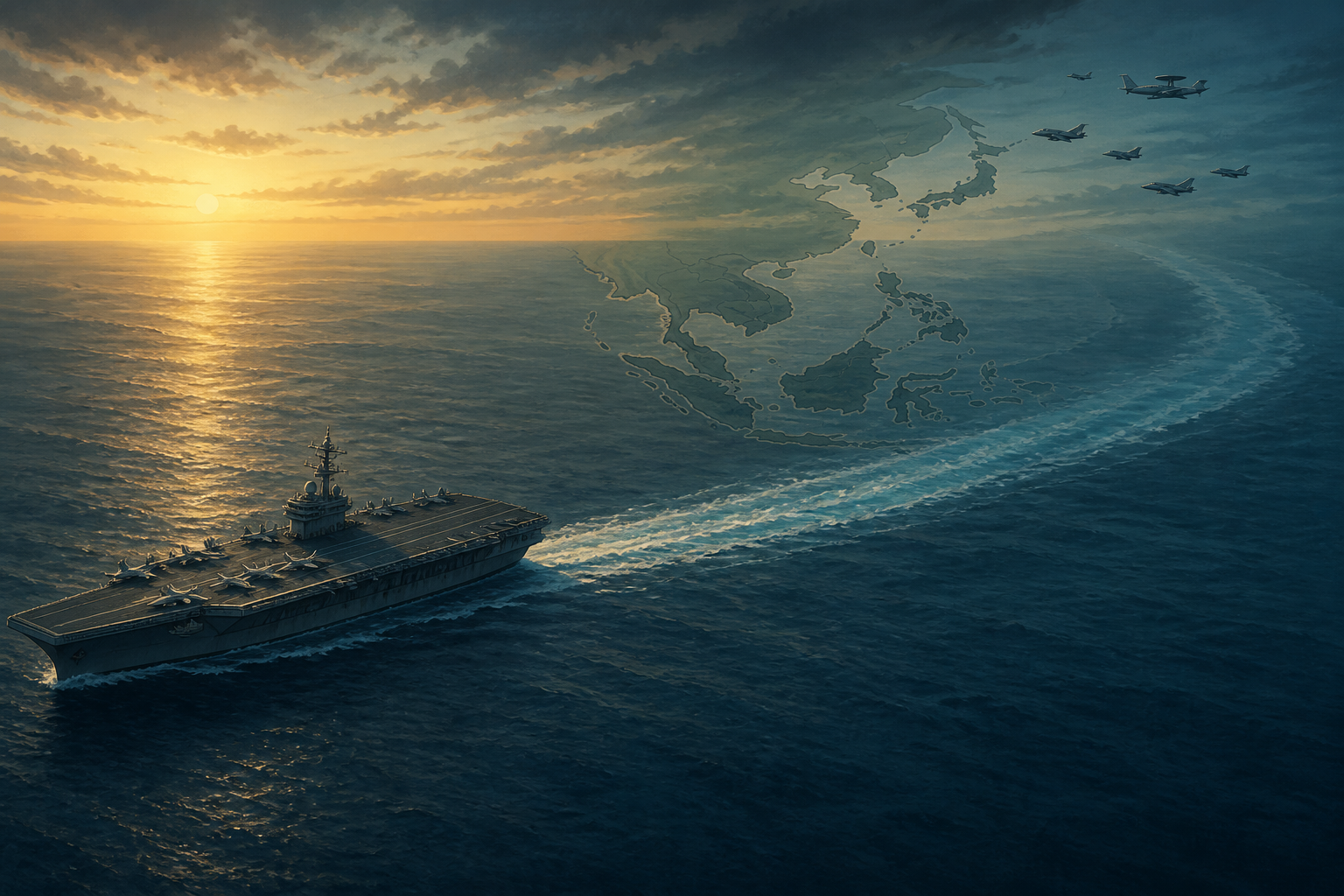
WASHINGTON - The United States is moving its only aircraft carrier in the western Pacific toward the Middle East, creating at least a temporary gap in one of the world's most strategically important regions while the Navy relieves a crew stretched by the war with Iran.
The USS George Washington is expected to replace the USS Abraham Lincoln, according to reporting by The Associated Press. The Lincoln has remained deployed beyond its planned May return and has spent more than 240 consecutive days at sea supporting U.S. operations against Iran.
The George Washington left a scheduled port visit in Da Nang, Vietnam, and was later observed crossing the Singapore Strait. A Navy official confirmed to AP that the carrier was in the Strait of Malacca, placing it on a route toward the Indian Ocean and the Middle East.
The Navy has not said how long the western Pacific will be without a U.S. carrier. Another ship could deploy within the next several months, and American power in Asia does not disappear when one carrier leaves. Submarines, bombers, land-based aircraft, Marines and allied forces remain spread across the region.
Still, carriers carry political weight beyond their aircraft. Their presence reassures Japan, the Philippines and other partners that Washington can respond quickly during a crisis. Their absence gives Beijing an opportunity to argue that China is the enduring regional power while the United States is distracted elsewhere.
The timing is sensitive. China has continued military pressure near Taiwan and disputed waters in the South China Sea. AP reported Chinese drills near Scarborough Shoal, claimed by both China and the Philippines, as well as a recent live-fire exercise by a Chinese destroyer near Japan's southernmost island of Okinotori. China also conducted naval exercises with Indonesia this week.
No serious analyst is claiming that moving one carrier makes a Chinese attack imminent. Deterrence is a system, not a single ship. But deterrence also depends on perception, and gaps invite rivals to test boundaries with patrols, coercion and incremental pressure that remain below the threshold of open war.
The move also exposes the human limit behind military planning. Reports of supply and mental-health problems aboard the Lincoln prompted lawmakers to seek greater oversight. The Navy has disputed claims of increased suicidal behavior and says sailors have clean water and healthy meals, but the extraordinary deployment length is not in dispute.
A warship is not an abstract symbol on a map. It is a floating city of sailors working around dangerous machinery, aircraft and weapons for months without normal rest. Exhaustion affects maintenance, judgment and morale. Rotating the Lincoln home is therefore not weakness; it is necessary to preserve the force that future crises may require.
The harder question is why the United States reached a point where relieving one exhausted carrier creates visible uncertainty in Asia. Washington has global commitments but a finite fleet. The USS Gerald R. Ford returned in May after an 11-month deployment, while the Lincoln's mission kept expanding. Strategy becomes fragile when every unexpected crisis is answered by extending the same people and equipment.
America should remain capable of confronting Iran and protecting navigation through the Strait of Hormuz. It should also resist the Chinese Communist Party's effort to dominate its democratic neighbors and rewrite maritime rules through pressure. Doing both requires priorities, sustainable rotations and more contributions from capable allies, not promises that every mission can continue indefinitely without cost.
Pacific allies can help by investing in dispersed air defense, anti-ship systems, logistics and resilient bases. The United States should accelerate ship maintenance, munitions production and agreements that let forces operate from more locations. A carrier is powerful, but a wider network is harder for an adversary to intimidate or disable.
The George Washington's departure may prove brief. Even so, it is a warning. American credibility is strongest when commitments are backed by forces that can endure, crews that are protected and leaders willing to admit tradeoffs. Beijing watches not only what Washington says, but what it can sustain.
Comments
Loading comments…