
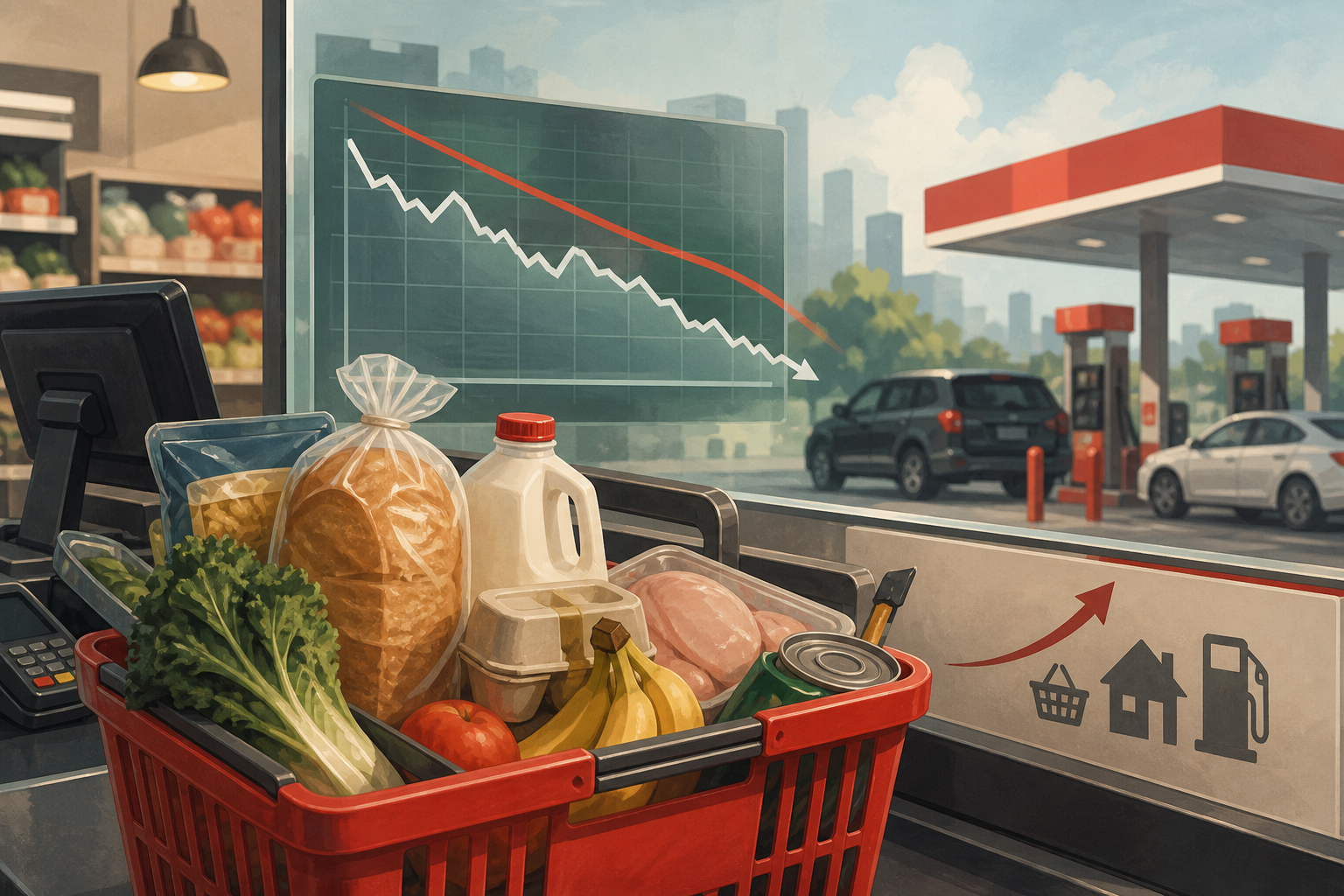
WASHINGTON - U.S. inflation eased in July as gasoline prices declined, offering households and the Federal Reserve a measure of relief even though the cost of living remained elevated and workers' inflation-adjusted hourly earnings slipped.
The Consumer Price Index rose 0.1% from June and 3.4% from a year earlier, the Bureau of Labor Statistics reported on Wednesday. The annual rate was down from 3.5% in June. Excluding volatile food and energy prices, the core index increased 0.2% for the month and 2.5% over the year, also one tenth of a percentage point lower than in June.
The details were mixed. Energy prices fell 1.5% during July and gasoline declined 2.9%, helping restrain the headline figure. Grocery prices edged down 0.1%, while food consumed away from home rose 0.3%. Shelter increased 0.1% and accounted for roughly two-thirds of the overall monthly gain, according to BLS.
Some categories continued to rise quickly. Airline fares increased 2.2% in one month, medical-care services rose 0.6%, and apparel prices were 3.9% higher than a year earlier. Energy was still 14.7% more expensive than in July 2025, with the gasoline index up 24.6% over the year despite July's monthly decline. That explains why the national data can look better while many family budgets still feel worse.
A separate BLS report showed that real average hourly earnings for all private nonfarm employees fell 0.1% from June to July and were down 0.2% from a year earlier. Real weekly earnings were unchanged for the month and up only 0.1% over the year. Inflation is cooling, but the average worker has not received a broad improvement in hourly purchasing power.
The Associated Press reported that the figures could reduce pressure on the Federal Reserve to raise its benchmark interest rate, currently about 3.6%. The central bank is confronting an awkward combination: inflation remains above its 2% goal, while recent employment data showed weakness. Raising rates could restrain prices but further slow hiring; holding steady risks allowing another price surge to become embedded.
The July report is evidence that the American economy is absorbing several shocks without losing control. Higher tariffs, the Iran war's impact on oil and gas, and extraordinary investment in artificial-intelligence infrastructure have all added price pressure in different parts of the economy. Yet core inflation moved back toward its post-pandemic low instead of accelerating across a broad range of goods and services.
That resilience matters. The United States still has deeper capital markets, stronger consumer demand and more room for technological investment than its authoritarian competitors. Its advantage, however, depends on economic credibility. Families must be able to trust that official optimism reflects what they encounter at the supermarket, the pharmacy and the fuel pump.
The political temptation is to celebrate one favorable report as a victory or dismiss every difficult number as someone else's fault. Both responses are too easy. A 3.4% inflation rate means prices are still rising faster than the Federal Reserve's target, and the cumulative increase from earlier years is not reversed when the annual rate declines. Lower inflation slows the climb; it does not restore the old price level.
Policymakers should also separate temporary movements from structural pressure. July's gasoline decline helped significantly, but AP noted that pump prices rose again in late July and August. Services inflation was 3% over the year, and service costs are less directly tied to monthly energy swings. If oil prices jump or firms pass delayed input costs to customers, headline inflation could accelerate again.
For the Federal Reserve, patience now has a defensible case. The monthly core reading of 0.2% is compatible with gradual progress toward the 2% target if it persists. At the same time, officials should avoid promising rate cuts or declaring that inflation has been defeated. Credibility comes from responding to sustained evidence, not from giving markets the answer they want after a single release.
For the administration and Congress, the priority should be expanding supply and competition: energy resilience, housing construction, efficient ports, domestic production and a stable trade framework. Tariffs can defend strategic industries, but poorly targeted costs are eventually paid somewhere in the supply chain. A strong America can protect essential production while being honest about those tradeoffs.
July's report is a welcome improvement, but it is a pause in the pressure rather than an all-clear. The next test is whether wages regain purchasing power while inflation continues to cool. That combination, rather than a market rally or a political headline, is what would turn better statistics into a better daily economy.
Comments
Loading comments…