
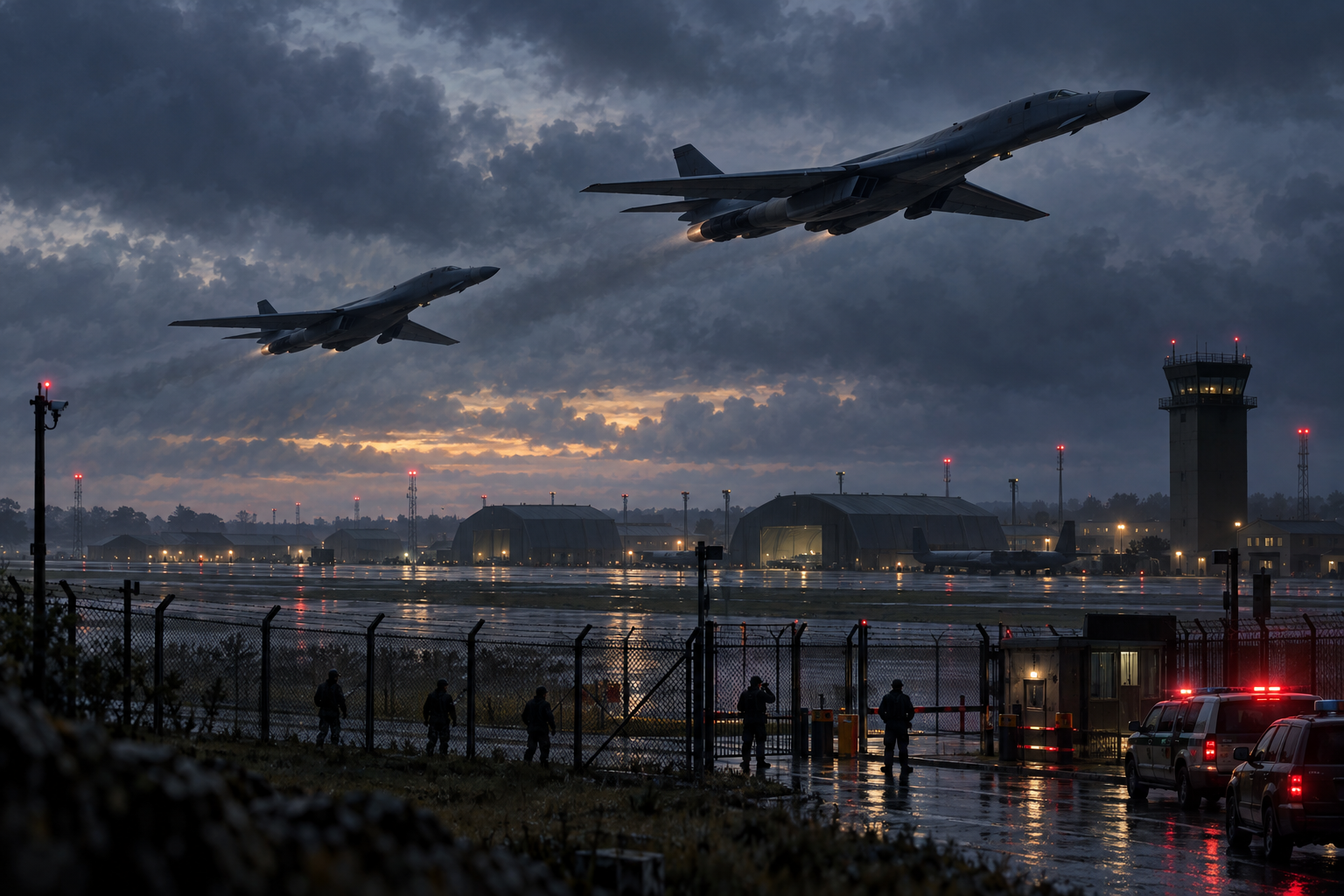
LONDON - The United States has withdrawn B-1 bombers from RAF Fairford in England after a security threat near the base, President Donald Trump said Monday, linking the threat to Iran while British counterterrorism police continue an investigation into possible foreign-state involvement.
The aircraft returned to their home stations in the United States. A Pentagon official confirmed the redeployment, and the Pentagon said the American bomber force remained capable of conducting global strikes. RAF Fairford, about 90 miles west of London, is one of the few European bases equipped to support heavy U.S. bombers.
The base has been used during the war with Iran, including for strikes that Britain described as defensive operations against Iranian missile sites threatening shipping in the Strait of Hormuz. Moving the aircraft creates more distance from the immediate threat but could complicate rapid bomber missions from Europe.
Trump told reporters that U.S. officials had information suggesting a threat and decided there was little reason to leave valuable aircraft exposed. Asked whether those responsible were connected to Tehran, he said they would be linked to Iran. Vice President JD Vance said the bombers were moved out of an abundance of caution.
Secretary of State Marco Rubio offered a more limited account, saying there was no direct link between the sudden movement and the suspected plot and that the Pentagon routinely reallocates forces. Iran has denied involvement and called accusations against it baseless.
The security investigation began after police received reports of suspicious vehicles travelling toward RAF Fairford early on Sept. 27. Five British men in their 20s were arrested near the base on suspicion of explosives offenses and preparing a terrorist act. A sixth suspect, a 25-year-old dual British-Iranian national, was arrested in London on Oct. 1 on suspicion of preparing terrorist acts.
All six have been released on bail while the investigation continues. British Counter Terrorism Policing has not announced charges or said that Iranian responsibility is proven. Senior coordinator Vicki Evans said investigators were examining multiple lines of inquiry, including possible foreign-state involvement.
Deterrence now extends beyond the battlefield
The redeployment is a prudent protection measure, not an admission of military defeat. Aircraft can be replaced at another operating location; crews and billion-dollar strategic assets cannot be casually left inside a known threat envelope. Commanders are supposed to reduce avoidable risk while preserving the ability to act.
Yet the episode exposes a harder reality of modern conflict. An authoritarian state does not need to defeat the U.S. Air Force in open combat to impose costs. A warning, a suspected proxy network or a small group near a base can force security changes, consume intelligence resources and strain alliances. Cheap asymmetric pressure can move expensive democratic military power.
That is precisely why attribution must be disciplined. Iran has a documented history of using proxies and has publicly treated bases used for attacks on its territory as potential targets. Those facts justify vigilance. They do not erase the need for evidence about this specific incident. Public officials weaken their own credibility if an initial assessment is presented as a completed criminal case.
The contrast between American and British statements also matters. Washington is speaking in strategic terms about an Iranian threat; British police are building an evidentiary case governed by domestic law. Those roles are different. Intelligence can justify moving aircraft before it is detailed enough to support charges in court, but allies need a common public account before uncertainty becomes a source of mistrust.
Britain's decision to grant the United States limited use of Fairford also shows the pressure placed on allies. London supported defensive strikes while restricting broader offensive operations. That distinction may be politically necessary, yet an adversary may still treat the base as part of the war. Hosting American power brings deterrence and protection, but it also brings exposure.
The United States and Britain should respond on two tracks: harden key installations against drones and sabotage, and disclose verified facts when doing so will not compromise the investigation. Democracies cannot imitate authoritarian secrecy every time a threat emerges. Public confidence comes from proving that security measures are proportionate and that suspects are judged individually.
Fairford remains secure, the bombers remain available, and no attack on the aircraft has been reported. Those are important facts. The warning is that distance alone will not end the threat. Western deterrence must protect bases, supply lines and civilian institutions while denying hostile governments the confusion they seek to create through deniable operations.
Comments
Loading comments…