
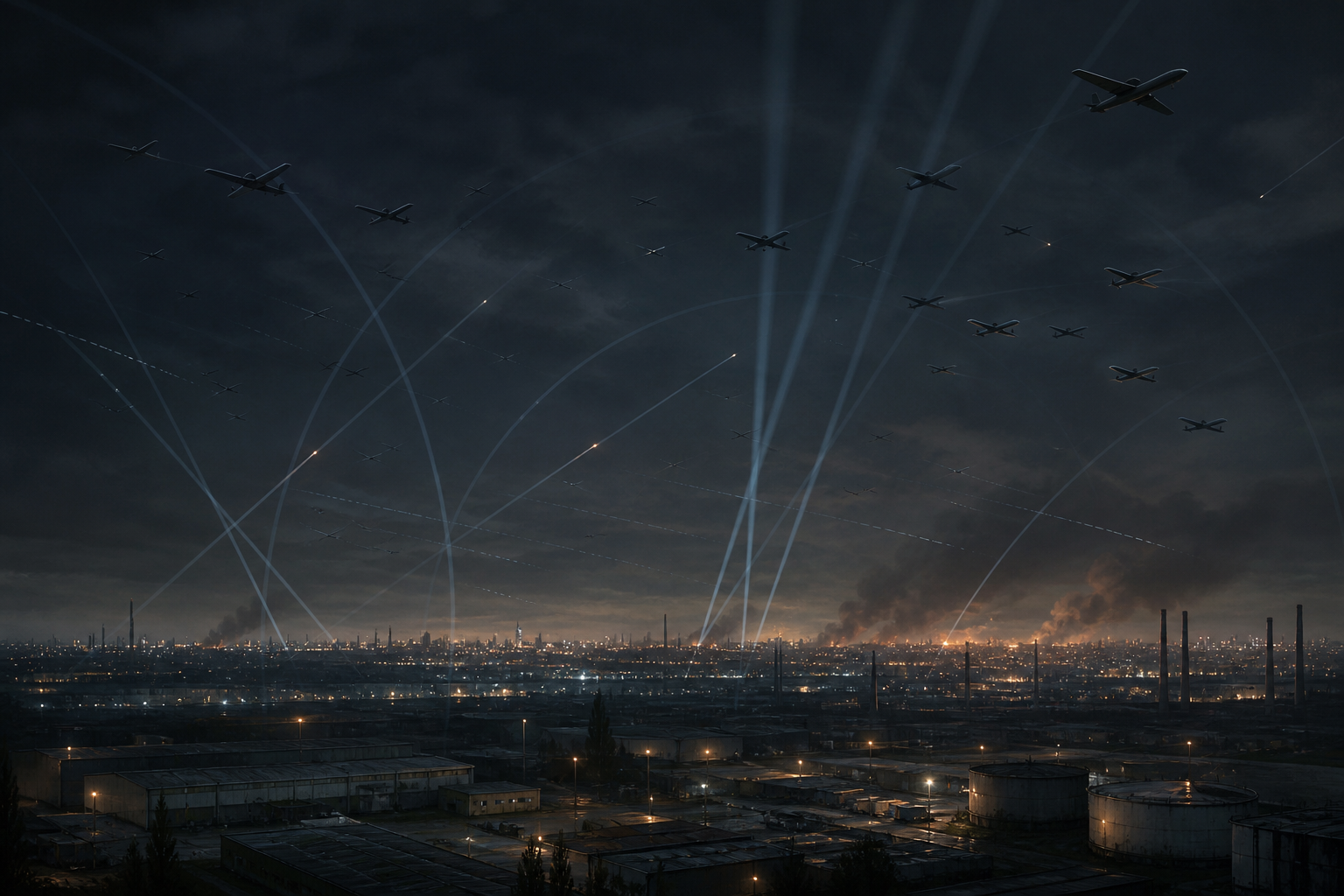
KYIV - Ukraine launched hundreds of long-range drones across Russia on Sunday in one of the largest aerial operations of the war, killing at least six people according to Russian regional officials and demonstrating that Moscow's invasion can no longer be kept far from Russia's own cities and industries.
The exact scale could not be independently verified. Russia's Defense Ministry said it destroyed 822 Ukrainian drones overnight, while Moscow Mayor Sergei Sobyanin said about 600 were detected heading toward the capital and 201 were destroyed over the Moscow region. A later Russian claim covering a broader 24-hour period put the national interception total at 1,478. The differing figures and reporting windows underline why official wartime counts must be treated cautiously.
One drone struck a private home in the Moscow region and killed an 83-year-old man, local Gov. Andrey Vorobyov said. Five other people were reported killed in attacks across the southern Rostov region, where officials said homes and a railway station were damaged and a forest fire began.
A major fire also swept through a Wildberries distribution center near Podolsk, south of Moscow. The Guardian reported that the warehouse covered about 250,000 square meters. Ukraine says Wildberries facilities support Russian military logistics, but the warehouses also hold goods belonging to ordinary businesses, making attacks on them economically disruptive and legally and morally more complicated than strikes on an unmistakable weapons plant.
Ukraine has increasingly used domestically produced drones and missiles to hit Russian military industries, fuel infrastructure and logistics far behind the front. Kyiv says the campaign is intended to reduce the resources available for Russia's invasion and force Russian society to experience some of the cost that Ukraine has endured for more than four years.
Russia continued its own attacks on Ukraine during the same period. A missile strike on Kryvyi Rih killed two people and wounded 14, according to President Volodymyr Zelenskyy. Other strikes killed civilians in Sumy and Zaporizhzhia regions. Fires in Kyiv wounded six people and burned through the city's Petrovka book market, where booksellers described losing their stock ahead of the school season.
The aerial conflict also crossed another NATO boundary. Romania's Defense Ministry said a Spanish F-18 on an air-policing mission shot down a drone after it entered Romanian airspace near Galati. Romanian officials did not publicly identify the drone's origin. Moldova separately reported tracking a Geran-type drone that entered its airspace from Ukraine and continued toward Romania.
The operation shows a genuine shift in capability. Russia began the full-scale invasion with a much larger missile force and the expectation that its rear areas would remain protected. Ukraine has built a comparatively inexpensive deep-strike arsenal that can force Moscow to disperse air defenses, interrupt airports, protect industrial facilities and explain casualties to a public long shielded from the war.
That does not mean mass drone raids will decide the conflict. Russia can absorb damage across an enormous territory, and claims of interception are difficult to test. Drones that penetrate defenses may burn warehouses or halt production, but tactical disruption becomes strategic leverage only when it consistently reduces military output or changes the Kremlin's choices.
The civilian deaths also require honesty. Ukraine is defending itself against an authoritarian state that invaded its territory, occupied cities and has repeatedly attacked civilian infrastructure. That context matters. It does not erase the duty to distinguish military targets from civilians, investigate errors and avoid treating Russian families or small businesses as acceptable symbols of pressure on Vladimir Putin.
Moscow exploits every Ukrainian strike for propaganda while denying or minimizing the far greater destruction its forces have inflicted in Ukraine. Democracies should reject that manipulation without adopting the Kremlin's moral standard. Support for Ukraine is strongest when its operations remain tied to lawful defense and clearly identified military effect.
The harder reality is that inexpensive unmanned aircraft have made distance a weaker form of protection for every country. A few attackers can force defenders to spend heavily on interceptors, sensors and constant readiness. Civil airports, warehouses and energy sites become part of the same contested airspace as military facilities. NATO's interception over Romania shows how quickly an attack intended for one country can create danger in another.
Ukraine's expanding reach can raise the cost of aggression and challenge the Kremlin's promise of security at home. Western partners should help Kyiv target military infrastructure accurately while strengthening air defense for Ukrainian cities and NATO's eastern edge. The purpose should be to end Russia's ability to wage its invasion, not to normalize an endless exchange in which ever-larger swarms make civilians on both sides pay for decisions made by the Kremlin.
Comments
Loading comments…