
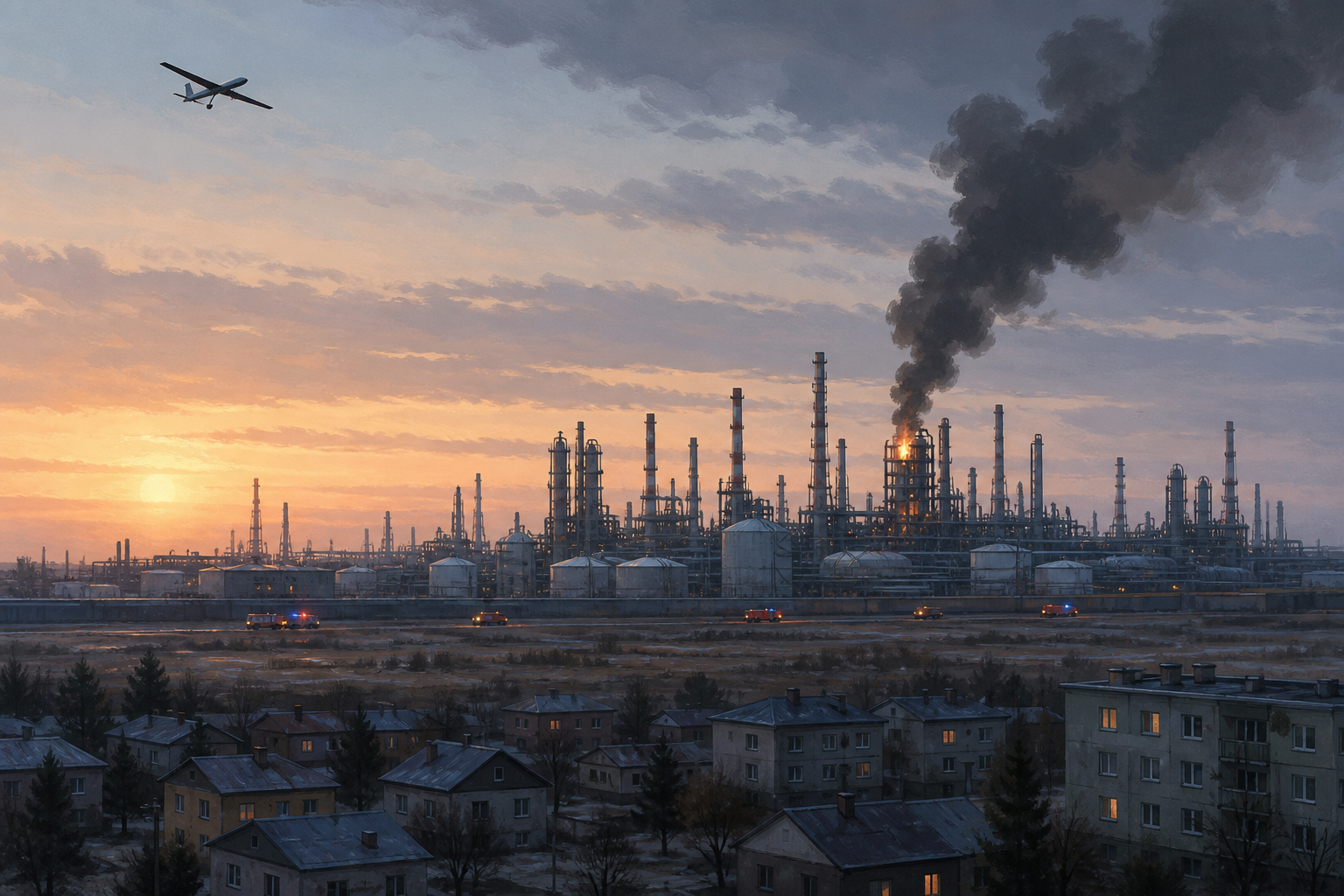
NIZHNEKAMSK, Russia — A Ukrainian drone attack on the oil-refining city of Nizhnekamsk killed 13 people on Monday, August 10, according to authorities in Russia’s Tatarstan region, while Ukraine’s military said its intended target was the Taneco refinery.
Tatarstan’s official information channel said 75 people had sought medical care by 2 p.m. local time and 21 were hospitalized. One child was among the dead. Regional authorities declared a day of mourning, and the city opened temporary accommodation for residents whose homes were damaged. The Associated Press reported the same toll, describing the 75 as injured.
Nine of those killed died at a hostel in the industrial area, according to Tatarstan’s state media agency and the Associated Press. Uzbekistan’s consular office identified seven Uzbek nationals among those killed, AP reported. Officials did not immediately publish a complete list of the dead.
Ukraine’s General Staff said its forces struck the Tatneft-owned Taneco refinery overnight and that a fire was recorded at the site. It said the operation was intended to reduce Russia’s capacity to wage war. The refinery lies roughly 1,200 kilometres east of Ukraine’s border, making the attack another demonstration of Kyiv’s expanding long-range drone reach.
Russian officials presented a different account of the attack’s purpose. Nizhnekamsk Mayor Radmir Belyayev said drones had hit both industrial and civilian sites, and Russia’s Investigative Committee opened a terrorism case. Neither the mayor nor the regional authorities identified the precise industrial installations struck. There was no immediate independent evidence establishing whether the hostel and residential areas were deliberately targeted, hit by drones that missed their targets, or damaged by debris after interception. The extent of damage at Taneco also remained unverified.
That uncertainty matters because Nizhnekamsk is not an incidental point on Russia’s energy map. Taneco is one of the country’s largest and most technically advanced refineries, using complex units to turn crude into gasoline, diesel, aviation fuel and other products. Industry data cited by Reuters show that it processed about 17 million tonnes of crude in 2024. Ukraine has attacked the refinery before, including in June and July, as part of a wider campaign against Russian fuel infrastructure.
The strategic logic is direct. Crude oil cannot fuel tanks, aircraft or trucks until it is refined, and sophisticated processing units are harder to replace than storage tanks. Repeated strikes can force shutdowns, divert air-defence resources and increase the cost of repairs, especially when sanctions complicate access to imported equipment. The recent campaign has reduced refining capacity and contributed to fuel shortages inside Russia, according to reporting by the Associated Press and Reuters.
Yet an oil refinery is also part of a civilian economy. It supplies ordinary motorists and businesses, employs civilian workers and may sit beside housing and temporary accommodation. That makes the label “energy target” the beginning of a legal and moral assessment, not the end of one.
Under international humanitarian law, an object may be attacked only if it effectively contributes to military action and its destruction offers a definite military advantage in the circumstances. Even then, an attacker must distinguish civilians from military objectives, take feasible precautions and refrain from an attack if the expected civilian harm would be excessive in relation to the concrete and direct military advantage anticipated. Those rules apply to Ukraine and Russia alike.
The publicly available information is not sufficient to decide whether Monday’s strike complied with those standards. That would require evidence about the target selected, the weapons and flight paths used, the intelligence available to Ukrainian commanders, the expected presence of civilians and any Russian interceptions. Moscow’s designation of the incident as terrorism is therefore an allegation, just as Kyiv’s statement that it hit the refinery does not by itself explain the reported civilian deaths.
The wider context remains essential. Russia began the full-scale invasion in February 2022 and continues large missile, drone and glide-bomb attacks on Ukrainian cities. United Nations monitors recorded 1,396 civilians killed and 7,978 injured in Ukraine during the first half of 2026, a 37 per cent increase from the same period a year earlier. The same UN release cited Russian authorities as reporting 250 civilians killed and 1,596 injured inside Russia over those six months.
That profound imbalance in responsibility and harm does not create a licence for reciprocal civilian suffering. Ukraine’s case for international support rests not only on its right to defend itself against aggression, but also on its claim to fight differently from the authoritarian state attacking it. A campaign that degrades Russian war logistics can be strategically rational; one that cannot reliably protect civilians risks eroding that legitimacy and handing the Kremlin a propaganda victory.
Nizhnekamsk therefore presents Kyiv with two tests at once. The first is military: whether long-range drones can impose durable costs on a refinery far beyond the front. The second is democratic and legal: whether Ukraine can account credibly for a strike that Russian officials say killed a child and 12 other people. The next evidence to watch is verified imagery of the damage, a fuller casualty accounting and any Ukrainian explanation of how civilian sites came to be hit.
Comments
Loading comments…