
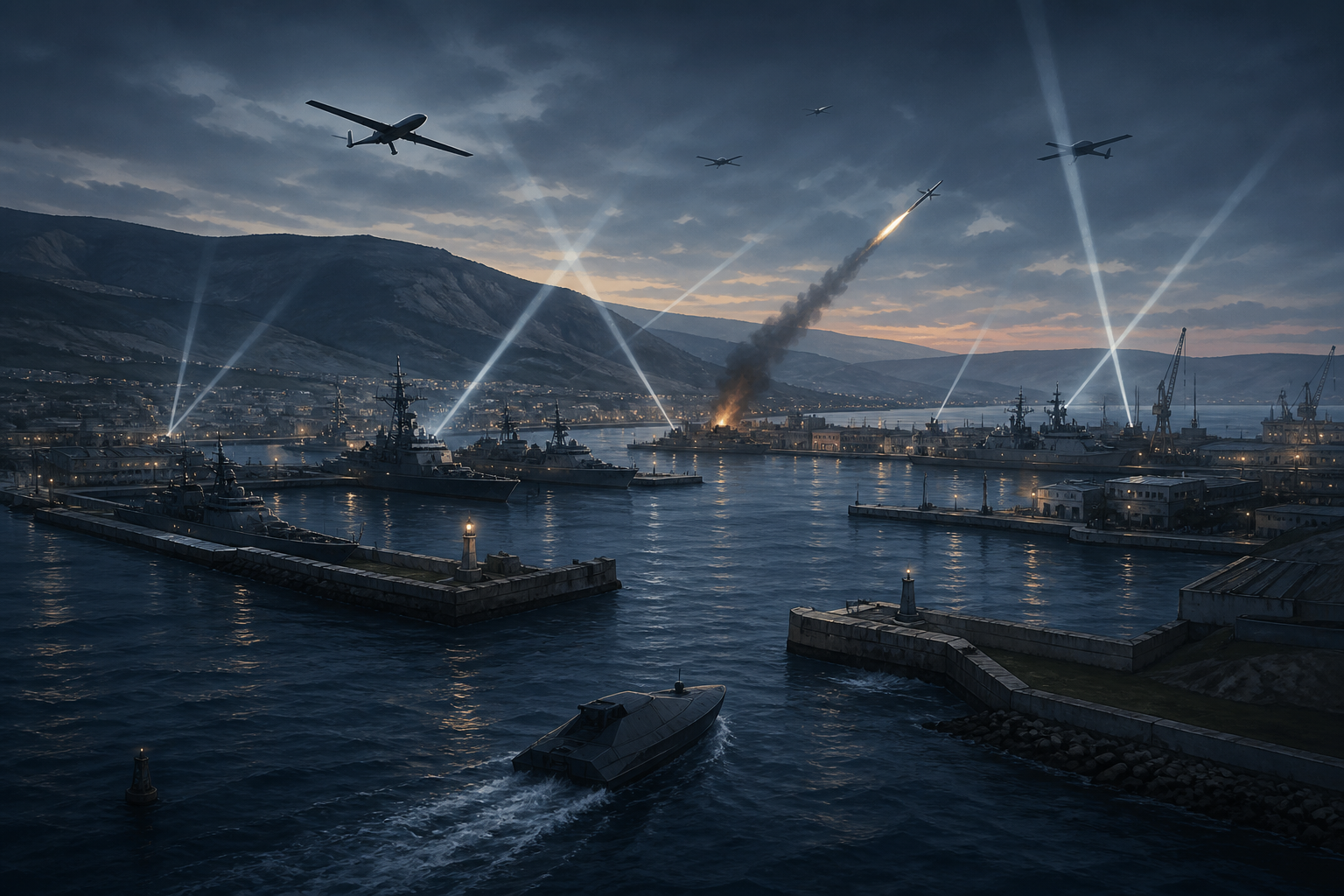
KYIV, Ukraine - Ukraine said on Wednesday that its forces carried out a combined missile and drone attack on the Russian naval base at Novorossiysk, striking air-defense positions, piers and port infrastructure at what President Volodymyr Zelenskyy called Moscow's last major Black Sea fleet stronghold.
In an official statement, Zelenskyy said Ukrainian forces used Palianytsia jet-powered drones, Neptune missiles and unmanned maritime systems against designated targets more than 300 kilometers from the front line. The Associated Press reported the attack and said Ukrainian officials described it as a coordinated nighttime operation. The extent of the military damage has not yet been independently established, and no confirmed list of vessels hit was available at the reporting cutoff.
Russian authorities acknowledged an unusually large assault across the Krasnodar region. Governor Veniamin Kondratyev said hundreds of drones targeted Novorossiysk, Anapa, Gelendzhik and the Temryuk district. Russia's Defense Ministry claimed its air defenses destroyed more than 500 Ukrainian drones. Such interception claims cannot be independently verified in real time, but reports from both sides confirm that the region came under a major attack.
The human cost was immediate. Kondratyev said an 8-year-old child was killed in Novorossiysk and another person wounded in Temryuk later died in hospital. Twelve other people were injured, he said, while falling debris damaged industrial sites and residential buildings. Ukraine did not address those reported civilian casualties in Zelenskyy's statement. A legitimate military objective does not remove the obligation to minimize harm to civilians.
The attack also affected commercial infrastructure. The Russian business newspaper Vedomosti reported that two of Novorossiysk's three grain terminals were damaged and one stopped operating. That report was cited by AP but had not been independently confirmed by Ryu News. No report indicated that the nearby Grushovaya oil terminal was struck.
Russia attacked Ukraine during the same night. Ukraine's air force said Moscow launched 138 long-range drones along with missiles, with damage recorded at 16 locations. Regional officials said two people were killed in the Kherson region, while a shopping mall in Zaporizhzhia was destroyed and a residential fire broke out in Odesa. The parallel attacks underline how deep-strike warfare is now operating in both directions, even as the original cause remains Russia's full-scale invasion of Ukraine.
Novorossiysk matters because it became the refuge for much of Russia's Black Sea Fleet after Ukrainian strikes made Sevastopol in occupied Crimea increasingly dangerous. Moscow moved ships east, strengthened harbor defenses and treated distance as protection. Ukraine's message on Wednesday was that relocation no longer guarantees sanctuary.
That is a significant strategic achievement for a democracy fighting a larger authoritarian power. Ukraine has used domestically developed missiles and relatively inexpensive unmanned systems to constrain a navy that once dominated the Black Sea. The effect is larger than any single damaged pier: Russia must spread air defenses, protect more coastline and decide whether valuable ships can safely remain concentrated in port.
The harder reality is that military adaptation does not stay neatly inside military boundaries. Novorossiysk is also a major grain and energy gateway. The Caspian Pipeline Consortium carries crude from Kazakhstan to the Russian coast and serves fields in which American companies Chevron and ExxonMobil have interests. Washington previously objected when attacks around the port threatened that route. Kyiv therefore has to balance pressure on Russia's war machine against the risk of harming civilians, food exports and infrastructure connected to partners.
Russia faces the same issue in far more severe form because it has repeatedly attacked Ukrainian cities, homes and energy systems as part of the invasion. Moscow's answer has been escalation and denial rather than withdrawal. Zelenskyy also said Ukrainian intelligence believes the Kremlin is preparing another large mobilization, though Russian officials denied that claim and no public evidence has independently confirmed the alleged timetable.
For Ukraine's partners, the operation demonstrates why continued support for air defense, intelligence and domestic weapons production can alter the balance without pretending the war is cost-free. A smaller state can deny an aggressor easy control of the sea when technology, targeting and political will are combined. But partners should continue demanding credible battle-damage assessments and transparent accounting of civilian casualties.
The next evidence will matter more than triumphal claims from either capital. Satellite imagery, port operations, ship movements and repair activity will show whether Ukraine caused lasting military damage or mainly forced another expensive defensive response. What is already clear is that the Black Sea is no longer a secure rear area for Russia, and the invasion continues to push danger deeper into places Moscow once assumed were beyond Ukraine's reach.
Comments
Loading comments…