
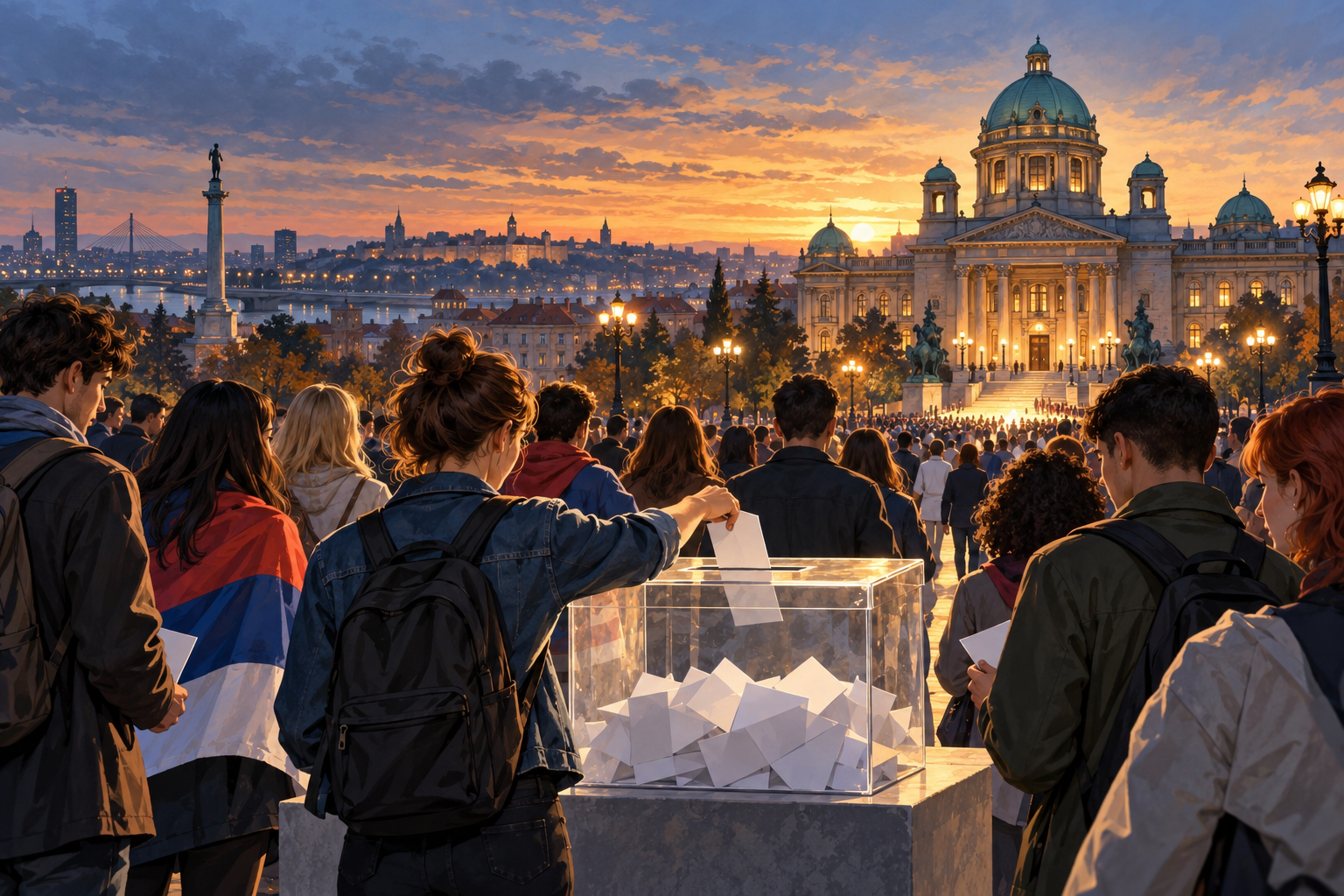
BELGRADE, Serbia - Aleksandar Vucic conceded defeat in Serbia's parliamentary election on Sunday after preliminary projections showed a student-led movement winning a majority, a result that could end his party's 14-year domination of national politics.
Vucic told supporters that the Students' List was projected to take between 135 and 140 seats in the 250-member parliament, while his Serbian Progressive Party, or SNS, was expected to win about 105. He said the student-backed list received roughly 2.2 million votes compared with about 1.7 million for his side.
Official final results were still pending, but Vucic's concession removed the central uncertainty over who had won. Crowds poured into Belgrade's streets within minutes, honking car horns, dancing and chanting in a celebration that spread to other Serbian cities.
Turnout was close to 70%, according to pollsters and the election commission, the highest level since the breakup of Yugoslavia in 1992. The unusually heavy participation was widely seen as favoring a movement that had spent nearly two years turning street demonstrations into a nationwide electoral campaign.
The protests began after a concrete canopy at the renovated railway station in Novi Sad collapsed in November 2024, killing 16 people. Students and other demonstrators argued that the disaster exposed corruption, weak oversight and a political system that protected officials from accountability. The government denied accusations of corruption and repression, while Vucic repeatedly portrayed the movement as influenced by foreign interests.
The Students' List brought together university professors, actors, farmers and other largely unknown candidates rather than relying on Serbia's established opposition parties. Cardiologist Ilija Srdanovic led the list, but the movement had not yet identified who would serve as prime minister or fill the most powerful ministries.
European Commission President Ursula von der Leyen and EU enlargement commissioner Marta Kos congratulated the movement and said the bloc was ready to work with Serbia on its European future. That message matters because Serbia has long tried to balance its formal ambition to join the European Union with deep energy ties to Russia and major investment from China.
Vucic, who had served as either prime minister or president since 2014, stepped down during his second presidential term to lead the SNS ticket as a candidate for prime minister. His supporters credit him with roads, railways, hospitals and economic modernization. His critics accuse his political machine of concentrating power, weakening independent institutions and dominating much of the media environment.
A victory at the ballot box is the beginning, not the repair
The result is an important democratic answer to a familiar authoritarian tactic: dismiss public anger as foreign manipulation until citizens begin doubting their own ability to change the system. Nearly 70% turnout made that story harder to sustain. Serbians did not need an outside power to explain why a railway station collapse, unanswered questions and years of concentrated rule demanded accountability.
There is also a lesson in how the movement won. Protest alone can expose a government's failures, but it does not automatically replace it. The students built a candidate list, reached voters beyond university campuses and accepted the discipline of an election. They moved from moral pressure to institutional competition without surrendering the anti-corruption cause that gave the movement legitimacy.
That achievement should not be romanticized. A coalition of professors, farmers, performers and activists may be effective at defeating an entrenched ruling party while still struggling to govern. Serbia needs budgets, judges, professional police leadership, credible procurement rules and a foreign policy that cannot be improvised in a public square. The uncertainty over the next prime minister is therefore not a minor detail.
The harder danger comes after celebration. Political systems built around one leader do not disappear when that leader concedes. Loyalists remain inside ministries, state companies, security institutions and media organizations. Business networks formed under the old order can resist scrutiny, while inexperienced winners may be tempted to replace one partisan structure with another.
A democratic transition will be measured by restraint as much as speed. Investigations should follow evidence, public contracts should become transparent and institutions should serve citizens rather than conduct revenge. The movement's mandate is strongest when it applies the rules it demanded from its opponents.
Serbia's new leaders will also face pressure from Moscow, Beijing, Brussels and Washington. Russia will want to preserve strategic and energy influence. China will seek protection for its investments. The EU will offer a democratic destination but demand difficult reforms. None of those powers should be allowed to substitute its preferences for the choice Serbian voters made.
Sunday's election showed that even a deeply entrenched political machine can be challenged when civic anger becomes organized, patient and electoral. The students have won the right to try. Their next task is harder: proving that a movement born from tragedy can turn victory into durable law, honest government and a state that no longer depends on one man.
Comments
Loading comments…