
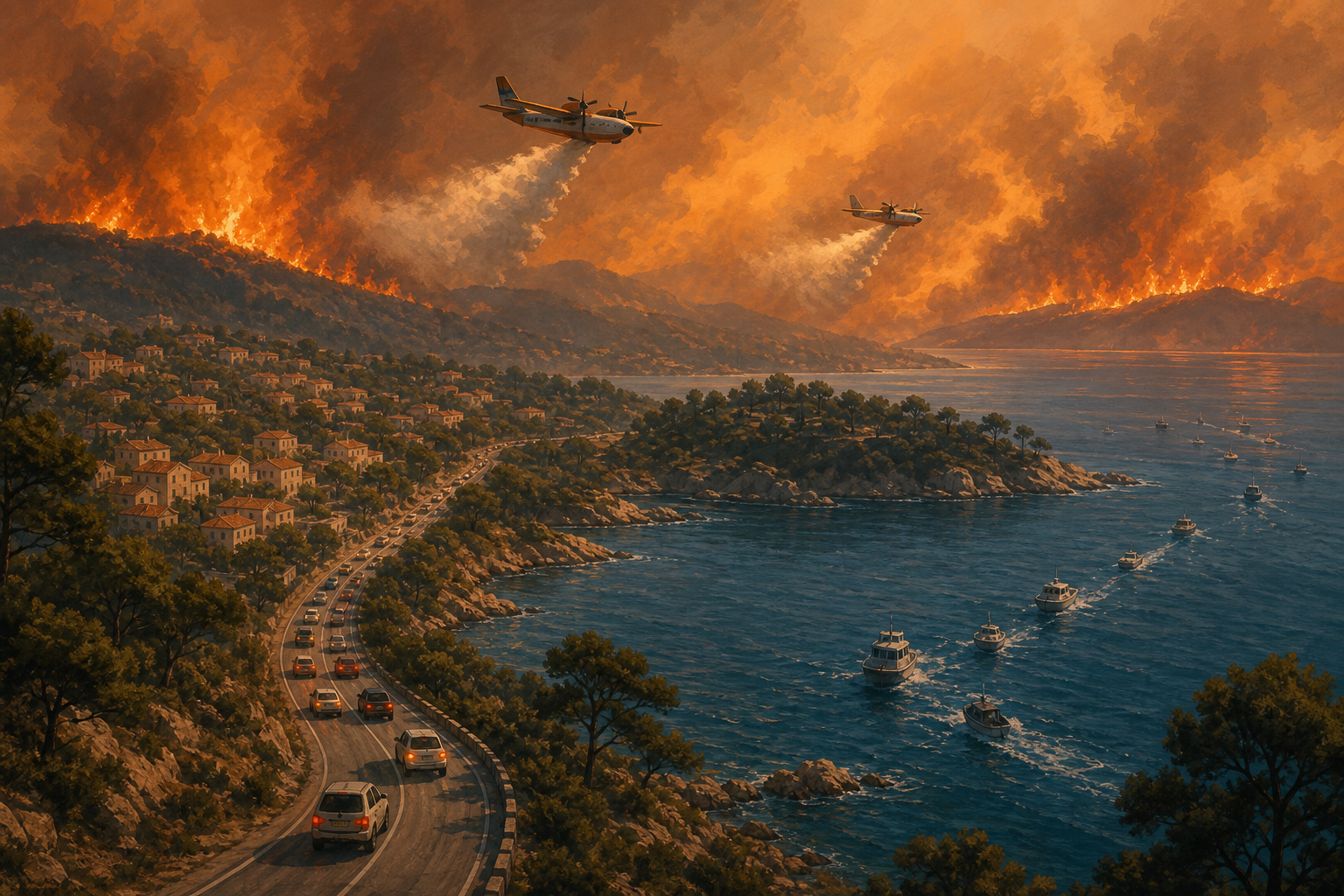
More than 200,000 people were driven from homes and holiday accommodation, or ordered to remain indoors, as fast-moving wildfires swept southwestern France and central Spain on Friday. French authorities expanded the evacuation of the Cap Ferret peninsula by land and sea as flames threatened its only road connection, while Spain placed the Madrid region and Ávila province under a national emergency declaration and centralized command of the response.
The total changed sharply as fire lines moved. The Associated Press, citing French and Spanish interior ministry figures, reported about 201,000 evacuees by late Friday: roughly 141,000 in France’s Gironde and Landes departments and about 60,000 in central Spain. The Guardian separately counted more than 200,000 people evacuated or under confinement orders, including more than 63,000 in Spain. The difference reflects rapidly expanding perimeters and whether official tallies included people told to shelter rather than leave.
On France’s Atlantic coast, authorities ordered Cap Ferret cleared village by village after describing the Gironde fire as intense and highly unpredictable. Boats carried evacuees across Arcachon Bay as officials feared flames could sever the peninsula’s single access road. About 110,000 people had left the wider Gironde area, according to late official estimates reported by AP and the Guardian, while a separate blaze near Biscarrosse forced about 31,000 more from the Landes department.
Estimates of the burned area also rose during the day. AP reported the principal Gironde blaze had consumed about 140 square kilometres, while the Guardian later put the affected forest above 19,000 hectares. Hundreds of firefighters and water-bombing aircraft were deployed, but officials said the fire remained unstable and capable of changing direction. A second coastal fire near Biscarrosse had burned more than 2,500 hectares and was generating new fire starts ahead of its main front.
In Spain, Interior Minister Fernando Grande-Marlaska declared an emergency of national interest for the Community of Madrid and Ávila province. The Interior Ministry said the decision followed the convergence of fires around Villa del Prado, San Martín de Valdeiglesias and Burgohondo, exceptionally adverse weather, preventive evacuations and a growing threat to population centres. Under Spain’s civil-protection law, the minister assumed overall direction and placed operational command with the head of the Military Emergency Unit.
Two large fires west of Madrid had merged by Friday, and officials warned that another front could join them. The declaration allowed the central government to coordinate national, regional and local resources in an emergency normally managed by Spain’s autonomous communities. Madrid’s regional authorities described the situation as beyond their normal extinguishing capacity. France and Spain both activated the European Union’s civil-protection mechanism, drawing aircraft and heavy helicopters from several partner countries, while France also mobilized military support.
The emergency is larger than a dramatic holiday-week evacuation. It is a test of whether European governments have adapted their institutions as quickly as the hazard has changed. France’s interior minister said 32 fires were burning nationally and that about 50,000 hectares had already been scorched this year, nearly four times the area recorded by the same point in 2025. Spain reported 29 major forest fires in 2026 and about 114,796 hectares burned, compared with 25,133 hectares at the same stage last year.
Climate change does not establish how any individual blaze began, and authorities must investigate each ignition separately. It does, however, load the conditions in which a spark becomes a regional disaster. Scientists have repeatedly linked a warming climate with more intense heat, drier soils and vegetation, and longer periods in which fire can spread explosively. Europe is warming at roughly twice the global average, making old assumptions about a limited Mediterranean fire season increasingly unreliable.
The harder policy question begins before the first aircraft takes off. Firefighting budgets and fleets matter, but so do managed vegetation, defensible space around settlements, building standards, emergency alerts and evacuation routes designed for peak tourist populations. Cap Ferret’s dependence on one road turned geography into an operational risk. Spain’s need to transfer authority to Madrid and both countries’ requests for EU help show that local capacity can be overwhelmed faster than administrative boundaries can adjust.
Governments also face incentives to spend visibly on suppression after flames appear while postponing less visible prevention. That balance is becoming untenable. Coastal tourism, housing, forests, insurance systems and public health all bear the cost when evacuation becomes the default safety tool for entire districts. As crews continued fighting uncontained fronts on Friday night, the immediate priority remained moving people away from danger. The lesson for the next fire is that resilience must be built before smoke is on the horizon.
Comments
Loading comments…