
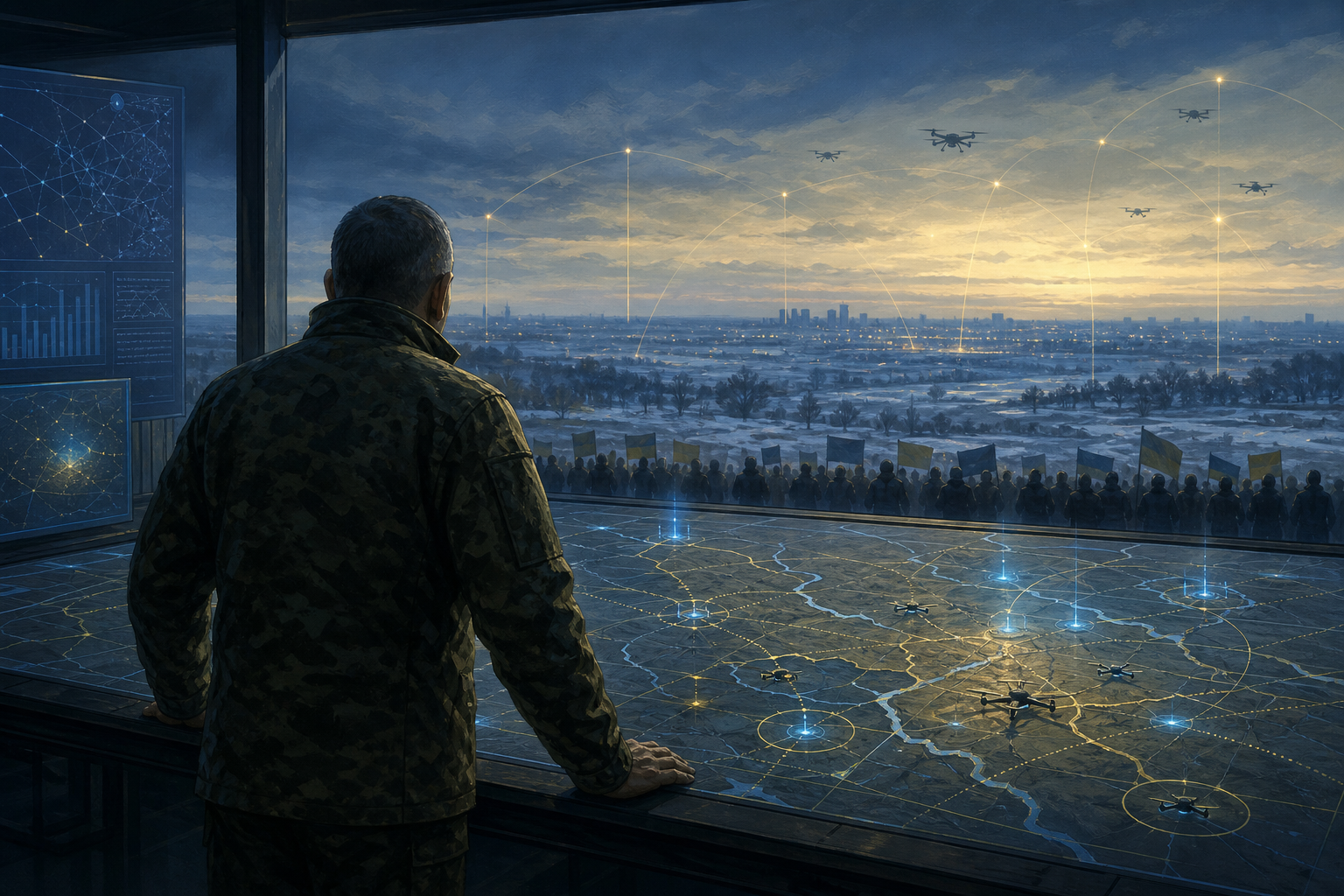
KYIV — President Volodymyr Zelenskyy announced late Tuesday, July 21, that Maj. Gen. Mykhailo Drapatyi will become commander-in-chief of Ukraine’s armed forces, replacing Gen. Oleksandr Syrskyi after days of rare wartime protests demanding changes at the top of the military.
Zelenskyy said the decision followed meetings with senior corps, marine and operational commanders and that the formal steps would be completed Wednesday. He praised Syrskyi’s record in the defence of Kyiv, the Kharkiv counteroffensive and the Kursk operation, while saying Ukraine now needed to modernise the army’s command structure.
The timing makes the change inseparable from a wider political crisis, even if the presidency did not say protesters dictated the decision. Demonstrations began after Zelenskyy removed the popular defence minister Mykhailo Fedorov last week. Protesters, veterans and serving personnel called for Fedorov’s return and Syrskyi’s dismissal, arguing that a more technology-driven military culture was being blocked by an older command system.
The backlash spread unusually far for a country under martial law. Thousands gathered in Kyiv and other cities, while an air force deputy commander resigned and warned that the shake-up could damage air defence. Organisers had threatened indefinite protests unless the leadership changed. Their mobilisation created a visible deadline for a presidency that has generally maintained broad authority through nearly five years of full-scale Russian war.
Drapatyi, a career officer who fought Russian-backed forces in Mariupol in 2014, has built a reputation as an assertive field commander. He later led formations in several of the war’s most difficult sectors and became associated with commanders seeking faster adaptation. His new position will require more than battlefield credibility: he must reform a vast institution while it remains in continuous combat.
Zelenskyy assigned immediate priorities that reveal the scale of the problem. Drapatyi is expected to prepare an updated defence strategy, continue corps reform, improve the delivery of weapons, drones and equipment, strengthen protection against Russian air attacks and present a credible approach to mobilisation. The president also said Ukraine’s long-range strike programme would continue without interruption.
Fedorov has not been restored as defence minister; that job is held by former special-operations commander Yevhenii Khmara. Zelenskyy instead offered Fedorov a senior government role intended to unify the country’s technological capabilities. The details remain unsettled, and that ambiguity will matter to demonstrators who demanded not only a new army chief but the return of the official they trusted to accelerate drones, data systems and digital reform.
A command transition during intense war is dangerous. Russia can exploit confusion, bureaucratic rivalry or even a short delay in operational decisions. Drapatyi must preserve continuity while proving that reform means better decisions at the front, not merely new names in Kyiv. Soldiers will judge the change through ammunition, air cover, rotations and whether field experience can move upward without being smothered by hierarchy.
Yet the public pressure behind this moment also exposes one of Ukraine’s strategic strengths. Citizens challenged their government while their country was fighting for survival, and the government responded without crushing the dissent. That is messy, risky and unmistakably democratic. It is also a sharp contrast with Vladimir Putin’s Russia, where military failure is filtered through an authoritarian system that punishes public accountability.
Democratic protest does not make every demand correct, and popularity is not a substitute for command competence. But institutions fighting in democracy’s name cannot ask for limitless trust while insulating themselves from scrutiny. Ukraine’s partners have invested weapons, money and political capital in a state whose legitimacy rests on being different from the power invading it.
Drapatyi therefore inherits two fronts. One is military: resisting Russian pressure, protecting the skies and making scarce manpower more effective. The other is institutional: proving that Ukrainian command can learn faster than its enemy and remain answerable to the society it defends. That is a demanding test of military skill and civic trust. If the transition succeeds, the protests will not have weakened the war effort. They will have forced it to adapt.
Comments
Loading comments…